2025 AIChE Annual Meeting
(419a) Mechanism for Nanoparticle Release from Automotive Tire Tread.
Authors
Hong-Sik Eom, University of Cincinnati
Jianqi Wang, University of Cincinnati
Kabir Rishi, NIOSH
Edward Terrill, Akron Rubber Development Laboratory
Jason Poulton, Akron Rubber Development Laboratory
Jan Ilavsky, Argonne National Laboratories
Lutz Weigert, Brookhaven National Laboratory
Benjamin Yavitt, Stony Brook University
Caroline Rosen, University of Cincinnati
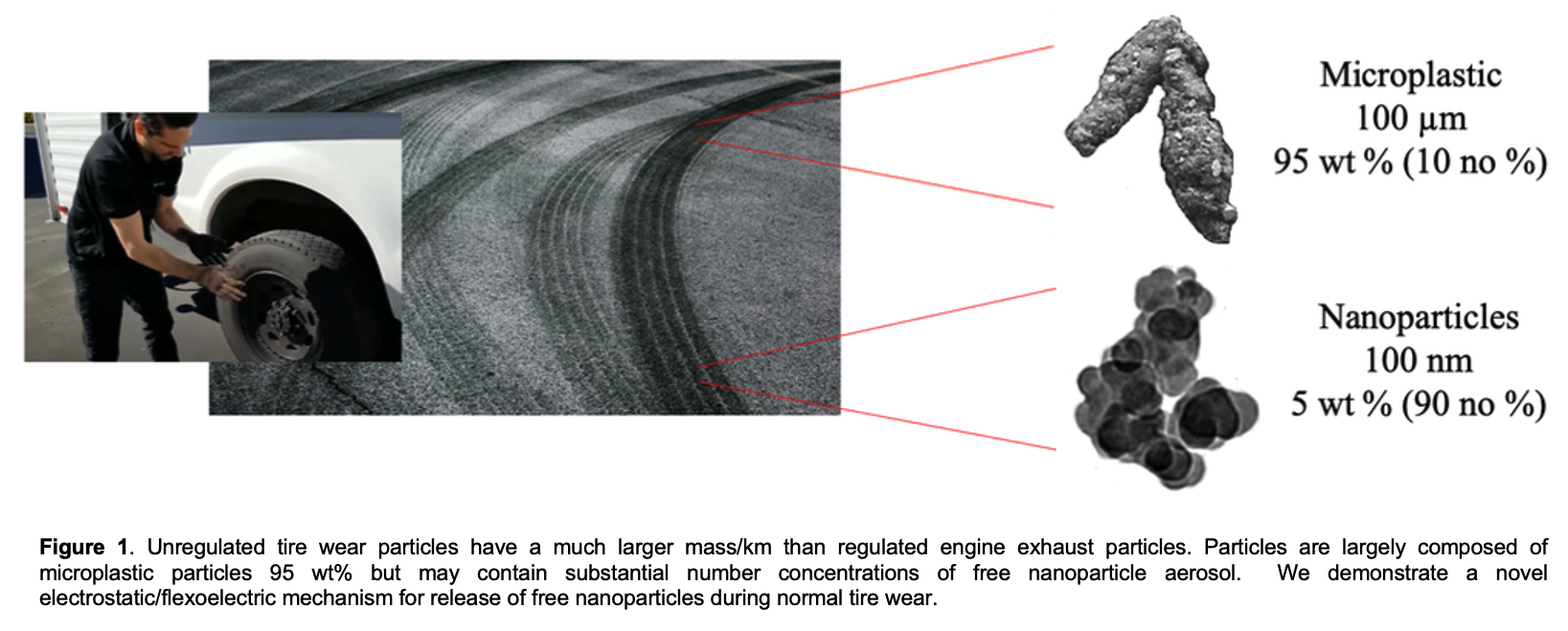
In the US, automotive tire wear generates nearly a million tons of tire wear particles (TWPs) annually, making up 40% of microplastic (MP) pollution, predominantly made of 100-micron cylindrical particles (MP-TWPs). This unregulated particulate emission from tires exceeds the regulated emission from exhaust by three orders of magnitude. With electric supplanting internal-combustion vehicles TWP emissions will increase due to higher torque and vehicle weight. Automotive tire tread is composed of 25-30% nanoparticles (NPs) of carbon black and/or silica. Our preliminary work shows for the first time that interfacial charged nanoscale tire wear particles (nano-TWPs) can be found adhering to the surface of in-use tires and can be collected from laboratory abraders as an aerosol and as electrostatic depositions. Partly based on this observation, a novel interfacial electrostatic mechanism is proposed which involves: 1) breakup of the filler network under cyclic load; 2) chemical-mechanical breakup of the elastomer network at the tread surface; 3) enhanced convective transport of the nano-aggregates under cyclic shear of the rubber; 4) newly recognized cyclic flexo-electric and more conventional tribo-electrostatic interfacial charge on the elastomer/nanoparticles which drive expulsion from the rubber matrix. We have used X-ray Photon Correlation Spectroscopy, voltage measurements under cyclic load, static X-ray scattering measurements, aerosol mobility and charge analysis, spectroscopy, dynamic mechanical testing as well as microscopy to verify a proposed mechanism that drives free nanoparticles from tire tread during tire wear. We have studied the impact of nano-filler surface treatment and various typical tread compounds to understand methods to prevent the release of nanoparticles during tread wear. The work is a collaboration between researchers at the University of Cincinnati, Akron Rubber Development Laboratory, the Health Effects Laboratory (HELD) of the National Institute of Occupational Safety and Health in Cincinnati and X-ray scientists at Argonne and Brookhaven National Laboratories.
The project is supported by NSF CBET - 2409292 Beaucage, the Centers for Disease Control, Argonne National Laboratory, and Brookhaven National Laboratory. This research used resources of the Advanced Photon Source, a U.S. Department of Energy (DOE) Office of Science user facility at Argonne National Laboratory and is based on research supported by the U.S. DOE Office of Science-Basic Energy Sciences, under Contract No. DE-AC02-06CH11357. This research used beam line 11-ID CHX of the National Synchrotron Light Source II, a U.S. Department of Energy (DOE) Office of Science User Facility operated for the DOE Office of Science by Brookhaven National Laboratory under Contract No. DE-SC0012704.