2025 AIChE Annual Meeting
(437f) Magnetic Resonance Particle Tracking Reveals Intruder Dynamics in 3D Fluidized Beds
Authors
Imaging modalities like MRI have been deployed to investigate these systems [3-5], however information thus obtained is only at the level of density and 2D or of poor temporal resolution. In this work, we introduce a novel measurement technique called Magnetic Resonance Particle Tracking (MRPT) [6]. This non-invasive method leverages nuclear magnetic resonance in a new way, allowing to study systems at the most fundamental level at very high resolution, and in 3D. MRPT can track multiple individual particles at the spatiotemporal scale of microns and milliseconds, allowing to get grain trajectories for long periods of time while preserving their identity. From this data, many important properties of fluidized particles can be obtained such as residence times, velocity maps and distributions as well as mixing efficiency of the beds.
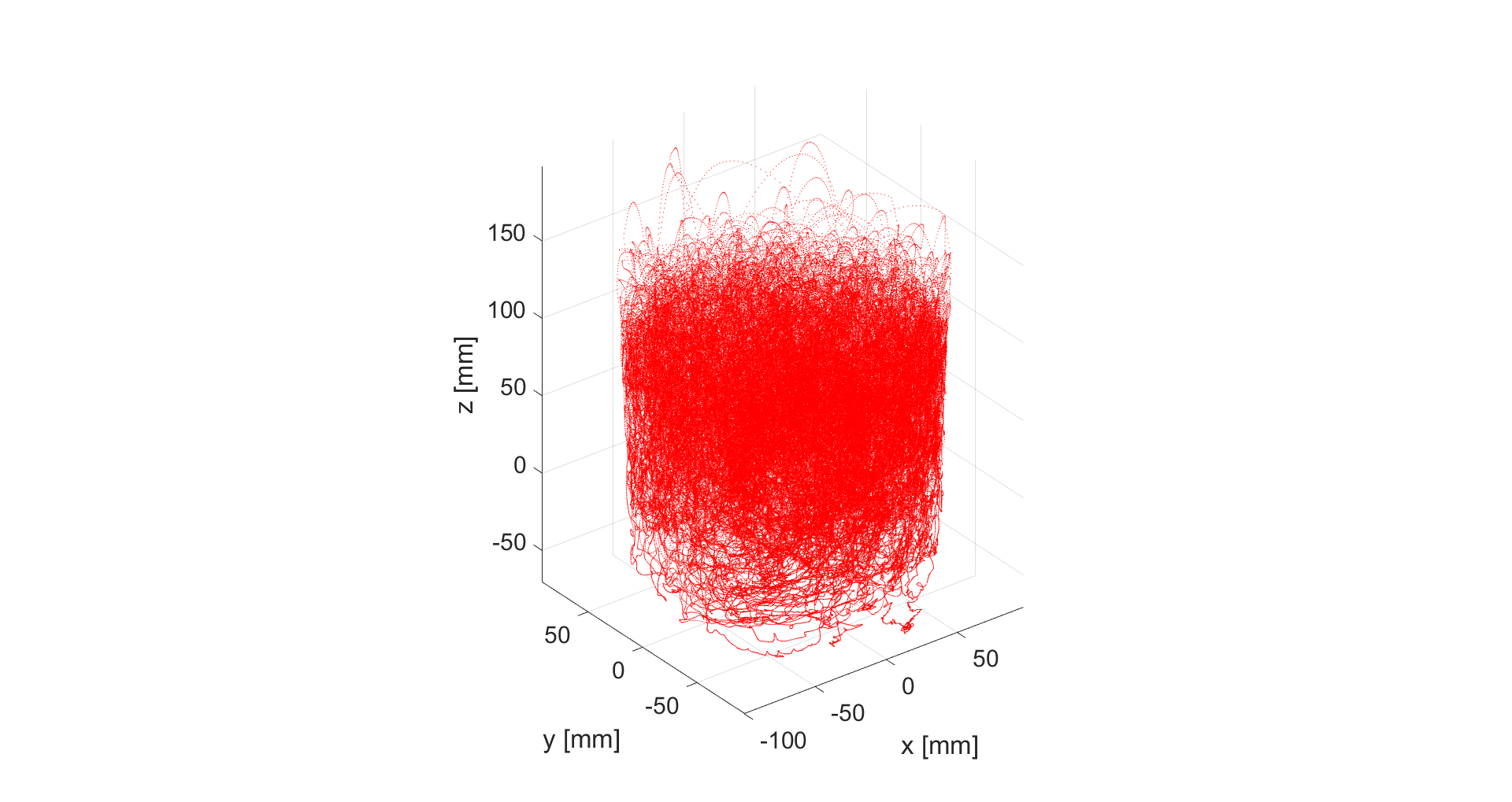
We demonstrate the capabilities of MRPT by tracking intruders of different sizes and shapes in a fluidized bed of glass particles at varied fluidization level over tens of minutes using a 16-channel detector [4]. The fast and complex behavior of intruders is resolved, revealing collisions and ejected particles in free fall (Fig. 1). Thanks to the high spatiotemporal resolution of MRPT, we can obtain detailed maps of residence times and velocity as a function of fluidization level as well as long term general statistics. For example, we observe an exponential velocity distribution of intruders, independent of tracer size or shape and air flow.
References
[1] W. Kaminsky, Fuel Communications 8, 100023 (2021).
[2] Y. Xue, S. Zhou, R. C. Brown, A. Kelkar, and X. Bai, Fuel 156, 40 (2015).
[3] C. R. Müller, J. F. Davidson, J. S. Dennis, P. S. Fennell, L. F. Gladden, A. N. Hayhurst, M. D. Mantle, A. C. Rees, and A. J. Sederman, Phys Rev Lett 96, 154504 (2006).
[4] A. Penn, T. Tsuji, D. O. Brunner, C. M. Boyce, K. P. Pruessmann, and C. R. Müller, Sci Adv 3 (2017).
[5] R. Stannarius, Rev Sci Instrum 88 (2017).
[6] M. Suter, J. P. Metzger, A. Port, C. R. Müller, and K. P. Pruessmann, 2025), p. arXiv:2503.22425.
Figure 1. Trajectories of intruders in a fluidized bed for 300 s.