2025 AIChE Annual Meeting
(148h) Machine Learning Enhanced Modeling of Chemically Recyclable Polymeric Materials for Sustainability
Authors
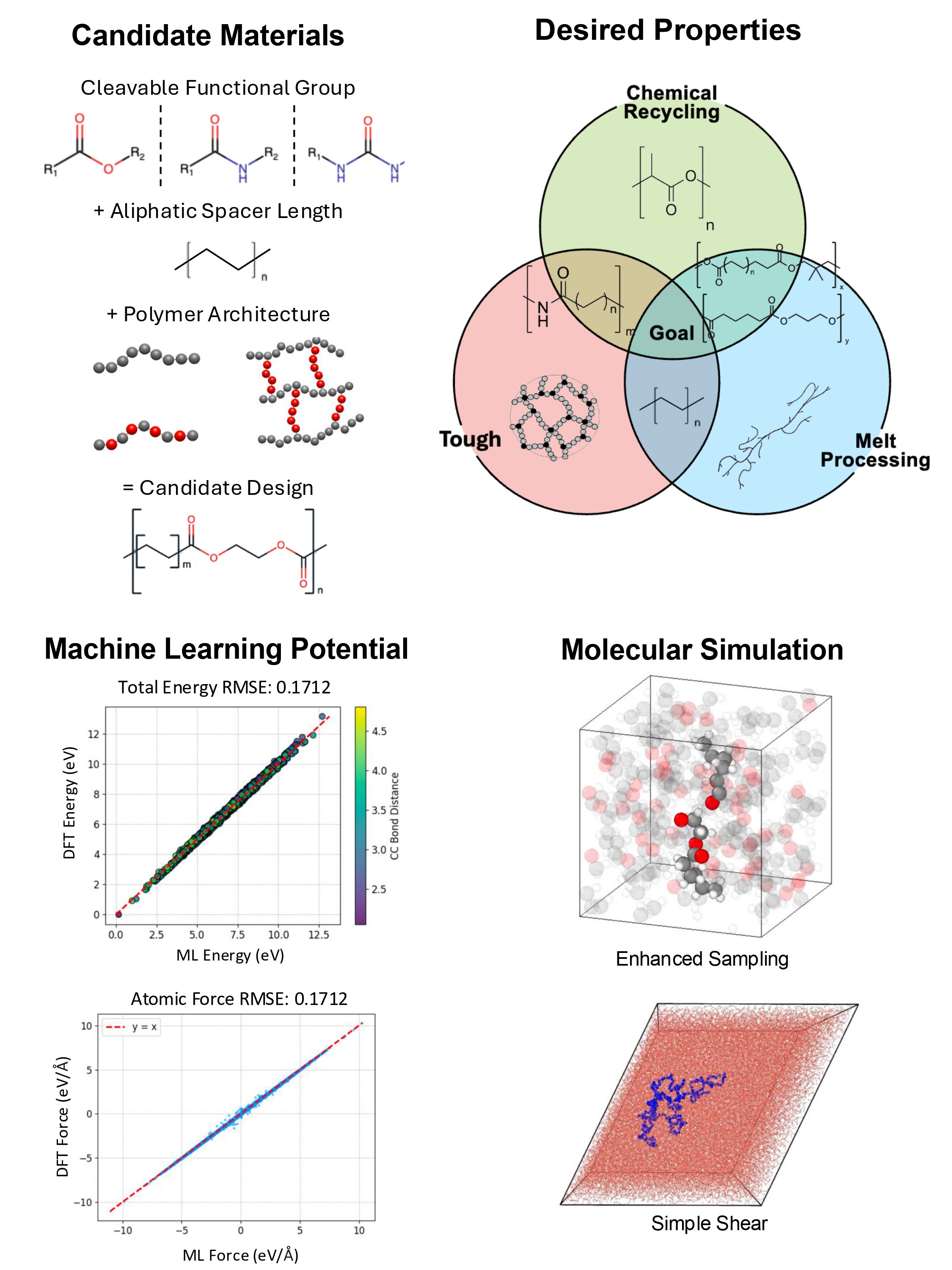
This work leverages polymer simulations to complement experimental efforts and accelerate the discovery of PE-like materials. Properly modeling recycling and degradation processes are essential for assessing the performance of PE-like materials. These processes require capturing adaptable bond topologies, which are unaccounted for in most existing molecular dynamics force fields. To overcome this, highly accurate machine learning force fields (MLFFs) are trained on single-point DFT calculations of PE-like materials. The DFT input configurations were obtained from biased molecular dynamics trajectories involving changing bond topologies. MLFF molecular dynamics simulations are then used to study how certain design choices including functional group selection and chemical environment affect mechanical properties and recyclability.