2025 AIChE Annual Meeting
(172b) Machine-Learning Assisted Development of PFAS and PFAS-Free Omniphobic Coatings
Authors
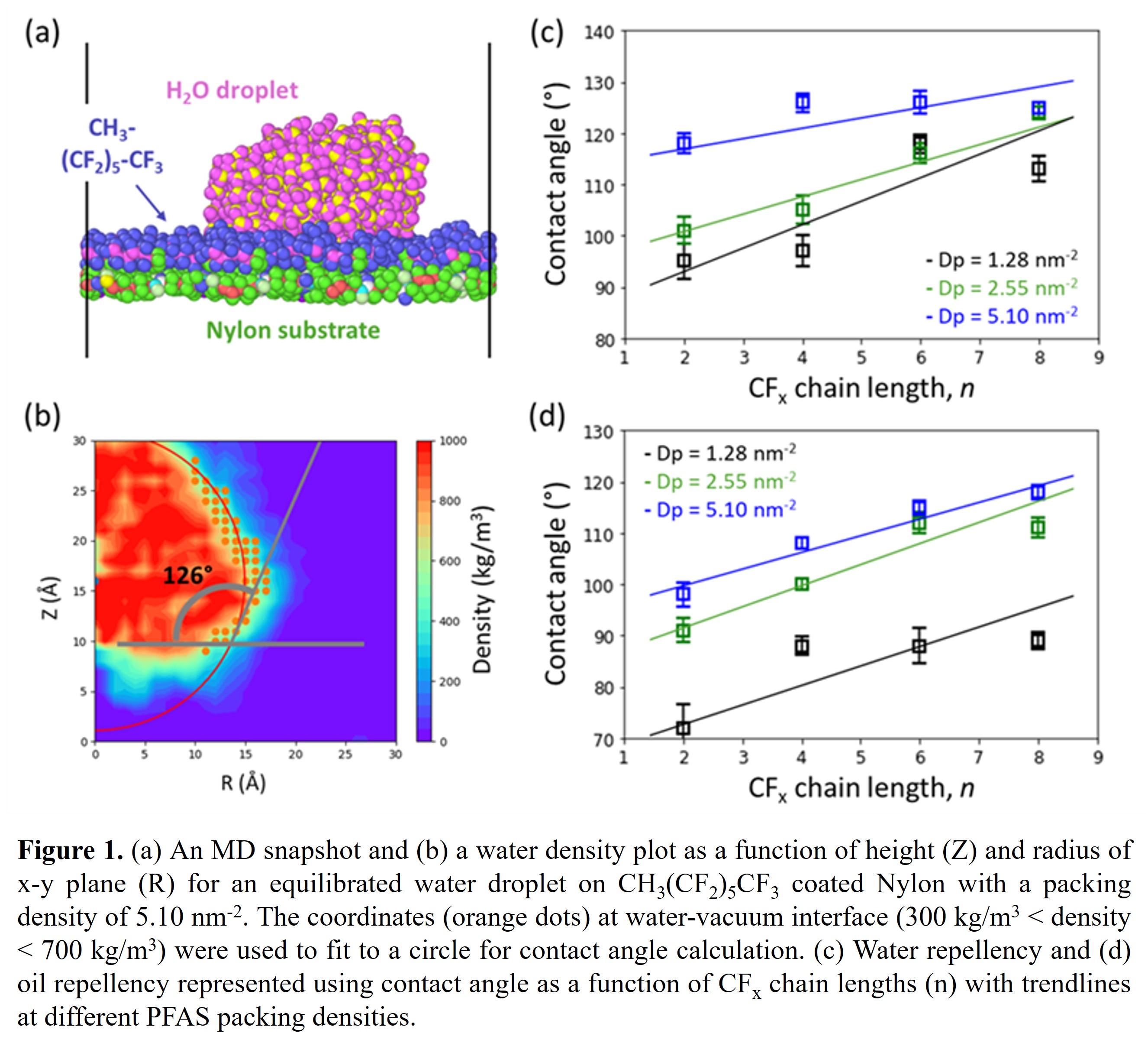
Our MD simulation models a system consisting of a water or oil droplet, a CH3-(CF2)n-1-CF3 coating on a Nylon 6,6 (110) slab substrate. Various CFx chain lengths (n = 2, 4, 6, 8) and a broad range of packing densities (Dp = 1.28, 2.55, 5.10 nm⁻²) are considered (Figure 1). The lowest contact angle for water droplet (~95°) is observed for the shortest PFAS and lowest Dp, indicating the least hydrophobicity. A similarly low repellency is observed for oil droplet at the same PFAS chain length and Dp. At this Dp, the contact angle for oil droplets increased by ~20° as the chain length increases from 2 to 8, and the contact angle for water droplet also increases by ~20° over the same chain length range. As DP increases, the effect of chain length on repellency becomes less prominent for both oil and water. The best repellency is observed for the highest considered Dp (5.10 nm⁻²) and chain lengths of 6 and 8. The omniphobicity of PFAS alternatives including biobased materials will also be simulated. Finally, new PFAS alternatives along with chain length and optimal packing density will be predicted using machine learning.