2025 AIChE Annual Meeting
(639h) Leveraging Pretrained Machine Learning Models for Surface Energy Prediction and Intermetallic Catalyst Discovery
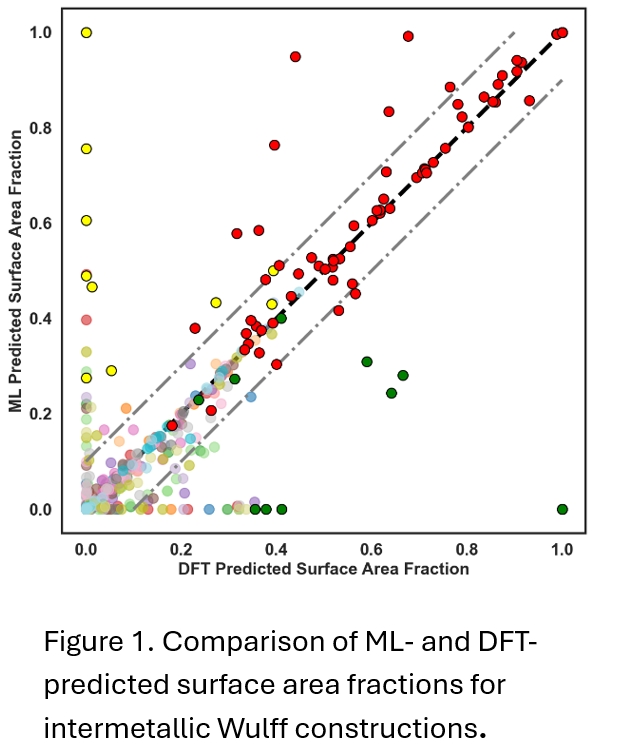
In this work, we present an integrated computational workflow centered on machine learning-based surface energy prediction to accelerate the discovery of intermetallic catalysts for selective hydrogenation reactions. Using pretrained models from the Open Catalyst Project, we predict surface energies for over 100 bimetallic intermetallic compounds—including both low-index and high-index facets—with accuracy comparable to DFT and at significantly reduced computational cost. We evaluate different surface energy referencing schemes, revealing their influence on facet ranking and Wulff morphology construction, particularly for non-stoichiometric terminations.
Rapid ML-based surface energy evaluation is one step within an overall workflow to computationally discover potential intermetallic catalysts. Cryst-ALL rapidly identifies stable intermetallic bulk structures composed of inert metals (Zn, Cd, In, Ga, Al) and active late transition metals (Pd, Pt, Ru, Rh, Ag, Ir). Stable facets are determined, and key hydrogenation intermediates are automatically placed on these surfaces to generate a high-quality DFT adsorption energy dataset, which is then used to train machine learning models for large-scale adsorption energy prediction. In parallel, automated transition state search is employed to identify reaction pathways and activation barriers, enabling a full thermodynamic and kinetic screening of intermetallic surfaces for efficient and selective hydrogenation catalysis.
Our study demonstrates the power of machine learning in accelerating surface energy evaluation and morphology prediction, while also enabling efficient screening of intermetallic catalysts for selective hydrogenation reactions. The approach offers a generalizable strategy for the rapid discovery and rational design of complex heterogeneous catalytic systems.