2025 AIChE Annual Meeting
(642f) Learning Phase Behavior and Solubility in Polymer–Solvent Systems with Hybrid Symbolic–Continuous Models
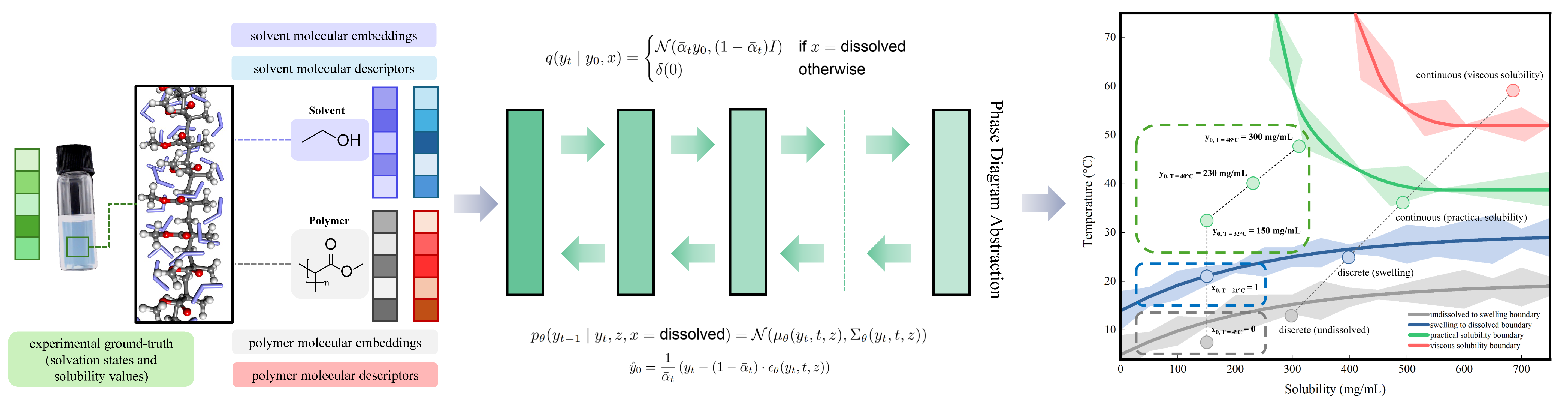
Understanding polymer–solvent compatibility is essential for advancing applications in formulation, separation, and recycling. However, traditional modeling approaches often treat solubility as either a symbolic phase classification (e.g., dissolved, gelled, swollen) or a continuous value (e.g., mg/mL solubility), neglecting the nuanced interplay between both. In this work, we present a data-driven framework that jointly models polymer solvation behavior using hybrid symbolic–continuous learning. Our approach integrates a large experimental dataset encompassing both solvation state labels and measured solubility values across varied temperatures and concentrations. To enrich feature representation, we incorporate molecular descriptors derived from quantum chemical calculations, molecular dynamics simulations, and COSMO-based solvation models, alongside learned molecular embeddings. We introduce a diffusion-based learning architecture designed to preserve semantic coherence between symbolic states and continuous properties across the solubility phase space. This enables the generation of consistent, interpretable polymer solubility phase diagrams that capture both state transitions and thermodynamic limits. Our results demonstrate the potential of this hybrid modeling approach to accelerate predictive understanding and screening of polymer–solvent systems. More broadly, this work highlights the value of aligning discrete and continuous representations in data-driven materials design.