2025 AIChE Annual Meeting
(474e) Learning to Choose: Categorical Bayesian Optimisation Framework for Motion-Aware Shapes
Bayesian Optimisation (BO) is increasingly used in computational fluid dynamics (CFD)-driven design under uncertainty [5]. However, when applied to high-dimensional shape optimisation, it faces serious limitations. In such settings, the curse of dimensionality renders exploration inefficient, as the volume of the search space grows exponentially and data becomes sparse. Standard Gaussian Process (GP) kernels struggle to capture the relevance of features across all dimensions, leading to poor generalisation. Moreover, the computational cost of GP inference, which scales as O(n3) with the number of observations n, quickly becomes a bottleneck in iterative design settings. Kernel hyperparameter tuning becomes unreliable, prone to overfitting or underfitting, and covariance matrices often become ill-conditioned. These issues make BO fragile and inefficient for shape optimisation tasks involving high-dimensional geometry parameterisations.
Our categorical Batch Bayesian optimisation (CBBO) framework explicitly addresses these limitations by decomposing the design space across shape-generation methods and modelling each with a dedicated surrogate, enabling scalable, motion-aware shape design. Categorical Bayesian Optimisation has been previously applied in materials discovery and machine learning, where categorical inputs correspond to molecule types or model classes. For instance, the Gryffin algorithm [6] optimises over categorical chemical building blocks guided by domain descriptors. In machine learning, CBO supports model selection and hyperparameter tuning [7]. Hybrid strategies such as CoCaBO (Continuous and Categorical Bayesian Optimisation) [8] and Categorical and Smooth Optimization for High-Dimensional Mixed Search Spaces (CASMOPOLITAN) [9] improve scalability in mixed-variable settings. However, these techniques remain underexplored in engineering domains involving geometry–physics coupling. To the best of our knowledge, this work is the first to apply categorical BO to shape optimisation with computational fluid dynamics (CFD), where categories represent fundamentally different shape parameterisations with distinct expressivity.
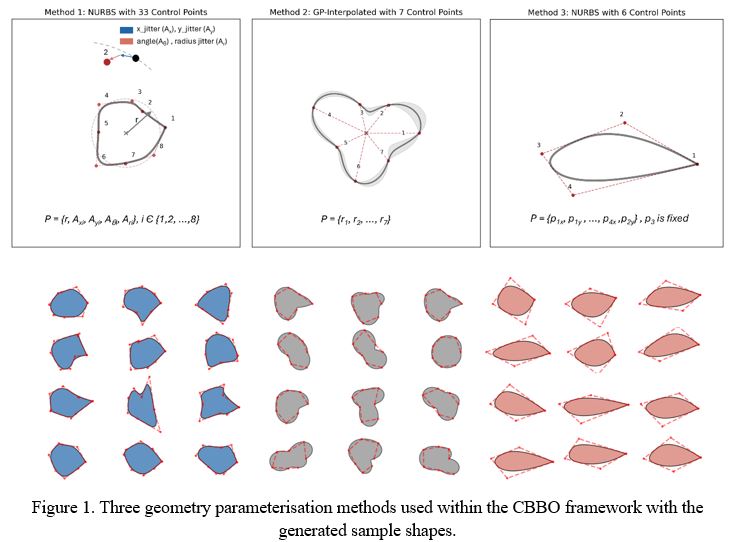
We present a CBBO framework that performs simultaneous selection of geometry generation methods Mk ∈ {Method 1,Method 2, Method 3} and continuous optimisation within their respective parameter spaces Θk. Rather than treating the entire shape design space as a single high-dimensional domain, we model each shape generation method: 1) NURBS with polar and Cartesian jitter, where each of the 8 control points is defined by Cartesian jitter (Axi,Ayi) and polar jitter (Aθi,Ari) around a shared base radius r, resulting in a 33-dimensional parameter space, 2) GP-interpolated radial profiles, where 7 radii {r1,...,r7} define the shape via a smooth radial interpolation around a central point, yielding a 7-dimensional parameter space, and 3) Non-uniform rational basis spline (NURBS) with 6 control points for symmetric profiles, as a separate “arm” in a multi-armed bandit structure. These methods span distinct subspaces of geometric complexity and curvature (Figure 1). Each arm is associated with a dedicated GP surrogate (via GPJax), trained independently on its own dataset Dk. Thompson sampling is used at each iteration to sample surrogate functions and identify the best-performing method–parameter combination. The optimisation proceeds in batches of 4, enabling parallel simulation of candidate geometries. After each batch, the framework updates the individual method surrogates and selects the next batch by combining information from across all methods.
Each candidate geometry is evaluated using a high-fidelity CFD pipeline that couples two-dimensional finite volume fluid flow with rigid-body motion, Eulerian particle transport [10], and level-set methods for tracking deposit evolution. Solution of the governing equations is made using a finite volume method (FVM) [10] on a fixed staggered mesh[11]. Shapes are normalised, checked for validity, and exported in a discretised format compatible with a Fortran-based solver. Simulations are run over long timescales (typically 100 s), and performance is quantified by the average deposition rate between 80–100s. This physics-based evaluation loop is tightly integrated with CBBO, ensuring meaningful feedback between geometry, motion, and deposition.
Results show that CBBO significantly outperforms traditional BO applied within any single method. For translational motion, low-dimensional NURBS shapes converge to airfoil-like profiles. For rotational motion, symmetric geometries from high-resolution NURBS dominate. Under compound motion, complex designs are seen to be optimal. Across all cases, CBBO reduces deposition with far fewer simulations, avoiding wasted evaluations on poorly matched geometry-motion pairs.
This work opens a new direction for design optimisation in chemical engineering systems by introducing method-aware co-design that simultaneously selects optimal geometry generation approaches and their parameters, eliminating the need for human expertise in pre-selecting appropriate parameterisations for different motion regimes while efficiently navigating high-dimensional design spaces.
References
[1] Y. Zhang, E. H. Xing, W. Han, P. F. Yang, S. Zhang, S. Liu, D. X. Cao, Mingfeng Li, Petrochemical Industry for the Future, Engineering 43 (2024) 99-114.
[2] D. Rokade, P. Patil, S. Nandimath, H. Pol, A rheology and processing study on controlling material and process defects in polymer melt extrusion film casting using polymer blends. Journal of Plastic Film & Sheeting. 39 (2023) 211-240.
[3] L. H. Wang, H. Wang, T. J. Wei, W. Dai, H. Y. Wang, An online intelligent detection method for slurry density in concept drift data streams based on collaborative computing, PeerJ Computer Science, 11 (2005) e2683.
[4] F. Kapteijn, J. A. Moulijn, Structured catalysts and reactors-Perspectives for demanding applications, Catalysis Today, 383 (2022) 5-14.
[5] Savage, T., Basha, N., McDonough, J., Krassowski, J., Matar, O., & Antonio, E. (2024). Machine learning-assisted discovery of flow reactor designs. Nature Chemical Engineering, 1(8), 522-531.
[6] F. Häse, M. Aldeghi, R. J. Hickman, L. M. Roch, and A. Aspuru-Guzik, "Gryffin: An algorithm for Bayesian optimization of categorical variables informed by expert knowledge," Applied Physics Reviews, vol. 8, no. 3, p. 031406, Sep. 2021.
[7] J. Snoek, H. Larochelle, and R. P. Adams, "Practical Bayesian optimization of machine learning algorithms," in Advances in Neural Information Processing Systems 25 (NIPS 2012), 2012, pp. 2951–2959.
[8] B. Ru, A. S. Alvi, V. Nguyen, M. A. Osborne, and S. J. Roberts, "Bayesian optimisation over multiple continuous and categorical inputs," in Proceedings of the 37th International Conference on Machine Learning (ICML 2020), 2020.
[9] X. Wan, R. Astudillo, M. A. Osborne, and P. Hennig, "Think global and act local: Bayesian optimisation over high-dimensional categorical and mixed search spaces," in Proceedings of the 38th International Conference on Machine Learning (ICML 2021), 2021.
[10] Y.F. Yap, F.M. Vargas and J.C. Chai, A level-set method for convective-diffusive particle deposition, Applied Mathematical Modelling 37 (2013) 5245-5259.
[11] S. V. Patankar, Numerical Heat Transfer and Fluid Flow, Hemisphere, New York, 1980.