2025 AIChE Annual Meeting
(382u) Ketonization of Mixed Carboxylic Acid-Rich Feedstock from Kraft Black Liquor-Derived Hydroxy Acids
Authors
Catalysis and reaction engineering | Biomass conversion and valorization | Process development and scale-up | Continuous-flow high-pressure reactor platforms for kinetic and mechanistic studies
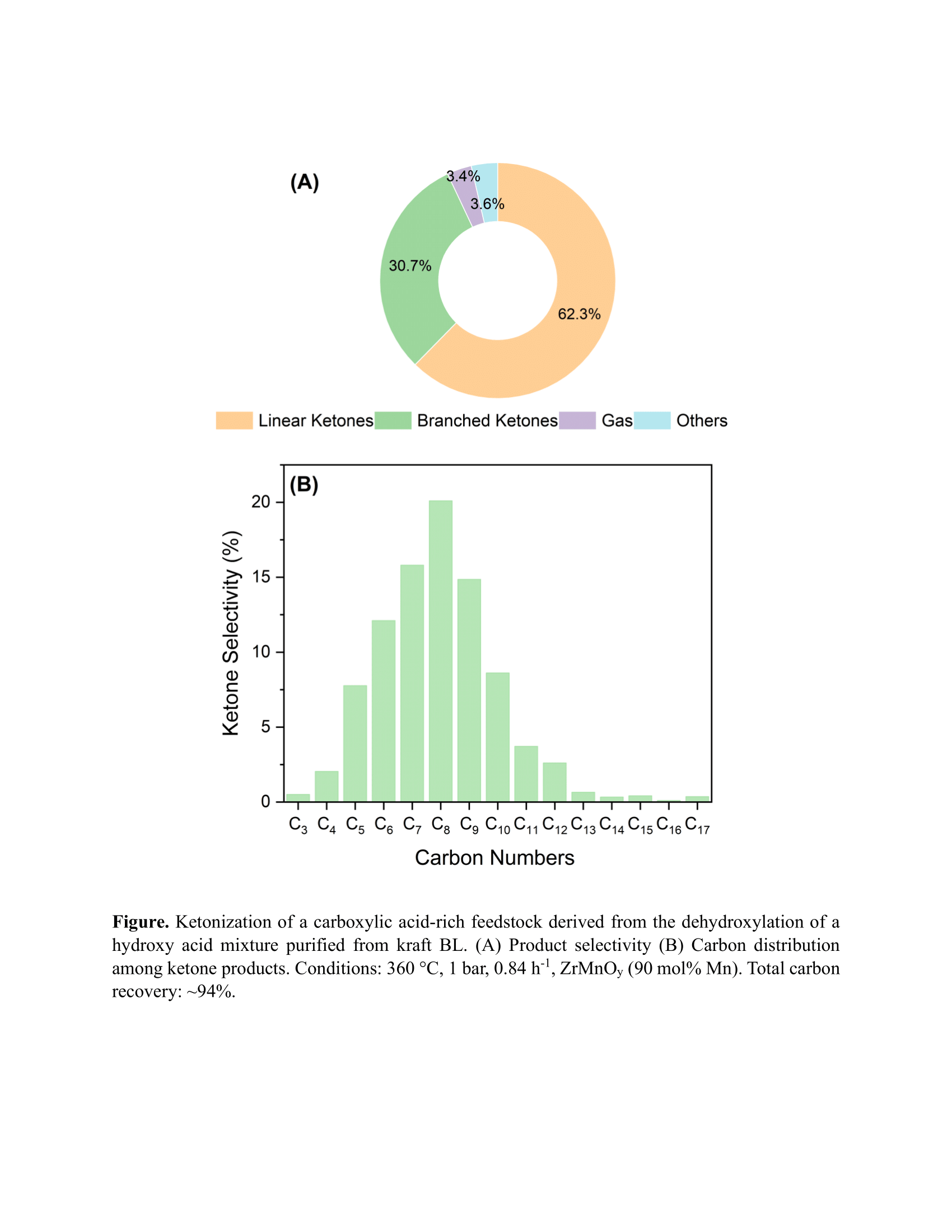
Ketonic decarboxylation of carboxylic acids offers a promising pathway to sustainably produce valuable intermediate platform chemicals. Building on previous work involving the catalytic conversion of black liquor (BL)-derived hydroxy acids to carboxylic acid-rich streams, this study investigates the ketonization of (1) a model mixture of linear C₂–C₉ and branched C₄–C₆ acids and (2) a complex acid-rich mixture derived directly from Kraft BL, using metal oxide catalysts. Initial screening of equimolar mixed-metal oxides ZrMOy (M = Mg, Nb, Ce, Mn) identifies ZrMnOy as the most active catalyst across varied reaction conditions. Further optimization reveals that Mn-rich ZrMnxOy (Mn = 90 mol%) catalyst exhibits the highest ketonization activity, delivering up to a 10-fold increase compared to t-ZrO₂. This catalyst further maintains high activity and structural stability over 55 h with minimal leaching. Mechanistic studies using C₂–C₉ carboxylic acids show that intrinsic ketonization rates decreased from C₂ to C₆, followed by a non-monotonic trend for C₇–C₉, due to steric hindrance and adsorption effects. Catalyst characterization shows that increasing Mn content in ZrMnOy enhances medium-strength acid-base active site pairs, enhancing ketonization activity. Additionally, the Mn-rich catalysts exhibit optimal Mn/Zr surface ratios, increased lattice oxygen, and mixed Mn oxidation states. Using the optimized ZrMnOy (90 mol% Mn), ketonization of a real kraft BL-derived feedstock achieves > 93% selectivity to C₃–C₁₇ ketones at full acid conversion. These products meet criteria for downstream upgrading to bio-lubricants, demonstrating the viability of kraft BL-derived hydroxy acids as renewable feedstocks.