2025 AIChE Annual Meeting
(706e) Joules to Moles: Deciphering the Energy Dissipation of Programmable Electrocatalysts across the Time Scales
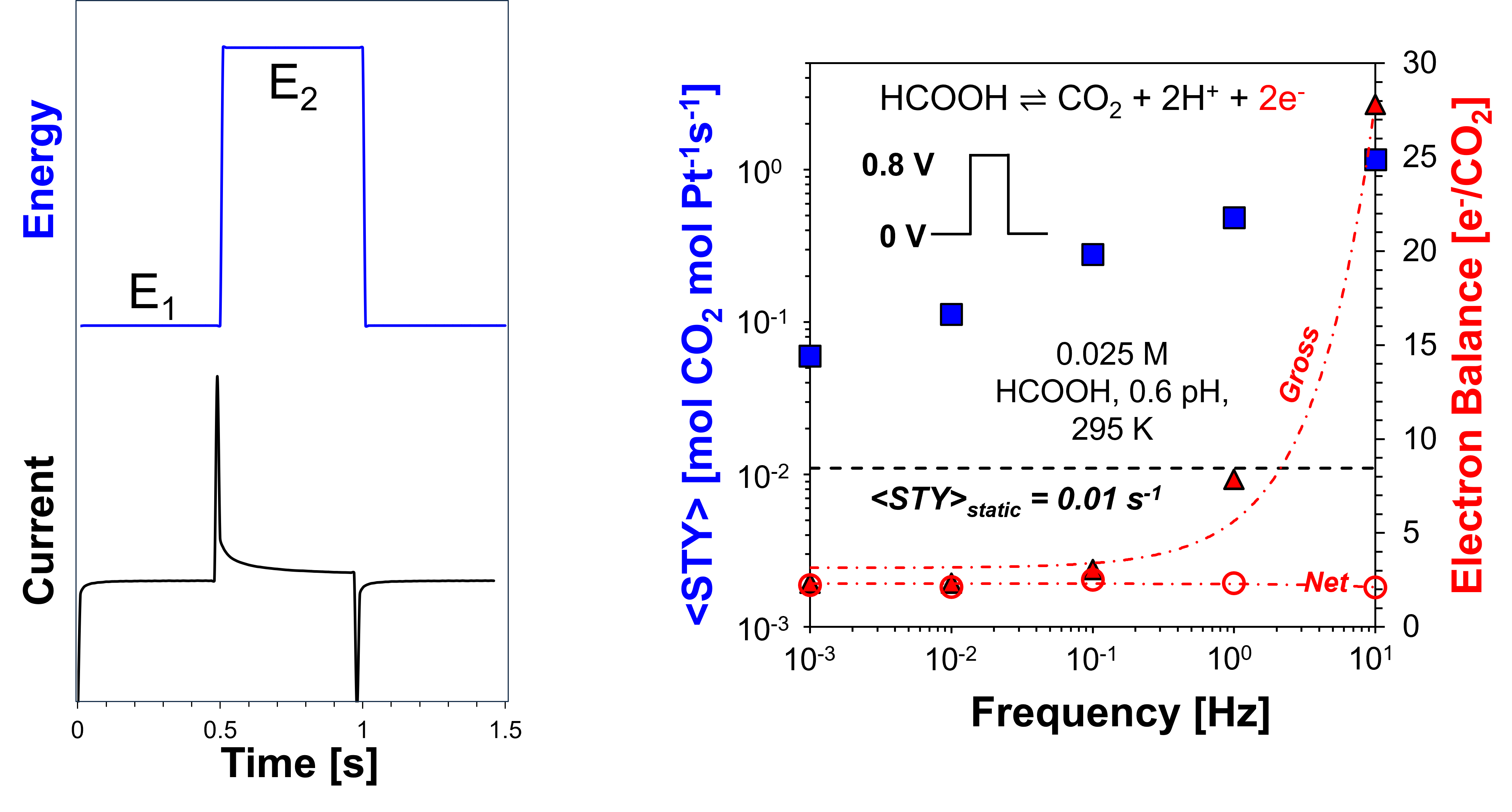
The delivery of programmable energetic waveforms to catalytic surfaces provides a tunable approach for selectively accelerating the rate of catalytic turnover, by synchronizing the energetic state of a catalyst surface in time with the energetic needs of individual elementary steps in a catalytic cycle. However, the ultimate fate of programmable energetic stimuli delivered to a catalytic surface, and the conditions under which energy is effectively harnessed versus inefficiently dissipated, remain unknown. To design programmable catalysts that selectively accelerate catalytic chemistry through energetically efficient routes, there is a need to understand the mechanism and relevant time scale through which oscillatory energetic waveforms delivered to a catalytic surface are dissipated. Using transient potential decay techniques and theoretical derivations of net versus gross electron balances, the energetic efficiency of electrochemical oscillation was quantitatively characterized across a range of time scales. While the net faradaic efficiency of potentiodynamic formic acid oxidation over Pt was found to be insensitive to oscillation frequency, duty cycle, and amplitude, we advocate that a gross efficiency must be considered in the context of electrochemical oscillation. While a faradaic efficiency (net) compares the molar rate of change of a chemical species to the net rate of electron transfer in a single direction (anodic or cathodic), a gross efficiency considers the rate of electron transfer in any direction (anodic and cathodic). The gross efficiency of potentiodynamic formic acid oxidation was found to rapidly deviate from ideality beyond a singular critical frequency (fcritical), which was quantitatively dictated by the rate at which an electrochemical perturbed surface restores itself to an equilibrated state (krelax). The distinction between net and gross efficiencies for faradaic electron transfer, and the ability to quantitatively predict the timescale at which energetic inefficiencies become significant, provides a framework through which to design both kinetically and energetically efficient programmable catalysts.