2025 AIChE Annual Meeting
(387ac) Integrating Machine Learning and CFD for Intelligent Reactor and Device Design
Author
My research centres on developing a new computational paradigm that combines machine learning (ML) with computational fluid dynamics (CFD) to enable automated, high-performance design of chemical engineering systems. This is motivated by the rise of additive manufacturing, which unlocks access to complex geometries, but also expands the design space far beyond what traditional tools can efficiently explore.
By integrating surrogate models, data-driven models, optimisation strategies and physics-based simulations, I seek to dramatically reduce development time and cost, while uncovering non-intuitable, high-performing designs. I aim to transform how we approach problems where fluid behaviour is tightly coupled to shape, from flow reactors to spray devices. Techniques include: Bayesian optimisation (exploration-dominated, multi-fidelity and categorical) and Graph-Neural Nets with shape encodings.
- Flow reactor optimisation
Exploration-driven Bayesian Optimisation: Plug flow behaviour is critical in many processes such as pharmaceutical manufacturing, biofuels, and fine chemicals as it enhances product yield and control. A promising platform is the oscillatory coiled flow reactor, which can achieve plug flow characteristics even at low net flow rates. I used Bayesian optimisation to explore the operating space-oscillation amplitude, frequency, and net flow rate, treating CFD as a black-box model [1]. By mapping performance onto key dimensionless groups (Strouhal, Reynolds, and Dean numbers), I identified the oscillatory conditions that yielding near-ideal plug flow with minimal axial dispersion. This approach uncovered design conditions without the need for high-throughput experimentation.
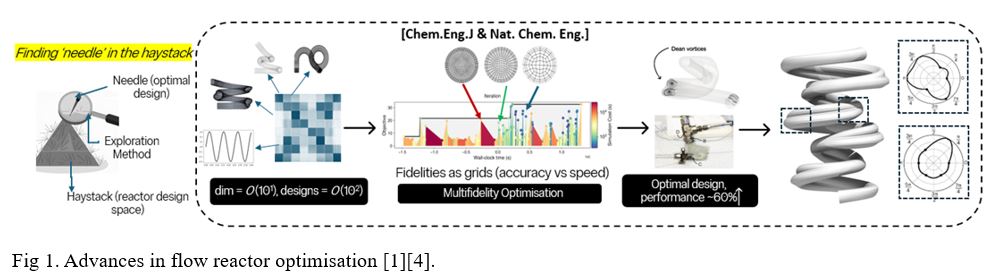
Shape Optimisation via Multi-Fidelity Bayesian Optimisation: To go beyond operating conditions, I extended my framework to the optimisation of reactor geometries themselves- a high-dimensional, computationally expensive task (Figure 1) [2] [3]. Here, a multi-fidelity Bayesian optimisation strategy where simulations at lower mesh resolutions guide exploration, while selected high-resolution runs validate promising designs. This approach led to the discovery of static geometries that achieved plug flow at low Reynolds numbers, without requiring oscillatory forcing, and resulted in ~60% improvement in plug flow performance in experiments compared to conventional designs [4]. The framework generalises to other CFD applications requiring mesh refinement, including atomisation in spray systems, where droplet breakup must be resolved through adaptive mesh refinement.
Method-Aware Geometry Design via Categorical Bayesian Optimisation: Finally, I addressed a more fundamental challenge: what if we don’t know the best way to parameterise shape? In applications such as particle-laden flows over moving objects, geometry interacts with motion to control deposition and erosion. Different motion regimes (e.g., translation, rotation, compound motion) favour different shape families. I developed a Categorical Batch Bayesian Optimisation (CBBO) framework that simultaneously selects both the shape generation method (e.g., NURBS, GP-interpolated profiles, symmetric basis sets) and its parameters. Each method is modelled with its own surrogate and optimised in parallel using Thompson sampling. Evaluated with a coupled CFD–particle transport solver, the framework identified optimal geometry–motion combinations while avoiding wasted simulations on poorly matched parameterisations, marking a new direction for automated, method-aware design when the best parameterisation is not known a priori.
- Geometry-Conditioned Graph Neural Networks
While Bayesian optimisation enables data-efficient discovery of high-performing designs, it still relies on computationally expensive and repeat simulations. To accelerate prediction and enable real-time design feedback, I develop geometry-conditioned surrogate models based on Graph Neural Networks (GNNs).
The performance of many chemical engineering systems, such as reactors, spray dryers, and drug delivery device, depends on geometric design, which directly affects fluid flow and performance. Among these, spray nozzles are critical in applications from agricultural spraying to pharmaceutical atomisation, including mRNA vaccine delivery. Nozzle geometry determines droplet characteristics and spray patterns, affecting field coverage and drift in agriculture, and ensuring repeatable, precise droplet formation for targeted delivery in pharmaceuticals.
In my nozzle atomisation case study, I use the Basilisk CFD solver to simulate two-phase jet breakup in 2D axisymmetric geometries defined by Non-Uniform Rational B-Splines (NURBS). The solver employs adaptive octree meshes to resolve fine interfacial dynamics. Each simulation is converted into a graph with up to ~12,000 nodes, where nodes represent mesh cells and edges encode local spatial connectivity. I then apply MeshGraphNets (MGNs) to learn time-evolving flow fields on these graphs. However, standard MGNs can be insensitive to subtle geometric variations, especially when wall deformations do not significantly shift node coordinates, limiting the model’s ability to generalise across nozzle designs.
To address this, I developed a geometry-aware conditioning strategy that enhances GNN expressivity through Bipartite message passing connecting nozzle wall nodes and selected fluid domain nodes and latent shape embedding [5]. With these enhancements, the GNN surrogate accurately predicts both velocity and volume fraction fields, achieving low mean squared error relative to ground-truth Basilisk simulations, while offering a 100× speedup in runtime. This enables not only rapid exploration of design spaces but also the potential for real-time control, uncertainty quantification, and data-driven optimisation across nozzle geometries.
Track Record and Recognition:
This work has been recognised through 8+ high-impact awards and 10+ invited talks. I was awarded the Sir William Wakeham Award for outstanding postdoctoral research at Imperial College London. My research on ML–CFD integration for reactor design, published in Nature Chemical Engineering, has attracted over 19K+ readers and was featured in a News & Views article. I have delivered invited lectures at the University of Cambridge, the Alan Turing Institute, and presented to record-high audiences at major international conferences such as the International Conference on Multiphase Flow (2023) and the American Physical Society (2024), where I was featured as one of 20 invited speakers in the Machine Learning in Fluid Dynamics session. I have contributed to over £25 million in EPSRC-funded research and secured an £80K+ UKRI Impact Acceleration Award.
My broader vision is a digital-first approach to chemical engineering, where scientists can prototype and evaluate designs virtually before experimental validation. Applications include optimising and discovering flow-field geometries in redox flow batteries for improved charge distribution and efficiency, predicting flow–crystallisation interactions to enable the scale-up of personalised medicines, or enabling climate-resilient agriculture through the design of optimised spray systems.