2025 AIChE Annual Meeting
(127g) Integrating Health Disparities into a First-Year Design Course to Promote Engineering Identity and Belonging
Retention of students in engineering, particularly those from historically marginalized backgrounds, is closely linked to their sense of belonging, confidence in their technical skills, and self-identification as engineers. Studies have shown that when students can connect STEM content to communal goals such as improving health equity, their motivation, engagement, and persistence in STEM fields increase. Thus, by introducing health disparities as a central theme in a first-year design course, we aim to help students build engineering identity and confidence while showing how engineering can positively impact their communities.
To explore this approach, we developed and delivered a section of ENGR 102 titled “Engineering Solutions for Health Disparities.” Through teamwork and creative problem-solving activities related to how engineers from all disciplines can create solutions to health disparities, the course was designed to build students self-confidence in technical skills and build a sense of community. To evaluate these goals, students completed anonymous surveys at the beginning and end of the 10-week course, assessing confidence in technical skills, sense of belonging, and identity as engineers. Ultimately, our findings contribute to ongoing efforts in engineering education to build a diverse and socially conscious community of future engineers.
Materials and Methods: Students enrolled in a first-year ENGR 102 section titled Engineering Solutions for Health Disparities were surveyed during weeks 1 and 10 of the 10-week quarter. Surveys assessed students' sense of belonging, confidence in technical skills, and identification as engineers using a Likert scale (1–5). Data were collected over two consecutive years, with 69 and 120 responses at week 1, and 83 and 108 responses at week 10. Responses included demographic data such as age, gender, race/ethnicity, and intended major. For clustering analysis, responses were z-score normalized, PCA-transformed, and grouped using K-means. The elbow method suggested three clusters corresponding to low, medium, and high self-assessment scores.
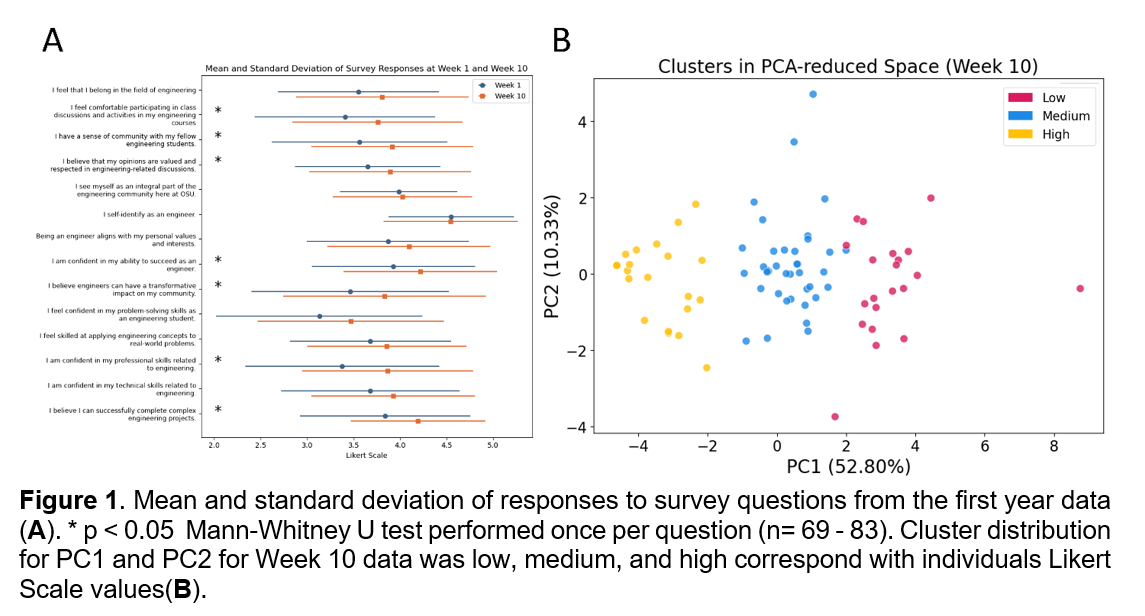
Results: We observed a general trend of an increased sense of belonging and confidence in skills by week 10, Fig. 1A. The cluster analysis of the week 10 data captured 52.80% of the variance in principle component (PC) 1, and 10.33% of the variance in PC2, Fig. 1B. Within the week 1 clusters, the majority of female students and non-binary students were represented in the low cluster, along with the majority of Hispanic/Latino, Asian, Black, and Pacific Islander students. The majority of students that identified as White or multiple races or ethnicities were predominantly represented in the medium cluster. Considering the week 10 clusters, the majority of Hispanic/Latino students were grouped in the low cluster; the majority of students interested in mechanical engineering, multiple majors, Asian or students that identified multiple races or ethnicities were grouped in the medium cluster; and the majority of students interested in chemical engineering were grouped in the high cluster. Comparing the influence of specifically gender identity between week 1 and 10, there was an increase in the percent of male and female students in the medium and high clusters by week 10, Fig. 1B. Similar trends were observed during the second year of the course. No students dropped out of the course either year.
Conclusions: From our results we can conclude that there is an overall increase in confidence of skills and sense of belonging in the engineering community by the end of the course. Analysis of how this applies to individuals based on their identities varies for each group. This study highlights the nuanced influences of demographics on students' perceptions of belonging and confidence in their skills and underscores the imperative for tailored interventions to foster inclusivity and support diverse student populations. As engineering continues to confront complex societal challenges, our research provides insights into cultivating a community of engineers equipped to address these issues effectively. Ultimately, our findings contribute to the ongoing discourse on enhancing diversity, equity, and inclusion in engineering education, paving the way for a more inclusive and socially conscious engineering workforce.