2025 AIChE Annual Meeting
(529g) Integrated Optimization of the Short-Term and the Long-Term Operation of a Blue Hydrogen Plant
Authors
The Plant produces hydrogen via autothermal reforming (ATR) of natural gas and it sequesters CO2. Its optimal operation is heavily influenced by the price of electricity, constraint on the maximum allowed carbon intensity, and the requirement to sequester annually at least as much CO2 as specified by its operating license.
The Plant has a CHP unit which generates electricity and steam. Electricity produced by CHP is used by the Plant or some of it may be exported to the grid. The main energy consumers in the plant are the air separation unit and the hydrogen liquefaction unit. The Plant produces: (i) hydrogen gas which is shipped to consumers via pipeline, and (ii) liquefied hydrogen.
Electricity prices change frequently, e.g. every 15 minutes; demand for gaseous hydrogen can change rapidly; limited liquefied hydrogen storage capacity requires that the liquefaction unit be operated periodically to meet variations in the lifting of liquified hydrogen.
The plant model employs component mass flows and local approximation of unit enthalpies in order to achieve high accuracy while preserving the model linearity. It is shown that using mass flows (instead of mole fractions and total stream mole flow) leads to linear surrogate models of ATR and of water gas shift reactors (WGS). Models of two-phase heat recovery heat exchangers as well as other heat exchangers and steam system are based on local approximations of physical properties. Such modelling approach leads to a plant model with many bilinear terms [flow*unit enthalpy], where unit enthalpy is a function of temperature.
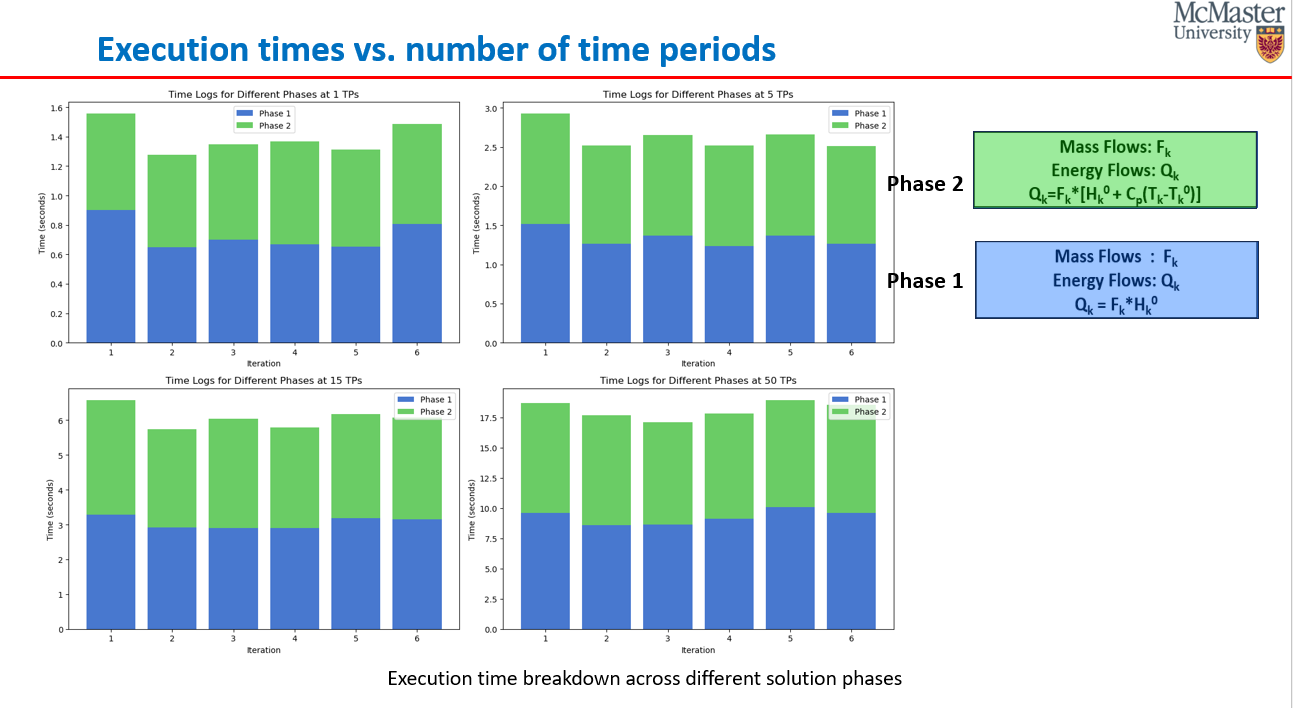
Instead of solving the entire set of model equations simultaneously, we have devised a composite algorithm which progresses towards more accurate solutions by solving two separate sets of linear equations as follows:
- Step 1: Solve mass balance equations and energy balance equations, with unit enthalpy of each stream kept constant at the stream conditions. This step is a directional trust based on the knowledge that the location of the optimum is largely determined by the flows.
- Step 1b: Nonlinear updates (if needed) of parameters of the set of linear equations in the next step.
- Step 2: Solve energy balance equations while holding the flows at the values computed in the first step. This step restores feasibility by correcting heat exchanger predictions to correspond to the flows computed in the first step.
- Steb 2b: Update the unit enthalpy of each stream.
- Repeat from the first step until convergence on the temperatures is achieved.
In the case of the hydrogen plant, it has not been necessary to update the local properties models via rigorous property calculations. Such an update may be necessary if the physical properties are highly nonideal.
The model has been implemented in Hybrid Plant Modelling and Optimization System (HyPMOS), which has been developed by our research group. Local physical property models are based on AspenPlus rigorous model of the plant or can be obtained from any other rigorous simulation software.
The topology of the plant model includes all heat exchangers and other equipment which are usually neglected in long term planning models. This ensures that the optimal operating conditions computed in each period can be implemented in the plant and that the long-term optimal plan is consistent with the short-term optimal operating plan.
Rapid convergence of the model allows modelling of the annual time horizon by e.g. 75 to 100 or more periods with periods length varying from 15 minutes to hours to days and weeks.
HyPMOS architecture allows different incarnations of node models to be employed in different periods. If appropriate, lower accuracy models can be used in the periods corresponding to the distant future, vs. high accuracy node models can be used for the near future. In the hydrogen plant model, we use different versions of the heat exchanger models at different steps of the algorithm.
We examine stability of the annual optimal operation under changes in the short-term electricity prices and hydrogen demand.
Out future work will include optimization of the hydrogen supply chain comprised of several hydrogen plants and several consumers connected via hydrogen pipeline.