2025 AIChE Annual Meeting
(232c) Integrated Electrocoagulation and Modified Nanofiltration Membranes for Removal of Microcystin
Authors
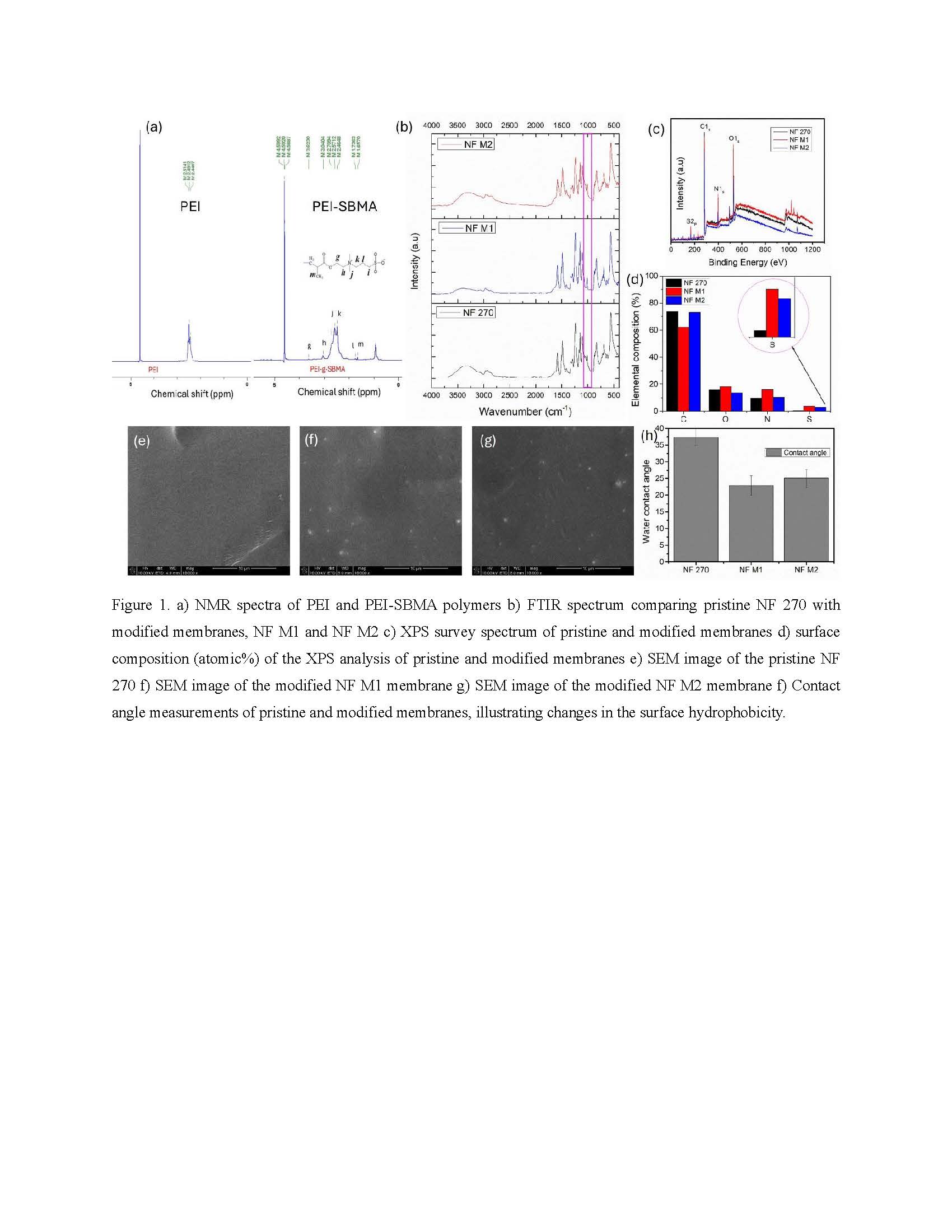
PEI-SBMA was synthesized through a Michael addition reaction. The barrier layer of the NF 270 membrane was modified with the PEI-SBMA. Two slightly different modification conditions were used (NF M1 modified at pH 6, room temperature while NF M2 modified at pH 9.0, 50 °C, Figure 1). PEI SBMA was characterized by NMR while the modified membrane surfaces were analyzed by Fourier transform infrared spectroscopy (FTIR), XPS, SEM and contact angle measurements. EC was conducted using 5 aluminum electrodes, with a spacing of 1 cm. Cross flow filtration experiments were conducted at a transmembrane pressure of 6.9 bar. Four feed streams were tested: 10 ppm NOM in DI water, 10 ppb model MC-LR in DI water, natural lake water, lake water spiked with 10 ppm NOM.
Figure 1 gives the results for analysis of PEI-SBMA as well as surface characterization of the membrane. The position of the protons confirm successful attachment of the SBMA polymer to the PEI backbone. FTIR and XPS data indicate successful surface modification of NF M1 and NF M2. Contact angle data indicate that the surface of NF M1 and NF M2 are much more hydrophilic while SEM images indicate no change in surface morphology. In all cases the performance of the NF M1 displayed the highest water flux. The performance of the modified membranes was superior to the unmodified NF 270 membrane. EC pretreatment led to a significant increases in flux. EC NF resulted in 100% MC-LR removal.
[1] Thamaraiselvan, C., McKean, T., Khalili, M., Do, S., Hackett, C., Rohana Liyanage, R., Qian, X., Wickramasinghe, S. R. (2025), Synergistic effect of electrocoagulation and antifouling nanofiltration
membranes for microcystin removal, Chemosphere 376 (2025) 144298