2025 AIChE Annual Meeting
(601h) Influence of Surfactant Distribution on Compound Droplet Dynamics in a Vertical Channel Under Steady Flow
Authors
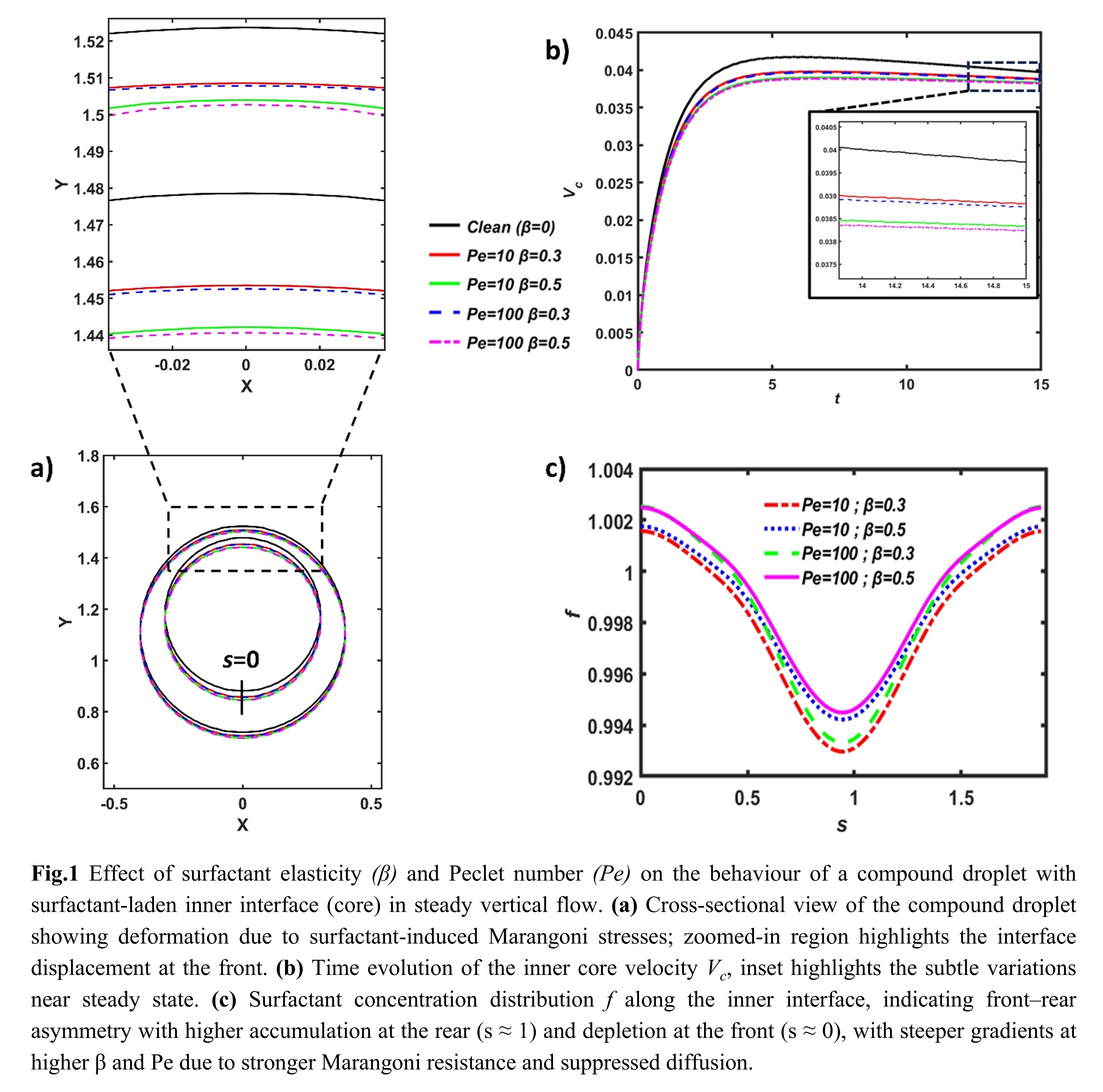
A two-dimensional fast local level-set method based inhouse solver is developed and employed to capture the deforming interfaces and accurately track the redistribution of surfactants along interfaces. The interfacial tension is allowed to vary locally due to surfactant-induced Marangoni stresses, which play a crucial role in resisting deformation and altering hydrodynamic behaviour. The study explores the influence of key parameters including interfacial elasticity, surfactant coverage, and Peclet number etc. on droplet dynamics.
The study reveals that the presence of surfactant significantly impacts the steady-state shape and lateral migration of the droplet. For instance, when surfactants are distributed solely on the core interface as shown in Fig. 1, Marangoni stresses arising from surfactant concentration (f) gradients resist internal motion and suppress the core velocity. These effects intensify with increasing surfactant elasticity (β) and Peclet number (Pe). The flow carries surfactant along the interface from front to back, causing depletion at the front and accumulation at the rear. This creates Marangoni stresses that resist further redistribution but when surfactant diffusion is weak (high Pe or low diffusivity), a strong concentration gradient remains and results in pronounced Marangoni flows that can hinder droplet motion.
These insights are critical for understanding the interplay between Interfacial physics and external flow in multi-phase systems and have direct relevance for microfluidic design involving compound emulsions. The findings align with prior observations on surfactant-mediated droplet stabilization [1–3] and extend the understanding to more complex compound droplet systems.
References:
- Matar, O. K., & Craster, R. V. (2009). Dynamics of surfactant-assisted droplet motion. Soft Matter, 5(22), 3801–3809.
- Eggleton, C. D., Pawar, Y. P., & Stebe, K. J. (1999). Insoluble surfactants on a drop in an extensional flow: A surfactant-induced Marangoni effect. Journal of Fluid Mechanics, 385, 79–99.
- Leal, L. G. (2007). Advanced Transport Phenomena: Fluid Mechanics and Convective Transport Processes. Cambridge University Press.