
2025 AIChE Annual Meeting
(178q) Influence of the Size of HEAT Exchanging Internals on the Gas Holdup Distribution in a Bubble Column Using GAMMA-Ray Computed Tomography.
Authors
Laith Sabri, Missouri University of Science and Technology
Ahmed Jasim, Missouri University of Science and Technology
Muthanna Al-Dahhan, Missouri University of Science & Technology-Rolla
A study was carried out to examine the effect of varying sizes of vertical internals on gas holdup distributions in a 6-inch (0.14 m) Plexiglas® bubble column using an air-water system. Advanced non-invasive gamma-ray computed tomography (CT) techniques were employed to analyze the system. The Plexiglas® internals used in the study occupied approximately 25% of the column’s cross-sectional area, and the investigation covered superficial gas velocities ranging from 0.05 to 0.45 m/s, encompassing both bubbly and churn turbulent flow regimes. CT scan images demonstrated that gas holdup distribution remained cross-sectionally uniform (symmetric) across all superficial gas velocities, regardless of the presence of internals. However, the column containing 1-inch internals exhibited a more uniform gas holdup distribution compared to the column with 0.5-inch internals. The core-annular liquid circulation pattern, typically observed in bubble columns without internals, was also present in columns densely packed with vertical internals. A significant finding was that the inclusion of vertical internals led to increased gas holdup near the wall in the churn turbulent flow regime compared to columns without obstacles. In the core region, at high superficial gas velocities within the churn turbulent flow regime, the gas holdup values in the column with vertical internals were comparable to those in the column without internals when considering the free cross-sectional flow area. In general, gas holdup magnitude increased with higher superficial gas velocities in both configurations. The gas holdup profile exhibited a wavy pattern in the column with vertical internals, whereas it followed a parabolic distribution in the column without obstacles.
Figure Caption: Dual source gamma ray computed tomography (CT) technique with a bubble column with internals
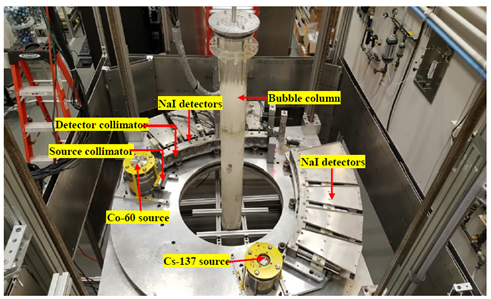
Figure Caption: Dual source gamma ray computed tomography (CT) technique with a bubble column with internals