2025 AIChE Annual Meeting
(270g) Industrial Perspective of New Value Chains from C-C Backboned Plastic Wastes
Author
Plastic pollution has increasingly become a clear threat to many environmental niches from the sea, rivers and lakes over the land to life, including fishes, birds and animals, due to rapidly increasing production of plastic products and leakage to the environment. Polyethylene (PE) is the most widely used and the largest-volume plastic (accounted for c.a. 30% of total plastic polymers; >100 million metric tons per annum). Due to the absence of reactive groups, the C-C backboned plastics are often categorized as non-degradable plastics; which are generally disposed by incineration or landfill (67%); and it is argued that it takes over 400 years for PE to degrade in a natural environment. About 12% plastic wastes (recycling) are mechanically recycled as the goods with inferior quality and performance for non-food grade applications. The real catalytic route for upcycling of PE wastes into value-added products (i.e. liquid fuels) is <1%. It is clear that there is an urgent need to develop new routes for innovative upcycling of plastic wastes towards a paradigm shift in the plastic economy.
Technology beyond the state-of-the art:
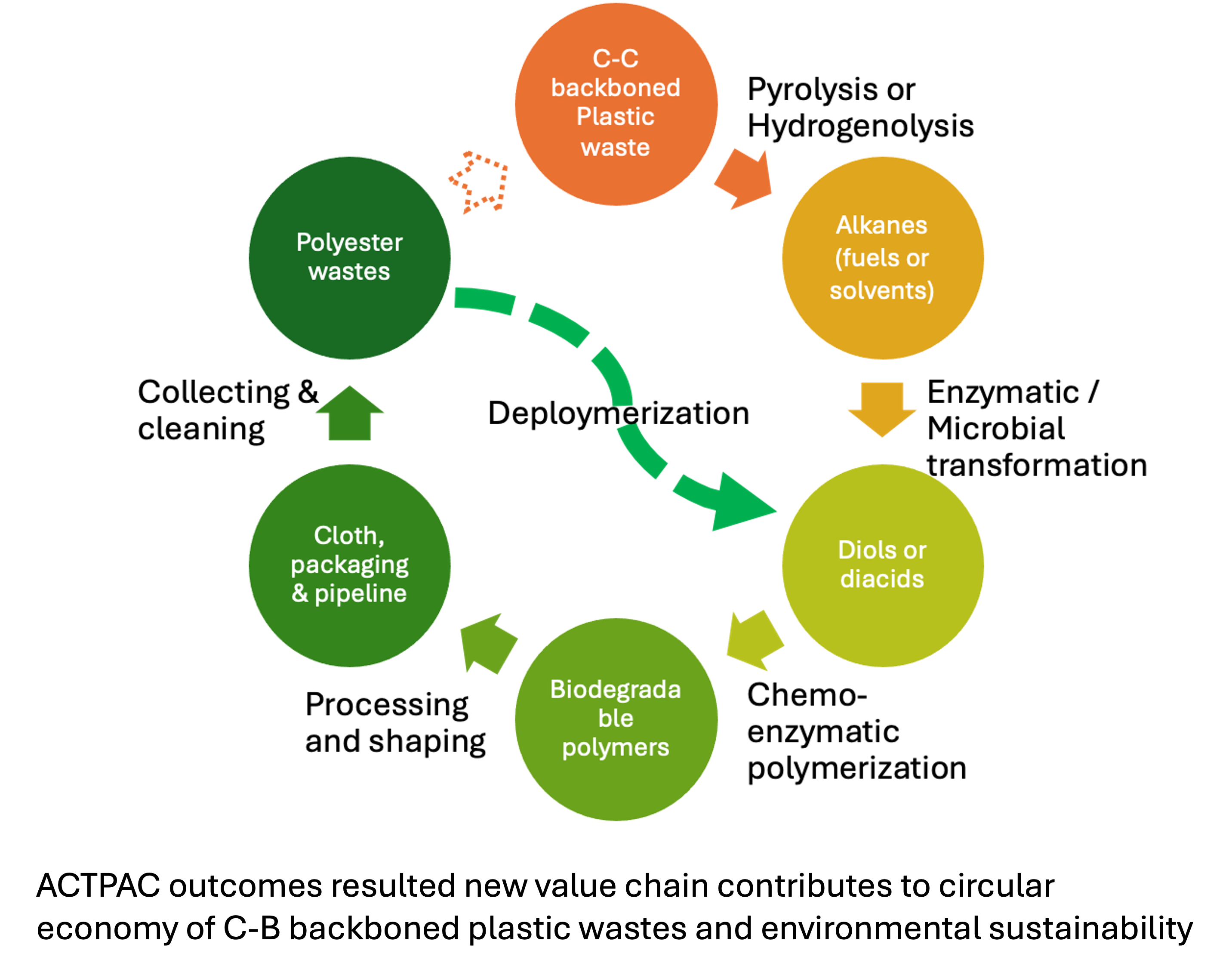
The ACTPAC project aims to establish a complete industry-viable chemo-biological transformation route for the conversion of C-C backboned plastic wastes into high value monomers and biochemicals; and the resulting new bio-feedstock will be explored for synthesis of biodegradable PE-like polyesters.
Thus, a zero-pollution bio-based solution to the existing environmental challenge is created, keeping plastic wastes out of the environment, reclaiming their values for better circular bioeconomy.
Contents of presentation:
In the present talk, I will address the following key issues in relation to the EU granted ACTPAC (A Complete Transformation PAth for C-C backboned plastic wastes to high-value Chemicals and materials) project:
Section 1. Governmental Incentive and initiative for recycling and upcycling of plastic wastes
Section 2. Industry’s action to shape plastic waste value chain
Section 3. Transformation paths to map plastic waste to value chain
Section 4. ACTPAC project and Core process development and technology clusters
Section 5. Matching UN’s sustainability and techno-economic assessment
Section 6. Formidable perspective