2025 AIChE Annual Meeting
(180av) Impact of the Hygroscopic Properties of Water Conduits in Artificial Mangroves for Climate Resilient Cities
Authors
Linfeng Piao, University of British Columbia
Jason Yu, University of British Columbia
Penghui Zhu, University of British Columbia
Feng Jiang, University of British Columbia
Jongho Lee, University of British Columbia
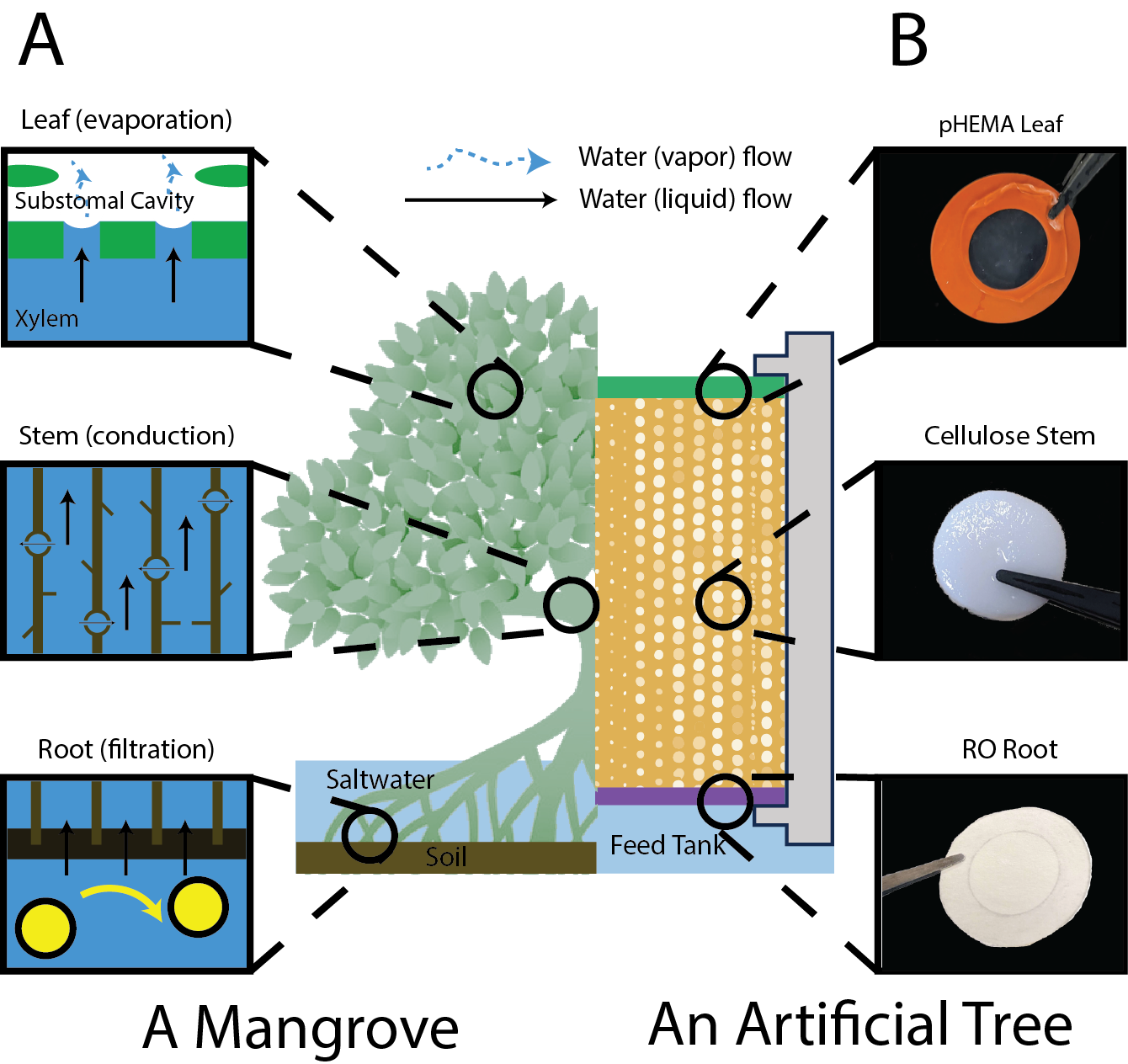
Severe heat events and flooding events are becoming more and more prevalent, and misbalances in the water cycle and heat distribution due to urbanization exacerbate these trends. Current mitigation technologies like green walls and green roofs are effective, but very expensive to install and maintain, leading to economic disparities in access to climate-resilient cities. Devices that mimic the capillary-pressure-driven water transport of trees have garnered attentions due to their potential as an alternative to currently existing green roofs/walls. Here, we demonstrate the feasibility and scalability of mangrove-mimicking devices that exhibit three different water transport functions in mangrove trees: solute rejection at the root, water conduction through the stem, and evaporation through leaves. Specifically, we investigate the effectiveness of hygroscopic material as the fast water-conducting stem and its function to enhance the evaporation rate at the artificial leaves. As a representative hygroscopic material, we 3D-printed a porous, hydrophilic stem using cellulose. The leaf for evaporation was fabricated by casting a polyhydroxyethylmethacrylate hydrogel film. A commercial seawater reverse osmosis membrane was used as the root membrane. We demonstrate the stable desalination performance of this artificial mangrove tree operated under large negative pressure up to -20 bar at varying environmental conditions. Then, we show that the tight binding between the cellulose stem and the hydrogel leaf leads to the oversaturation of hydrogel with water, which results in an enhanced water evaporation rate at the leaf. Finally, we measure the water flux at the root and at the leaf simultaneously for different leaf-to-root area ratios. The results show that the water flux at the root is nearly independent of the leaf-to-root area ratios, indicating that the device would attain high dewatering rates with large evaporation areas, such as on the side of a building. Our work supports the feasibility and scalability of a tree-mimicking device that could be installed onto the walls of buildings, providing passive cooling and flood resilience.
Figure 1. Comparison of the water transport functionalities in A) the natural mangrove and in B) the artificial mangrove.