2025 AIChE Annual Meeting
(362d) Impact of Coating Process Parameters on Tablet Bed Environment and Coating Quality
Authors
target/controlled release, taste masking, etc). A typical coating operation includes spraying aqueous
coating solution onto the hot tablet surface, with tablets tumbling in a perforated pan, with hot inlet
air drying off the water from the tablet surface, leaving behind a layer of pigments and other coating
material. The coating process parameters play a vital role in determining critical quality attributes
such as description and release, however, differences in equipment design and operator-specific
variables, such as baffle/spray nozzle designs, air flow pattern, spray angle, sensor locations etc.,
make technology transfer from small to pilot-scale equipment extremely challenging. Hence, the
study aims to characterize the local tablet bed conditions and leverage it as a scale-independent
variable across different equipments. The study is focused on: 1) highlighting differences between
thermodynamic predictions and tablet bed measurements, and 2) relating local tablet bed
conditions to coating defects to identify, characterize, and define the ideal coating design space.
Methods: This study involved coating placebo tablets (primarily composed of microcrystalline
cellulose) using common processing equipments, including the Flex 05 and Flex 100 pan coater
(Thomas Processing, Elgin, IL). The tablet bed temperature and humidity conditions were monitored
using penny-sized sensors known as ibuttons (iButtonLink Technology, Whitewater, WI). Tablet
surface temperature was also tracked using an IR thermometer gun, while tablet surface humidity
was measured via water activity. Spray rate, gun-to-bed distance, pan speed and tablet load were
analyzed to understand their impact on tablet bed conditions. The tablet coating quality was
assessed using surface roughness measurements.
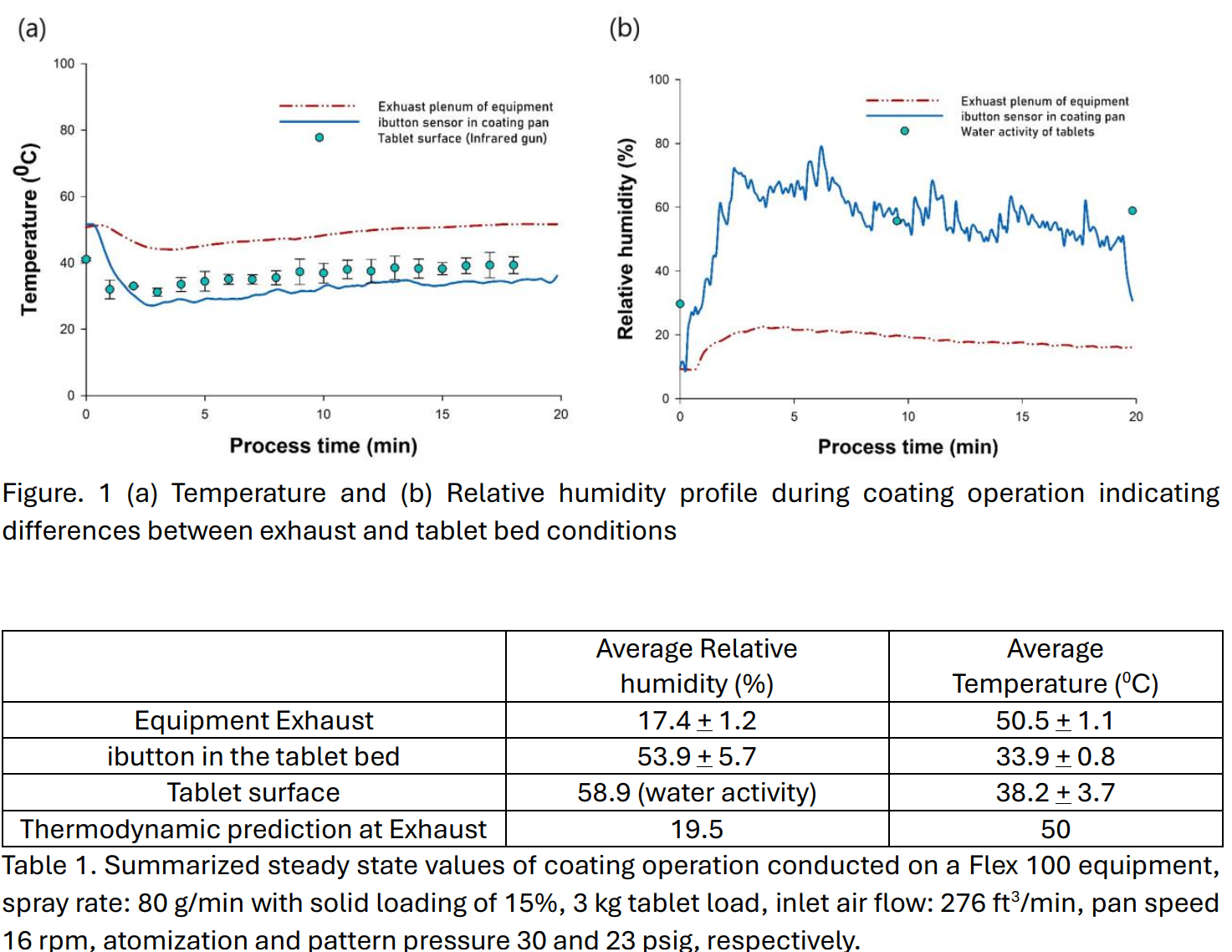
Results: An example of differences between thermodynamic modeling and local tablet conditions
is highlighted in Figure 1. The tablet bed temperature consistently remained below the exhaust
temperature (Figure 1(a)), owing to the evaporative cooling effect of the coating formulation,
consistent with prior research [2]. The tablet bed relative humidity spiked with the onset of spray
(Figure 1(b)). High local relative humidity (~55%) negatively impacted coating quality as depicted in
Figure 1(c). The rough surface coating was quantified through arithmetical mean height, Sa and
maximum height, Sz. The tablets had high Sa and Sz values (Sa = 3.019 µm, Sz = 38.7 µm), indicating
a relative rougher surface texture and hinting of coating defects and logo bridging. Summary results
of steady-state temperature and humidity are in Table 1.
Conclusion: Our findings reveal a correlation between ibutton sensor measurements and tablet
surface temperature and water activity. Notably, deviations from exhaust/thermodynamic conditions
were noted under high spray rate conditions, underscoring the importance of operating parameters
and local tablet bed conditions in critically influencing coating quality.