2025 AIChE Annual Meeting
(618e) Imaging Atoms and Ions in Polymers By Cryogenic Electron Microscopy
Authors
Nitash Balsara - Presenter, University of California, Berkeley
Xi Jiang, Lawrence Berkeley National Laboratory
Morgan Seidler, University of Notre Dame
Ronald N. Zuckermann, Lawrence Berkeley National Laboratory
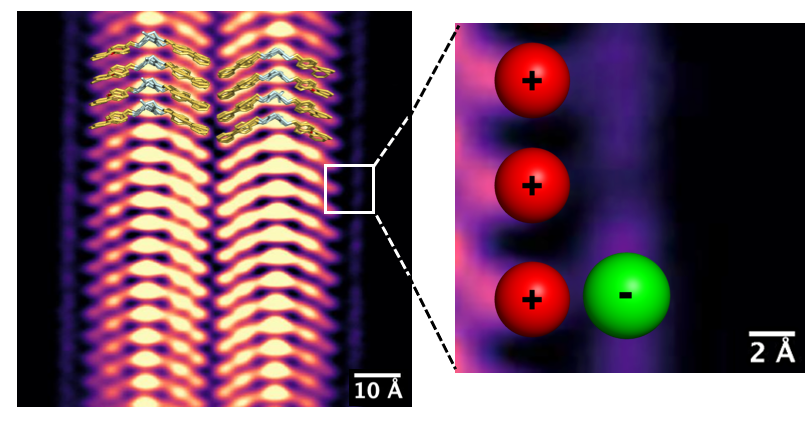
The location of atoms shown in the polymer science literature is based on indirect evidence or intuition. We have leveraged advances in the structural biology community to image atoms and ions in model polymer thin films using cryogenic electron microscopy. Our current work is focused on atomic-scale imaging crystals of polymers that are dipolar or ionic in nature. These images enable validating the underlying force fields of computer simulations on commensurate length scales. For example, subtle effects such as whether or not halogen bonds are formed in a polypeptoid crystal can be successfully modeled using molecular dynamics simulations. The situation is very different when the covalently bonded chlorine atom in the polymer is replaced by a chloride counterion that is ionically bonded to a positively charged polymer chain. Atomic scale images of crystalline nanofibers formed by self-assembly of the charged block copolymers in water show the presence of a layer of condensed chloride counterions that are separated from the charges on the main chain by one layer of water molecules. In other words, we clearly see the formation of solvent-separated ion pairs. While simulations show the presence of the condensed counterions, they only form contact ion pairs irrespective of the parameters used in the force fields (atomic radius, magnitude of the interaction well-depth, etc.). The agreement between atomic-scale images and simulation is worse when the condensed counterions are positively charged (e.g., H+). In this case, simulations suggest that the charged fiber should fall apart in water in a few nanoseconds (due to the high solubility of H+) while experiments clearly show them to be stable for many months. Efforts to resolve these discrepancies are currently underway.