2025 AIChE Annual Meeting
(479e) Hydrophobic Deep Eutectic Solvent-Embedded Mixed Matrix Adsorptive Membranes for Efficient Pharmaceutical Removal from Aqueous Solutions.
Authors
Conventional technologies such as adsorption and advanced oxidation processes (AOPs) have been extensively investigated for the removal of pharmaceutical residues. While these methods demonstrate high removal efficiencies, they are often plagued by limitations including high energy consumption, the requirement for frequent regeneration, and the use of costly reagents or catalysts. In recent years, membrane-based separation technologies have emerged as promising, energy-efficient alternatives for water purification, particularly for the removal of pharmaceutical pollutants. Membrane technologies, such as reverse osmosis (RO), nanofiltration (NF), and ultrafiltration (UF), offer several advantages including low chemical usage, compact design, and ease of integration. However, traditional membranes are limited by the intrinsic trade-off between permeability and selectivity. High permeability often comes at the cost of poor solute rejection, while improved selectivity can lead to diminished flux. Additionally, membranes are prone to fouling, which reduces operational efficiency and increases maintenance costs.
To address these challenges, recent research has shifted toward the development of Mixed Matrix Membranes (MMMs), which involve the incorporation of functional fillers into polymer matrices to enhance performance. Among various novel additives, Deep Eutectic Solvents (DESs) have garnered significant interest due to their tunable properties, environmental friendliness, and potential to interact with various foulants and contaminants. Hydrophobic DESs (HDESs), in particular, offer unique advantages in membrane fabrication, including their compatibility with hydrophobic polymers and their ability to improve membrane morphology and selectivity.
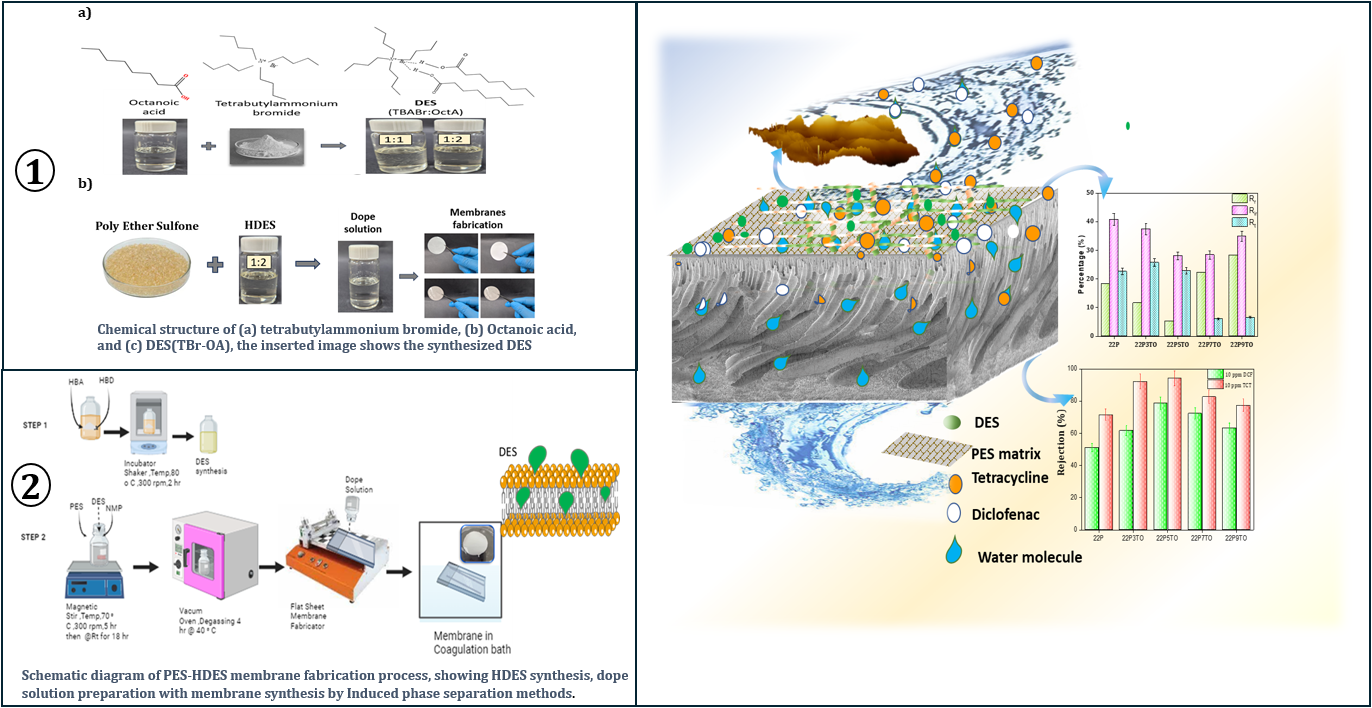
This study investigates the synthesis and performance of flat-sheet asymmetric Polyethersulfone (PES) membranes modified with a hydrophobic deep eutectic solvent (HDES). The HDES used in this work is a binary mixture of Tetrabutylammonium bromide (N4444Br) and Octanoic Acid (OA) in a 1:2 molar ratio. PES was chosen as the base polymer due to its excellent chemical and thermal stability, mechanical strength, and wide use in membrane fabrication. The membranes were prepared using the Non-Solvent-Induced Phase Separation (NIPS) technique, a well-established method for fabricating asymmetric membranes with controlled porosity.
A series of MMMs were fabricated by incorporating varying concentrations (3 wt.%, 5 wt.%, 7 wt.%, and 9 wt.%) of HDES into the PES matrix. Rheological studies were conducted to analyze the viscosity of the casting solutions, revealing that the addition of HDES increased solution viscosity, thereby influencing phase inversion kinetics. Membrane morphology and structure were analyzed using Scanning Electron Microscopy (SEM), which showed the development of more porous and finger-like structures with HDES incorporation. Fourier Transform Infrared Spectroscopy (FTIR) confirmed the successful interaction between the PES matrix and HDES molecules, particularly through hydrogen bonding and Van der Waals interactions.
Key performance indicators including Pure Water Flux (PWF), pharmaceutical compound rejection, porosity, surface hydrophilicity, mechanical strength, and antifouling behavior were thoroughly evaluated. The results demonstrated that the addition of HDES significantly enhanced membrane performance across multiple dimensions. The 5 wt.% HDES-modified membrane exhibited an optimal balance between permeability and selectivity. Specifically, the PWF of this membrane was measured at 10.07 LMH (liters per square meter per hour), which represented a 16-fold improvement over the pristine PES membrane. Furthermore, the rejection efficiencies for two commonly used pharmaceutical compounds—Diclofenac Sodium (DCF) and Tetracycline (TCT)—reached 58% and 92%, respectively.
The antifouling behavior was assessed by evaluating the Flux Recovery Ratio (FRR) after a standard fouling test using a model foulant solution. The 5 wt.% HDES-modified membrane achieved an FRR of 53.3%, indicating significant resistance to irreversible fouling. The enhanced antifouling properties were attributed to the improved surface hydrophilicity and the reduction in foulant-membrane interaction due to the HDES's surface-modifying effects.
Mechanical strength testing indicated that HDES addition did not compromise the membrane's structural integrity. On the contrary, membranes with lower HDES concentrations exhibited increased tensile strength due to better polymer-filler compatibility, though this trend reversed slightly at higher HDES loadings due to phase separation effects and plasticization.
These findings suggest that the integration of HDES into PES membranes provides a promising route toward developing high-performance, multifunctional membranes for pharmaceutical wastewater treatment. The use of hydrophobic deep eutectic solvents not only improves membrane permeability and rejection performance but also enhances antifouling resistance and membrane durability. Moreover, HDESs are relatively non-toxic, biodegradable, and easy to synthesize from inexpensive, readily available precursors, aligning with the goals of green chemistry and sustainable materials design.
In conclusion, the incorporation of N4444Br:Octanoic Acid-based HDES into PES membranes through the NIPS technique offers a novel and effective approach for tackling pharmaceutical pollution in water systems. The optimized 5 wt.% HDES membrane demonstrates a compelling combination of high flux, selective rejection, and fouling resistance, making it an ideal candidate for future membrane applications in water treatment. Future studies could further explore the long-term stability of these membranes under continuous operation, scale-up feasibility, and the performance of HDES-modified membranes in real wastewater matrices.