2025 AIChE Annual Meeting
(20e) Hydrodynamic Cavitation: A Novel Method for Enhanced PFAS Isolation from Wastewater
Per- and polyfluoroalkyl substances (PFAS) are a class of highly persistent organic pollutants frequently detected in industrial and municipal wastewater due to their extensive application in firefighting foams, coatings, and chemical production. Conventional techniques struggle to detect and measure them since their robust C–F bonds and tendency to associate with suspended solids or organic matter present significant environmental and health risks. This study examines the application of cavitation, a purely physical, chemical-free method, as a potential strategy for enhancing the release for improved and rapid detection of PFAS in wastewater.
Methods and Results
A hydrodynamic cavitation device was fabricated using 3-D printing technologies. The device forces liquid through a constricted geometry to generate microscopic vapor bubbles, which violently collapse to create localized high-pressure, high-temperature, and high-shear conditions. These physical effects can break weak interactions, such as van der Waals forces, hydrogen bonding, and electrostatic adsorption, between PFAS molecules and particles or dissolved organic matter in the wastewater matrix. As a result, PFAS compounds previously sequestered on solids in wastewater are desorbed and re-enter the aqueous phase in a freely dissolved and detectable form.
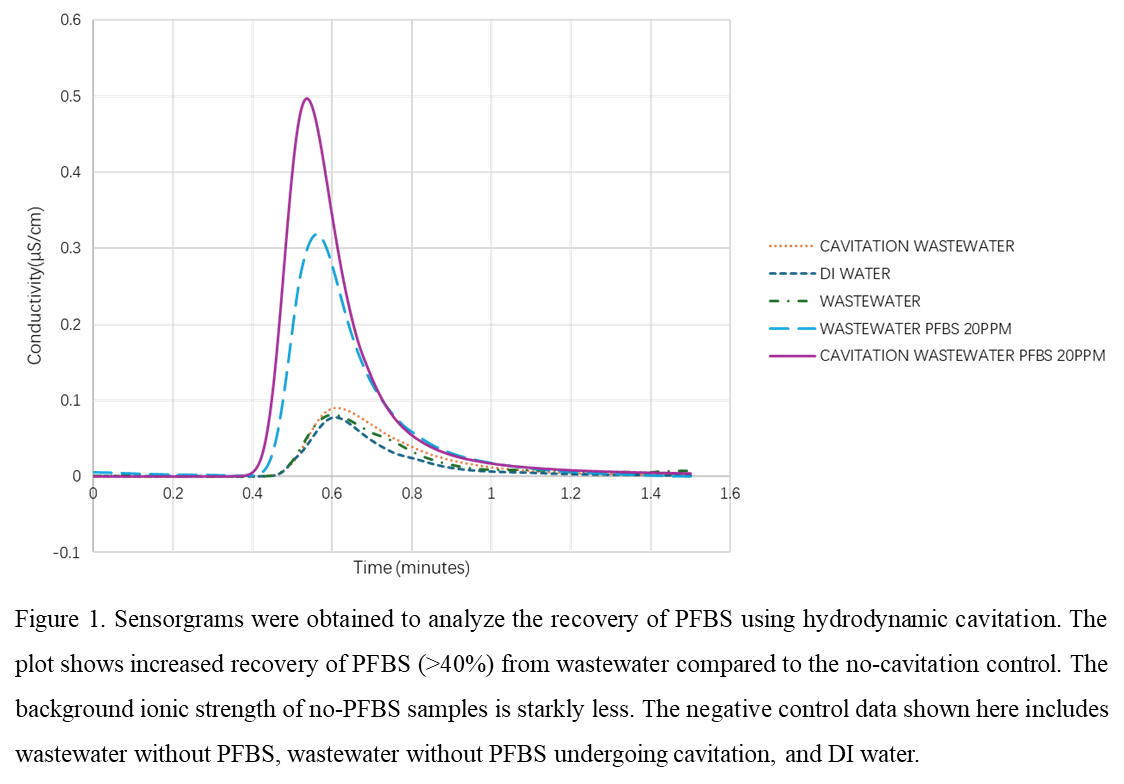
Electrical conductivity was measured before and after cavitation to evaluate the separation performance for these experiments. Notably, PFBS-spiked wastewater treated with cavitation exhibited the highest conductivity response among all samples, indicating the effective release of PFBS into the aqueous phase. This also indicates that cavitation facilitates the release of ionically active PFAS from bound states into the aqueous phase. Although conductivity provides a rapid and indirect indication of PFAS mobilization, further analysis employing liquid chromatography-mass spectrometry (LC-MS) is being pursued for better quantification and samples with much smaller quantities of PFAS (close to ppb or lower. We will also present pilot testing results from our work with a local pilot plant for wastewater reuse.
Significance
This study demonstrates the potential of a low-cost and modular cavitation reactor for isolating the PFAS from wastewater in less than 30 minutes. In contrast, the EPA-approved protocol is 8-12 hours long. The integration of rapid screening and LC-MS confirmation, coupled with chemical-free processes, can provide a scalable and eco-friendly approach to addressing emerging challenges in water quality management.