2025 AIChE Annual Meeting
(180ao) Hybrid Model of a Socio-Ecological System for Food Security Analysis Under a Global Warming Scenario
Authors
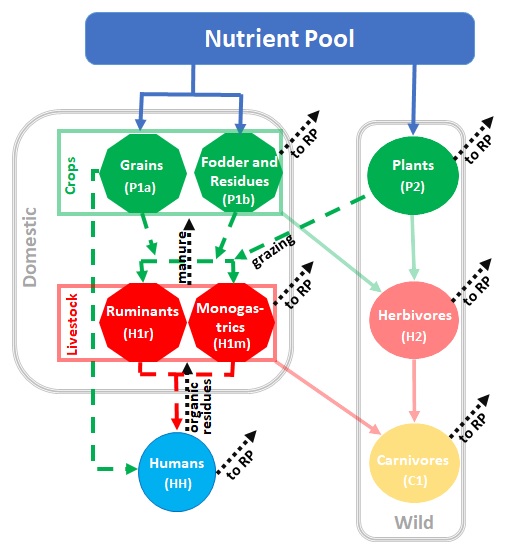
The model is built upon a classical mathematical foundation, using Lotka-Volterra equations to represent competitive and cooperative dynamics among various system compartments: agricultural production (P1), livestock production (H1), forest sector (P2), human population (HH), and a nutrient availability compartment (PN). This foundation is enhanced through the incorporation of ANNs, which add capabilities for handling non-linear relationships, learning from data, and adapting to diverse scenarios. The ANNs are specifically implemented in two areas of the model: vegetative growth (as a function of global average temperature and atmospheric greenhouse gas concentration, expressed in CO₂ equivalents) and the human mortality rate (as a function of per capita Body Mass Index, BMIpc).
Through this hybrid approach, the model aims to improve predictive accuracy and system sensitivity to variations in key parameters. This methodology captures the complexities of real-world systems, where multiple factors interact non-linearly and through feedback loops. The use of ANNs enables the model to “learn” from historical patterns and project more realistic future behaviors, especially under conditions of accelerated global change.
From a food security perspective, the model is designed to evaluate scenarios of nutritional solvency over long time horizons—in this case, 80 years (2020–2100). A minimum threshold of macronutrient availability per capita is defined, based on total food production (from both agricultural and livestock sectors), losses during the distribution chain, and per capita nutritional requirements. The model is forced to meet this growing food demand, which triggers a series of ecological, economic, and demographic repercussions that allow for an analysis of sustainability under current global trends.
Simulation results show that, when the model is forced to meet global nutritional demand primarily through increased agricultural (P1) and livestock (H1) production, significant pressure is exerted on the forest sector (P2). This occurs because the expansion of land for farming and ranching requires the conversion of forested areas, leading to a progressive reduction in forest cover. This loss has a direct impact on the planet’s ability to absorb greenhouse gases (GHGs), as forests serve as natural carbon sinks.
As the forest compartment decreases, atmospheric CO₂eq concentration increases, which in turn raises global average temperatures. This phenomenon generates a negative feedback loop: global warming alters vegetative development, affects crop productivity, and consequently undermines the system’s capacity to maintain food security. Additionally, rising temperatures may increase the occurrence of extreme weather events (not explicitly modeled but inferable), such as droughts or floods, further destabilizing the agri-food system.
The human mortality rate, calculated through ANN based on BMIpc, is also influenced by system dynamics. A decline in nutritional quality, driven by disruptions in food availability, leads to a gradual increase in mortality rates. This in turn feeds back into population growth dynamics, modifying the pressure on food demand. This component adds a demographic dimension to the model, allowing for an examination of how ecological and nutritional factors directly affect public health and life expectancy.
One of the model’s most critical findings is the emergence of a tipping point around the year 2075. At this point, the model shows a structural collapse caused by the depletion of key renewable resources, such as forest cover, and the inability to sustain food production without causing uncontrolled increases in GHGs and global temperatures. This collapse severely compromises the system’s nutritional solvency and, therefore, global food security, which could, in a real-world scenario, lead to widespread food crises, social unrest, and population displacement.
The model thus enables not only the visualization of possible trajectories under current conditions but also the identification of critical thresholds and feedback dynamics that must be considered in decision-making. In this sense, it becomes a valuable strategic planning tool, capable of evaluating the systemic effects of certain decisions—such as increasing food production without environmental constraints—and proposing more sustainable alternatives.
From a methodological standpoint, the model stands out for its ability to integrate multiple scales and variables, combining ecological theory, artificial intelligence, and demographic analysis. This flexibility allows for its adaptation to different regions or contexts, as well as the inclusion of new variables of interest, such as agricultural technologies, changes in consumption patterns, or conservation policies.
In conclusion, the findings of this study reveal that current dietary trends and unsustainable agricultural practices are pushing the global system toward a point of no return, where meeting nutritional demand comes at a disproportionately high environmental cost. Increases in GHG emissions, accelerated deforestation, and rising global temperatures are direct consequences of a production model that prioritizes quantity over sustainability. The projection shows that, if these trends continue without significant changes, the system will collapse around the year 2075, gravely compromising food security and ecological stability worldwide.
Given this scenario, it is imperative to rethink the global food production model. Strategies are needed that can decouple food production growth from environmental degradation, promoting regenerative agriculture, technological improvements that enhance efficiency without expanding the agricultural frontier, and shifts in consumption patterns to reduce pressure on natural resources. Furthermore, forest ecosystem conservation and restoration must be a top priority—not only as a mechanism for climate change mitigation but also as a safeguard for ecological stability.
The model developed in this work represents a powerful tool for exploring future scenarios, understanding the underlying dynamics of socio-ecological systems, and guiding public policy toward sustainability. Its ability to integrate ecological, social, and technological components within a dynamic framework enables the assessment of risks while identifying opportunities to build more resilient and equitable food systems in the future.