2025 AIChE Annual Meeting
(354c) Hybrid Microgel-MOF Networks for Dissolved CO? Sensing.
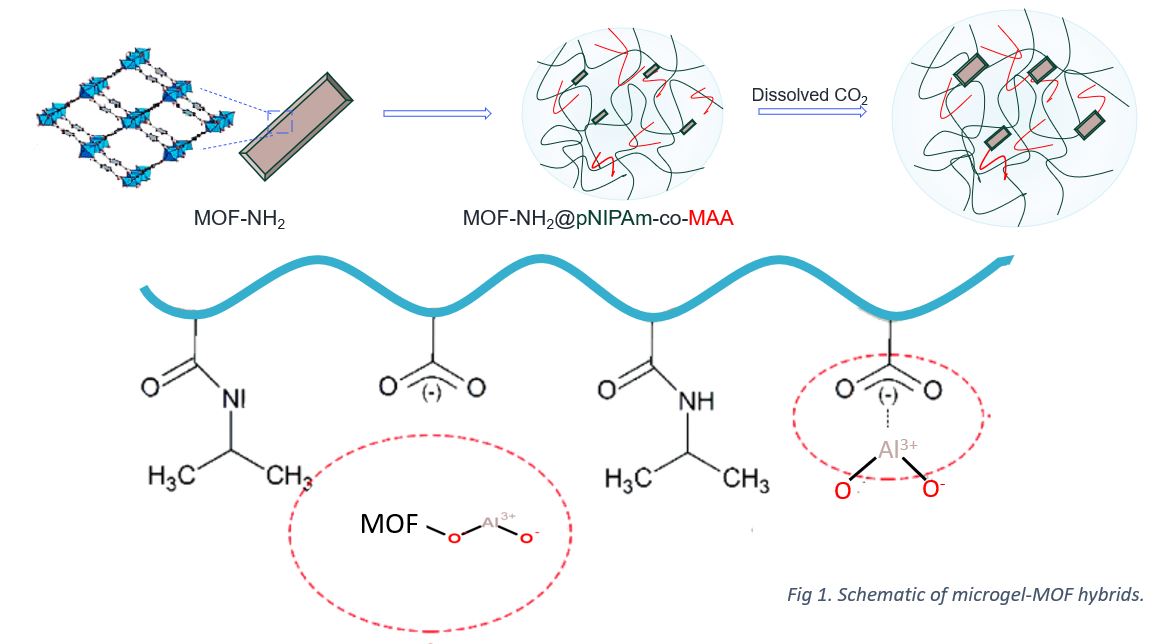
The novelty of our approach lies in the in-situ hybridization strategy, where the MOF is introduced during the microgel synthesis, enabling intimate interlacing through weak electrostatic and hydrogen bonding interactions between the MOF's amino functionalities and the microgel's carboxyl groups.
Dynamic light scattering (DLS) measurements confirmed a significant increase in particle size in the hybrid microgels (1344 nm at 25 °C) compared to pristine PNIPAM-co-MAA microgels (857 nm at 25 °C), reflecting the successful incorporation of the MOF within the microgel network. Zeta potential analysis showed less negative surface charge in the hybrid system, supporting the hypothesis of electrostatic stabilization and partial neutralization due to MOF inclusion. Thermogravimetric analysis (TGA) further validated the incorporation of the MOF into the microgel matrix by revealing differences in degradation temperatures and residue content.
To assess CO₂ responsiveness, we performed UV-VIS spectroscopy on both pristine and hybrid microgels exposed to bubbling CO₂. The hybrid material showed enhanced optical changes, attributed to the CO₂ uptake and structural breathing of MOF. The breathing effect of the MOF leads to a polymer network rearrangement, amplifying the swelling response of the micorgels to dCO2 (Fig1). Microgel-based etalon structures (6) were fabricated using the hybrid microgels, by sandwiching them within two gold coated layers. These optical sensors were tested for responsiveness to dCO₂, NaHCO₃, Na₂CO₃, and HCl. The hybrid sensors exhibited reversible and reproducible optical responses, demonstrating potential for real-world sensing applications. The durability and stability of the sensor under repeated dCO₂ exposure was tested by performing cycling experiments showing consistent performance.
This study demonstrates the potential of MOF-interlaced microgels as stimuli-responsive platforms for dCO₂ detection and lays the groundwork for future development in capture and separation applications by tuning polymer-MOF interactions and optimizing structural retention.
References
- Zimpel A, Preiß T, Röder R, Engelke H, Ingrisch M, Peller M, et al. Imparting Functionality to MOF Nanoparticles by External Surface Selective Covalent Attachment of Polymers. Chem Mater. 2016 May 24;28(10):3318–26.
- Maan O, Song P, Chen N, Lu Q. An In Situ Procedure for the Preparation of Zeolitic Imidazolate Framework‐8 Polyacrylamide Hydrogel for Adsorption of Aqueous Pollutants. Adv Materials Inter. 2019 May;6(10):1801895.
- Allegretto JA, Giussi JM, Moya SE, Azzaroni O, Rafti M. Synthesis and characterization of thermoresponsive ZIF-8@PNIPAm-co-MAA microgel composites with enhanced performance as an adsorption/release platform. RSC Adv. 2020;10(5):2453–61.
- Chen X, Zhuang Y, Rampal N, Hewitt R, Divitini G, O’Keefe CA, et al. Formulation of Metal–Organic Framework-Based Drug Carriers by Controlled Coordination of Methoxy PEG Phosphate: Boosting Colloidal Stability and Redispersibility. J Am Chem Soc. 2021 Sep 1;143(34):13557–72.
- Nagata S, Kokado K, Sada K. Metal–organic framework tethering pH- and thermo-responsive polymer for ON–OFF controlled release of guest molecules. CrystEngComm. 2020;22(6):1106–11.
- Gao Y, Li X, Serpe MJ. Stimuli-responsive microgel-based etalons for optical sensing. RSC Adv. 2015;5(55):44074–87.