Atmospheric air quality has been a concerning topic since the industrial revolution. Due to anthropogenic CO
2 emissions, we observe a rise in CO
2 concentration of atmospheric air from 280 ppm to 426.65 ppm according to the data shown by NOAA [1]. This persistent change has worsened global climate change and intensified the challenges associated with it, making CO
2 removal, often referred to as direct air capture (DAC), a priority. Although direct air capture (DAC) is inevitable in reducing carbon budget, its cost-effectiveness remains a challenge due to high energy requirement (22 kJ/mol CO
2 at 300K) for separation of CO
2 from dilute stream (∼ 400 ppm) [2]. Absorption-based DAC units are plagued with high solvent regeneration energy (7−13 GJ/tCO2 captured) and water losses (1−7 tH2O/tCO2) [3]. In contrast, membrane-based DAC (m-DAC) systems have gained popularity recently due to their energy efficiency, simple setup, and lower operational cost. A recent preliminary study showed that m-DAC costs less than $50 [4]. However, the cost of membrane separation increases with permeate stream CO
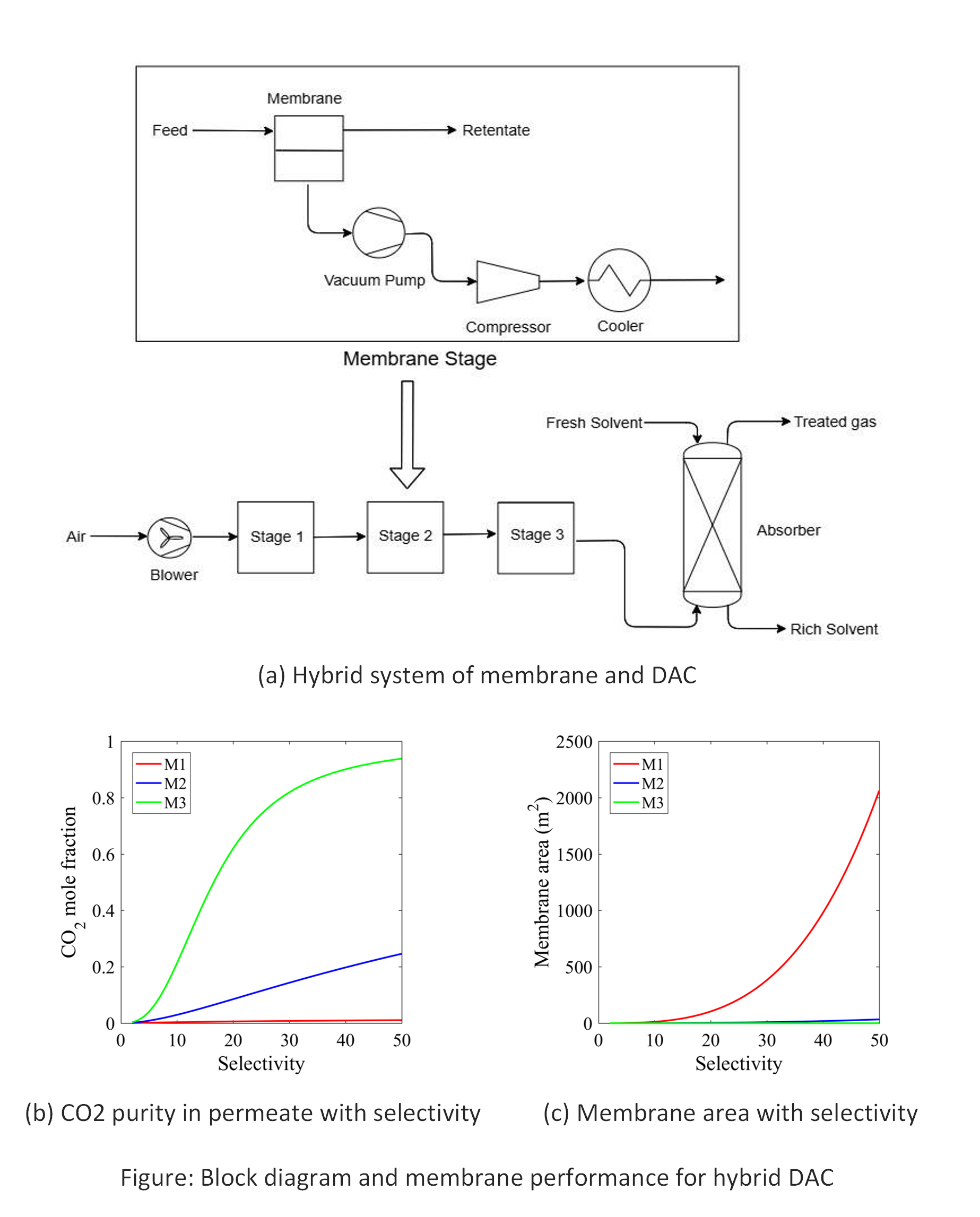
2 purity. We propose a hybrid absorption-based DAC with a membrane pre-concentrator [Figure (a)] to overcome the challenge of high cost and water losses. In this study, we simulate the hybrid system of membranes incorporating in ASPEN PLUS
® with an aim to identify suitable membranes for preconcentration of CO
2 from air. The proposed hybrid DAC system consists of three selective membrane modules designed to separate CO
2 from ambient air based on membrane properties. Robeson upper bound relationship for CO
2/N
2 mixtures is used for the membrane selectivity and permeability trade-off [5]. The membranes operate under controlled pressure conditions using vacuum pumps to enhance CO
2 flux. A parametric study was conducted by varying key parameters such as membrane selectivity, pressure drop, and number of stages. A detailed cost analysis is carried out to assess techno-economic feasibility. Results suggest that high permeability with a moderate selectivity membrane is preferable for this system as there is a trade-off between CO
2 purity [Figure (b)] and membrane area, which corresponds to cost [Figure (c)]. The insights from this study contribute in identifying cost-effective membranes for hybrid DAC technology.
References
[1] National Oceanic and Atmospheric Administration. Trends in atmospheric carbon dioxide. NOAA Global Monitoring Laboratory, 2025.
[2] Klaus S Lackner, Sarah Brennan, Jürg M Matter, A.-H Alissa Park, Allen Wright, and Bob Van Der Zwaan. The urgency of the development of co 2 capture from ambient air. 109:13156–13162, 2012.
[3] David W. Keith, Geoffrey Holmes, David St. Angelo, and Kenton Heidel. A process for capturing co2 from the atmosphere. Joule, 2:1573–1594, 8 2018.
[4] Christophe Castel, Roda Bounaceur, and Eric Favre. Membrane processes for direct carbon dioxide capture from air: Possibilities and limitations. Frontiers in Chemical Engineering, 2021.
[5] Lloyd M. Robeson. The upper bound revisited. Journal of Membrane Science, 320:390–400, 7 2008.