2025 AIChE Annual Meeting
(189aa) Humidity-Enhanced Chemoresistive Sensing By Metastable CoCu2O3 Nanocrystals
Authors
Hamin Shin, Human-centered sensing laboratory, ETH Zurich
Frank Krumeich, Particle Technology Laboratory, ETH Zurich
Andreas Güntner, ETH Zürich
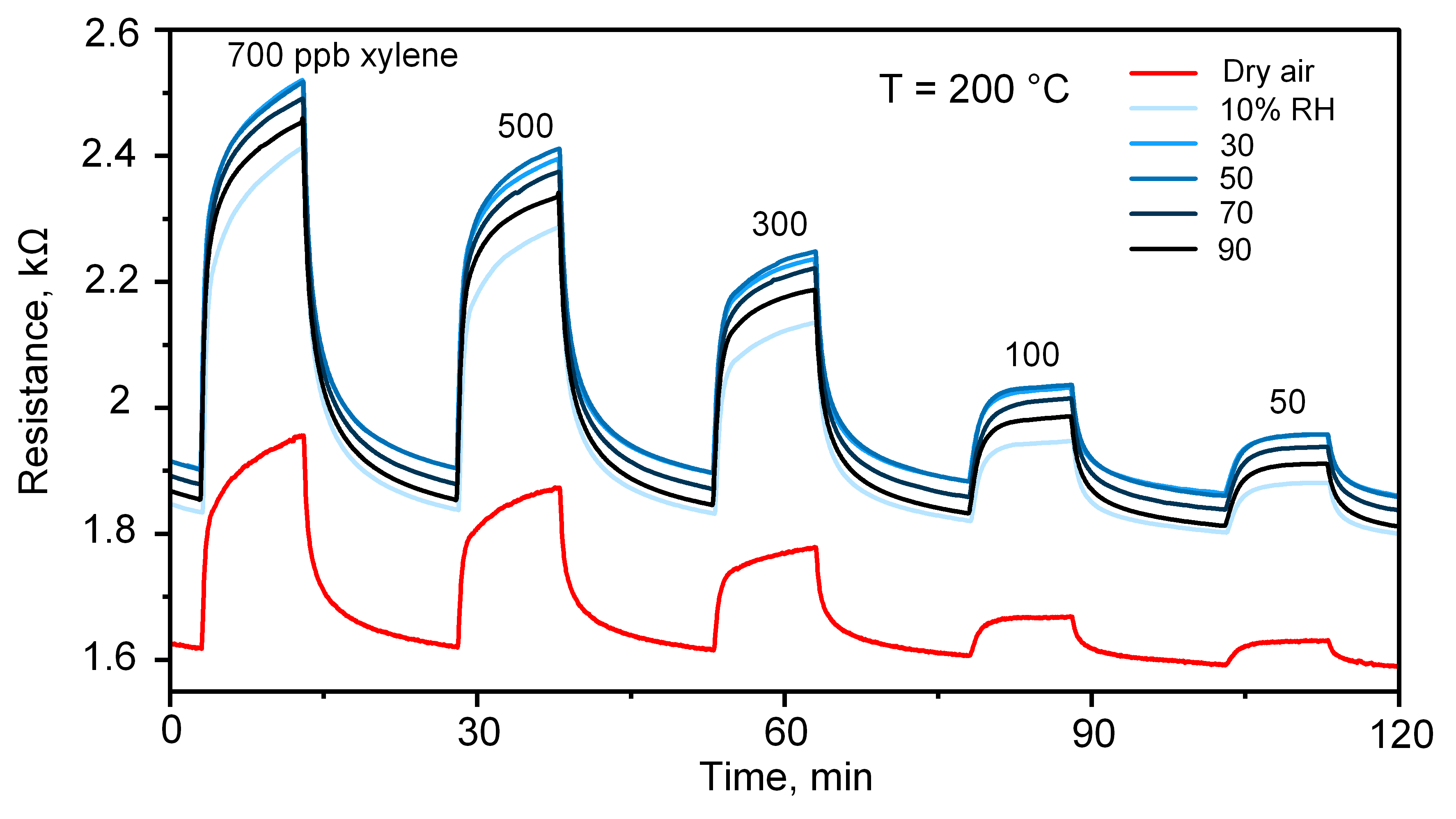
Metastable nanostructures, kinetically trapped in local energy minima on complex free energy hypersurfaces, can offer unique properties. This is associated, for instance, with higher surface energies due to their less stable atomic configuration, which may improve molecular interaction, fostering surface-active processes such as heterogeneous catalysis and molecular sensing. Combustion-aerosol technology in the form of flame spray pyrolysis [1] was recently showcased as an effective synthetic means for targeted metastable material design, investigating the occurrence of high-temperature CoCu2O3 in the CuO – Co3O4 pseudo-binary system [2]. This novel phase features chemoresistive behavior and could accurately quantify down to a few tens of parts-per-billion (ppb) xylene under realistic 50% relative humidity (RH), at a moderate temperature of 200 °C. Importantly, responses towards xylene, as well as model pollutant CO, are unexpectedly fostered in humid backgrounds compared to dry conditions (Figure 1). In fact, detection capabilities of typical metal-oxide-based sensors deteriorate in humid air (e.g., SnO2 in Figure 1d,e), that has been attributed to analyte/H2O-competitive adsorption and poisoning of catalyst active sites by hydroxyl-related species. Here, by a combination of in situ XPS (C 1s, O 1s, Co 2p, Cu LMM, Cu 2p), NAP-NEXAFS (O K-, Co L2,3- and Cu L2,3-edges), IR spectroscopy and electrophysical measurements, we identify the key role of adsorbed -OH groups in the molecular reception of xylene and CO. These promote electron transfer between C-/O-related species and the catalyst surface, with the synergistic operation of Co2+ and Cu2+ sites. Such improved redox chemistry results in enhanced kinetics as shown for the catalytic oxidation of air-quality-relevant 1 ppm xylene.
References
[1] Güntner, A.T.; Pineau, N. J. & Pratsinis, S.E., Prog. Energ. Combust. Sci. 2022, 90, 100992.
[2] D’Andria, M; Elias Abi-Ramia Silva, T.; Consogno, E.; Krumeich, F. & Güntner, A.T., Adv. Mater. 2024, 36, 2408888.
Figure 1 Caption: Resistance transients of metastable CoCu2O3 upon exposure to decreasing xylene concentrations at different relative humidities (RH) in the range of 0 – 90%.