Htchem: A High-Throughput Workflow for Reaction Network Expansion Integrating Automated Quantum Chemistry
2025 AIChE Annual Meeting
Htchem: A High-Throughput Workflow for Reaction Network Expansion Integrating Automated Quantum Chemistry
Accurately modeling complex chemical reaction networks is critical in fields such as catalysis, pyrolysis, and combustion, as it enables precise control and optimization of reaction pathways, improving process efficiency by maximizing desired products, minimizing waste, and reducing energy consumption. Kinetic modeling requires accurate reaction network generation and model parameterization, but existing approaches rely on reaction templates that may not exhaustively represent kinetically feasible reactions under all conditions and empirical correlations to quantify thermodynamics and rate coefficients, limiting model generalizability and accuracy. First-principles based calculations and rate based expansion offer greater predictive power but are computationally expensive for large networks. In addition, they often lack automated transition state searches, conformer analysis, solvation models, and robust treatment of complex electrochemical reactions.
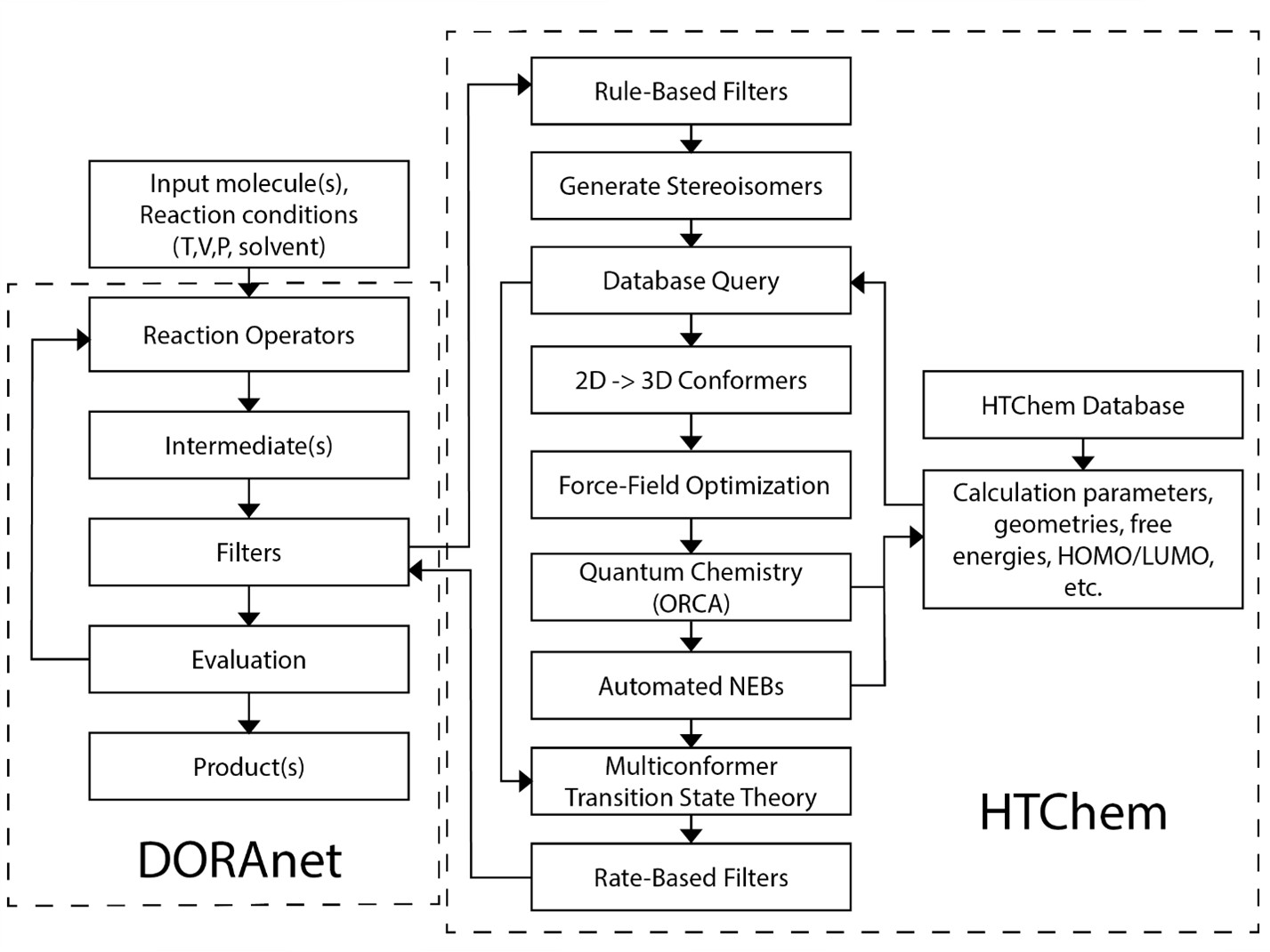
To address these limitations, we develop HTChem, a high-throughput computational workflow that was designed to enable rate-based reaction network expansion using on-the-fly density functional theory (DFT) calculations. This work implements a framework utilizing the Broadbelt group’s “Designing Optimal Reaction Avenues Network Enumeration Tool” (DORAnet) using the molecule manipulation framework RDKit, aiming to incorporate automated transition state searches, conformer optimization, and user-defined solvation models in a scalable pipeline. All thermodynamic and kinetic data are stored in a structured SQL database to ensure reproducibility and facilitate machine learning applications. By automating quantum chemistry calculations and streamlining reaction network expansion, HTChem enhances the accuracy and generalizability of kinetic models, paving the way for data-driven discovery in catalytic design, sustainable chemical manufacturing, and process optimization.