2025 AIChE Annual Meeting
(392at) High Accuracy Hybrid Plant Modelling Paradigm & Its Implementation for Integrated Solutions of Control, Optimization of Operating Conditions, Scheduling, and Planning
Authors
- changing the modelling paradigm from moles, fractions, and rigorous properties to component mass flows and local approximations of physical properties, and
- introducing a new type of solution algorithm.
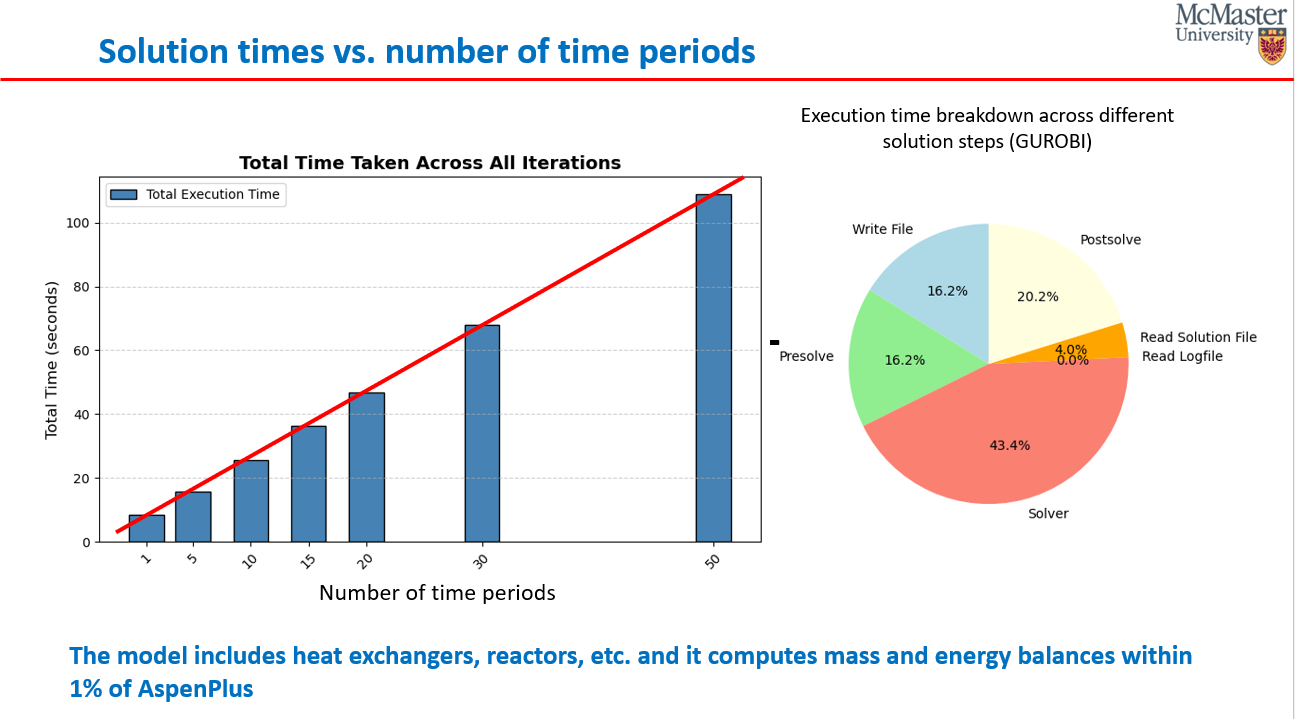
A hybrid model of a blue hydrogen plant is shown to predict the plant behavior with less than 0.5% relative error vs. an AspenPlus model. Solutions of the multi-period model, as required for optimization of production plans or for discrete-time scheduling, are shown to converge linearly vs. number of time periods. For example, 10-period and 50-period models converge in 20 seconds and 100 seconds, respectively, while retaining the high accuracy in each time period.
These results show that by changing the modelling paradigm [1], we can simultaneously solve high accuracy multi-period models as required for integrated solutions of optimization of operating conditions, scheduling, and planning. Benefits of integrated solutions are elimination of inconsistencies that currently arise from disjointed plant models implemented in different software tools.
Problem: Inconsistency of solutions between planning, scheduling, RTO and Control causes loss of opportunities to improve plant operation
Currently, there are three prevailing modelling paradigms representation of process plants:
- For simulation and optimization of operating conditions: detailed, rigorous models based on stream molar flows, component mole fractions, and rigorous physical properties. The models include rigorous calculations of mass and energy balances, as well as the operating conditions.
- For production planning and for scheduling: volumetric or mass flows with energy balances (if included) based on some ratios to the unit feed flows. Operating conditions are assumed to be constant.
- For control: data-driven MPC models, which ignore mass and energy balances.
Each of these paradigms is based on a different plant topology and has a different level of accuracy. This causes inconsistencies between their solutions and leads to inconsistent decision making and lost opportunities for improved operation.
In addition, the software implementations of each paradigm have different architectures due to the history of their development. Differences due to different software implementations can be alleviated by writing some bridging software, which unfortunately requires updating every time one of the models is changed.
In addition, the current rigorous modeling paradigm requires that data-driven models be embedded within mole flows paradigm while measurement in the plants are in mass or in volumetric units. This conversion requires that the material composition (expressed in mole fractions) be very accurate, otherwise the estimated properties will be incorrect. We show that a potential for erroneous physical properties is significantly reduced if properties are expressed per unit mass, which also maps easily to the measurements in the plants.
The solution is to introduce a new modelling paradigm which resolves the above issues.
In order to eliminate the inconsistencies, we need to resolve:
- Inconsistencies due to the topology: we can generate all incarnations of the plant models from the same topology. This does not mean that e.g. a planning model includes a detailed heat exchanger model. Instead, the planning model contains a heat exchanger model that is described by e.g. the mass balance equations; such equations will still be linear and will not increase the solution time. On the other hand, for optimization of operating conditions, the same node is modelled by equations that accurately represent heat transfer, mass balance, and energy balance. In other words, different levels of plant model abstractions are realized by different incarnations of the node models.
- Inconsistencies due to different levels of accuracy between e.g. planning or scheduling model and the model for optimization of operating conditions: we need to increase accuracy of the planning models and of scheduling models to be on par with the model for optimization of operating conditions. This can be accomplished by switching physical properties from moles to mass units, since physical properties are much less sensitive to changes in composition if they are expressed as [property/mass] instead of [property/mole]. This makes it possible to use local approximations of the bulk physical properties instead of rigorous property calculations and still retain high accuracy. In other words, e.g. enthalpy of a stream is described by the term F*H, where H=H0+Cp(T-T0), where “0” designates some base conditions.
The above changes lead to models that have many bilinear terms. To achieve rapid convergence, we change the stream representation to be in in mass component flows instead of moles and fractions. In addition, we introduce novel solution algorithm based on directional trust towards more and more accurate solutions that include improvements to local thermodynamic models. Even though the algorithm may appear similar to Boston-Britt “Inside-Out” flash algorithm, it should be pointed out that it is substantially different since Boston & Britt retain mole fractions and bilinear terms resulting from simplified thermodynamic properties.
Implementation and testing of the new modeling paradigm
We have implemented a software system (Hybrid Plant Modelling and Optimization System, HyPMOS) based on the above concepts. Implementation relies on PYOMO as the underlying modelling language. Each node has one or more incarnations, corresponding to the level of abstraction employed in a specific plant model or section of a plant model. Each node can also have different incarnations in different time periods. This makes it possible to use e.g. higher accuracy node models along the near time horizon and use lower accuracy models in the far time horizon.
Attributes of a node port (stream class & its variables, port location on the GUI icon, and mapping between the port variables and the node variables) are defined via system data. The architecture allows the system to be configured for different domains, using different stream/port classes and attributes.
Graphical user interface (GUI) is browser based, user defined plant models are stored in MondDB, while the system data are stored as SQL tables in PostgreSQL.
Users can add new node models by supplying the corresponding PYOMO equations and adding the node icon to the library.
The multi-phase composite algorithm is defined via data that specify actions in each phase of the algorithm. After each phase, auxiliary calculations can be performed, e.g. invoke a data-drive plant model to update parameters of a node model, or invoke a rigorous thermodynamic property calculations to update the approximate properties.
Results and Implications
We have shown on an example of a blue hydrogen plant model that model accuracy for multiperiod models can be raised to be on par with the rigorous plant models by changing the modelling paradigm. In addition, rapid model convergence is achieved by a new type of solution algorithm that successively moves towards more accurate solutions The model accuracy is on par with the rigorous model in AspenPlus (relative error less than 1%). For multiperiod models, the execution time grows linearly with the number of periods. For instance, 10-period and 50-period models are solved in 20 seconds and 100 seconds, respectively. The accuracy of the model in all time periods is the same, i.e. within less than 1% error relative to the AspenPlus model.
Rapid convergence and high model accuracy provide a basis for future work on integrated control, RTO, scheduling, and production planning.
[1] Mahalec, V. 2025. “A call for a different plant modelling paradigm and a new generation of software(Heresy in the land of moles, fractions, & rigorous physical properties)”, Computers and Chemical Engineering 194 (March) 108970
[2] Boston, J.F., Britt, H.I. 1978. "A radically different formulation and solution of the single-stage flash problem." Computers and Chemical Engineering (2-3) 109-122.