Heross: High-Throughput Exploration and Reprogramming of Sortase Specificity
2025 AIChE Annual Meeting
Heross: High-Throughput Exploration and Reprogramming of Sortase Specificity
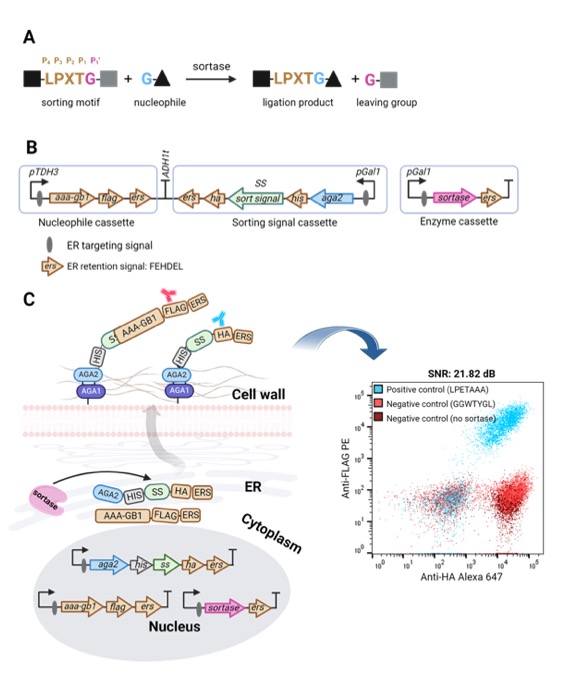
Sortases are cysteine transpeptidases found predominantly in Gram-positive bacteria that catalyze covalent attachment of surface proteins to the peptidoglycan wall. This reaction is initiated by sortase recognizing a pentapeptide motif, most commonly LPXTG in canonical SrtA, located near the C-terminus of substrate proteins[1]. The enzyme cleaves the peptide bond between threonine and glycine to ligate it to a nucleophile, forming a new covalent bond. Beyond their natural role as a bacterial virulence enabler, sortases have been widely adopted as a tool for site-specific bioconjugation and protein labeling. However, sortase-catalyzed reactions have a low turnover rate, often requiring excess substrate, and are limited to proteins that either naturally contain the substrate or are genetically modified to display it. There are also multiple families of sortases whose substrate specificity has not yet been completely explored. Thus, there is a need to improve the catalytic efficiency of sortases through either protein engineering or by profiling their specificity to find better substrates in a high-throughput manner.
To address these challenges, we developed HEROSS, a high-throughput yeast-based platform to reprogram and profile sortase substrate specificity. Using HEROSS with a DNA-encoded library of LPETXXX followed by multiple rounds of enrichment of improved substrates through flow-assisted cell cytometry (FACS) and data analysis on next-generation sequencing data, we have elucidated multiple substrates showing increased in vitro activity relative to the known LPETAAA-AAA sort signal for Streptococcus pyogenes sortase A (Spy-SrtA). We have further investigated the role of the nucleophile in catalytic activity by creating a library of nucleophiles paired with a weak sort signal and enriching for nucleophiles that show improved ligation. Future applications of HEROSS include evolving sortases with enhanced catalytic activity and discovering inhibitors through a library of nanobodies to limit their role as virulence enablers in pathogens such as Streptococcus pneumoniae, a leading cause of pneumonia.