2025 AIChE Annual Meeting
(291f) A Heart of Glass? Investigating the Spatiotemporal Correlation of Granular Dynamics in 3D Vibrated Beds
Authors
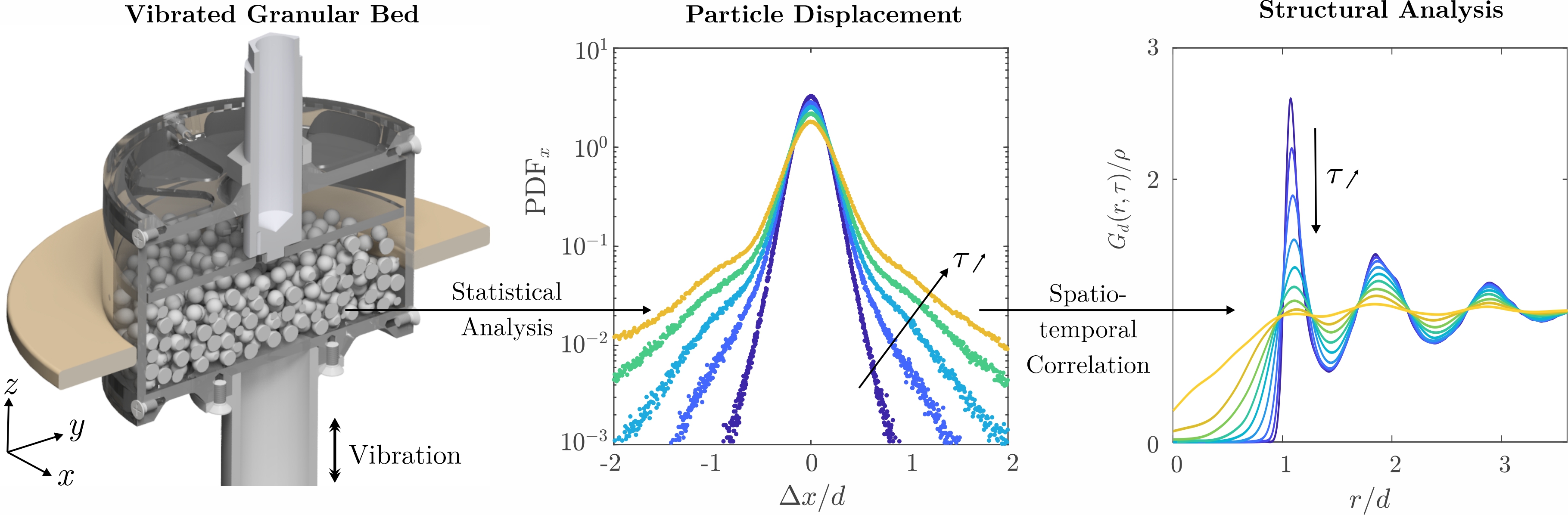
Recently, we have developed a novel technique based on nuclear magnetic resonance that is capable of tracking the motion of many particles in three-dimensional granular systems (MRPT).4 In this work, we deploy the high spatiotemporal resolution of MRPT to investigate the dynamics of granular materials in continuously vibrated, three-dimensional beds. We study the effect of vibration strength, solid fraction and polydispersity of granular materials on their microstructural relaxation.
Analyzing the probability density function of the particle displacement, we observe Gaussian distributions for low solid fractions as particles perform random walks. However, when increasing the solid fraction, exponential tails emerge indicating the presence of spatially heterogeneous dynamics5, i.e. the co-existence of regions with high and low mobility. In addition, we investigate the shape and evolution of the radial distribution function of the particle bed and find a splitting of the second peak as well as a short-term structural memory. Both features indicate that three-dimensional vibrated granular beds share fundamental commonalities with other disordered glass-forming systems such as colloids6 and supercooled liquids7 although on very different temporal and spatial scales.
References
1. Jaeger HM, Nagel SR, Behringer RP. Granular solids, liquids, and gases. Rev Mod Phys. 1996;68(4):1259-1273.
2. Reis PM, Ingale RA, Shattuck MD. Caging dynamics in a granular fluid. Phys Rev Lett. 2007;98(18).
3. Watanabe K, Tanaka H. Direct Observation of Medium-Range Crystalline Order in Granular Liquids Near the Glass Transition. Phys Rev Lett. 2008;100(15):158002.
4. Suter M, Metzger JP, Port A, Müller CR, Pruessmann KP. Magnetic Resonance Particle Tracking. arXiv:2503.22425. 2025.
5. Chaudhuri P, Berthier L, Kob W. Universal nature of particle displacements close to glass and jamming transitions. Phys Rev Lett. 2007;99(6).
6. Kegel WK, van Blaaderen A. Direct observation of dynamical heterogeneities in colloidal hard-sphere suspensions. Science. 2000;287(5451):290-293.
7. Kob W, Andersen HC. Testing Mode-Coupling Theory for a Supercooled Binary Lennard-Jones Mixture - the Van Hove Correlation-Function. Phys Rev E. 1995;51(5):4626-4641.