2025 AIChE Annual Meeting
(677g) Harnessing Physics-Inspired Machine Learning to Design Nanocluster Catalysts for Dehydrogenating Liquid Organic Hydrogen Carriers
Authors
Tej Choksi - Presenter, Nanyang Technological University
Bryan Chak Sing Lee, Nanyang Technological University
Uzma Anjum, Indian Institute of Technology, Delhi
Asmee Prabhu, Nanyang Technological University
Rong Xu, Nanyang Technological University
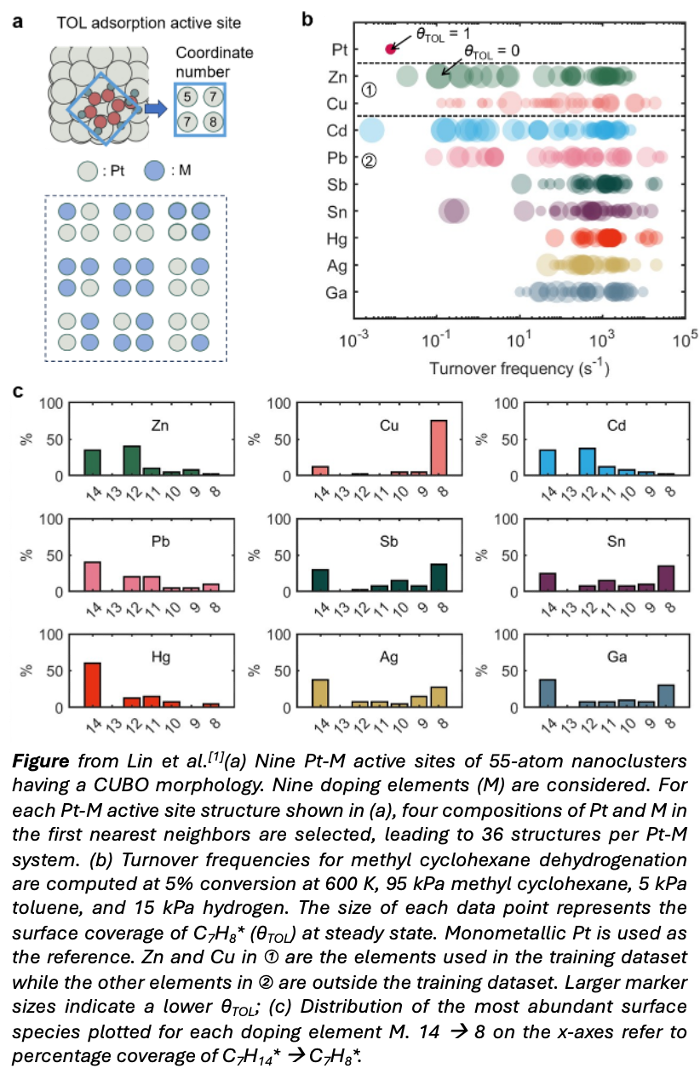
Using liquid organic hydrogen carriers for the trans-oceanic shipment of hydrogen requires selective and low-cost dehydrogenation catalysts. Machine learning methods can accelerate the discovery of these catalysts. Yet, state-of-the-art machine learning methods cannot perform this task because of challenges in predicting the energetics of large cyclic intermediates (20+ atoms) that adsorb and react on low-symmetry active sites of bimetallic nanoparticles. Data-greedy deep learning methods are unfeasible because of the computational cost of building training datasets for such complex molecules. Hence, tailored machine learning methods that work on small datasets are required. Moreover, incorporating physics-based features is essential to improve the transferability to catalysts outside the training set. Focusing on methylcyclohexane dehydrogenation to toluene, an industrially relevant hydrogen carrier, we introduce a physics-inspired machine learning approach to accelerate the design of selective and cost-effective bimetallic nanoparticle catalysts.[1] A gaussian process regression model is trained with active learning. This model predicts the adsorption energies and transition states of large hydrocarbon intermediates that are encountered during methylcyclohexane dehydrogenation. Across diverse active sites of bimetallic nanoclusters having varied shapes and compositions, our model yields mean absolute errors of 0.11 – 0.25 eV for adsorption and reaction energies of C7 species on test sets. This performance for large hydrocarbon intermediates is superior to data heavy foundational models that were built to predict the properties of less complex catalysts. This model is integrated with a coverage-consistent microkinetic model to identify improved catalysts. The model reveals that modifying Pt nanoclusters with IB, IIB, and post-transition elements like Cu and Sn increases dehydrogenation rates, reduces unselective reactions, and lowers Pt utilization, consistent with prior experiments. This work presents a scalable, and efficient framework for designing bimetallic catalysts for dehydrogenating hydrogen carriers.
[1] Lin, Lee, Anjum, Prabhu, Chaudhary, Xu, Choksi. Applied Catalysis B: Environment and Energy, 371, 125192, (2025)