2025 AIChE Annual Meeting
(276c) Harnessing Photoenzymatic Reactions for Unnatural Biosynthesis
Authors
Yujie Yuan - Presenter, Wuhan university
Maolin Li, University of Illinois at Urbana-Champaign
Zhengyi Zhang, University of Illinois at Urbana-Champaign
Huimin Zhao, University of Illinois-Urbana
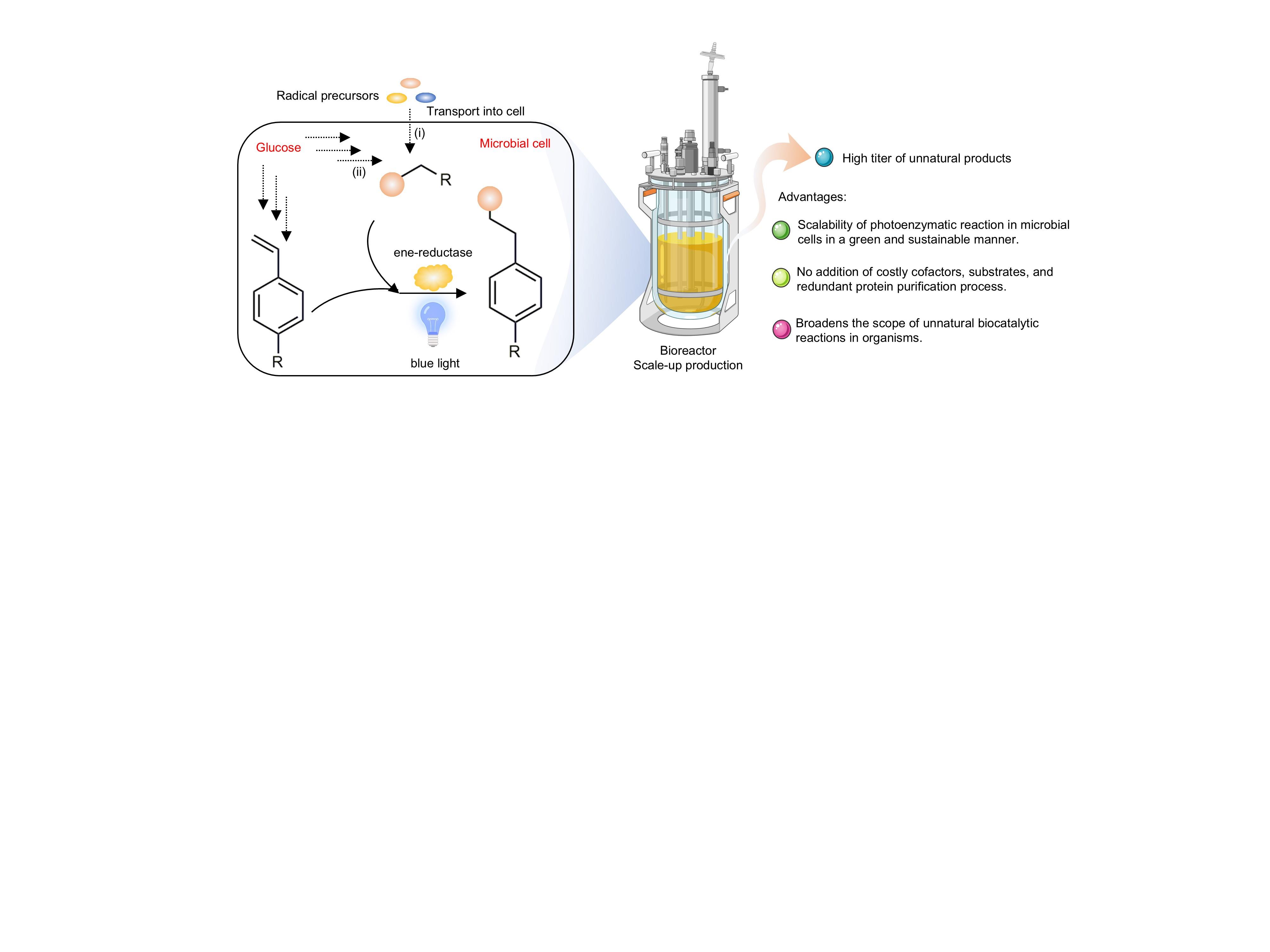
Biosynthesis enables precise assembly of complex molecules with remarkable efficiency but remains constrained by nature's enzymatic repertoire. Expanding its scope through the integration of new-to-nature reactions unlocks previously inaccessible chemical space, paving the way for the rational design of complex molecules. Photoenzymatic catalysis, which harnesses enzymatic selectivity and light energy, offers a transformative approach to synthetic biology by enabling biotransformations beyond traditional biosynthetic capabilities. However, its scalability is hindered by high enzyme loading, reliance on costly cofactors, and instability under radical-generating conditions. Here we report the integration of light-driven photoenzymatic reactions into the cellular metabolism of Escherichia coli, bridging flavin-based photobiocatalysis with biosynthesis. Using synthetic biology strategies, we engineered microbial cells to continuously produce olefin substrates and ene-reductase photoenzyme while regenerating cofactors directly from glucose. By externally supplying radical precursors or by introducing synthetic pathways for their in situ production, we enabled fermentation-based microbial photobiosynthesis, achieving high titres and demonstrating its feasibility for scale-up in bioreactor. This approach extends photobiocatalysis from in vitro applications to in vivo semi-biosynthesis and complete biosynthesis, revealing its full potential for integrating light-driven reactions into cellular metabolism. By broadening the synthetic capabilities of biological systems, this work establishes a programmable and scalable platform for ab initio biosynthetic design, opening a new avenue for sustainable biomanufacturing.