2025 AIChE Annual Meeting
(677a) Group Additivity-Driven Model for Field-Enhanced Catalysis
Authors
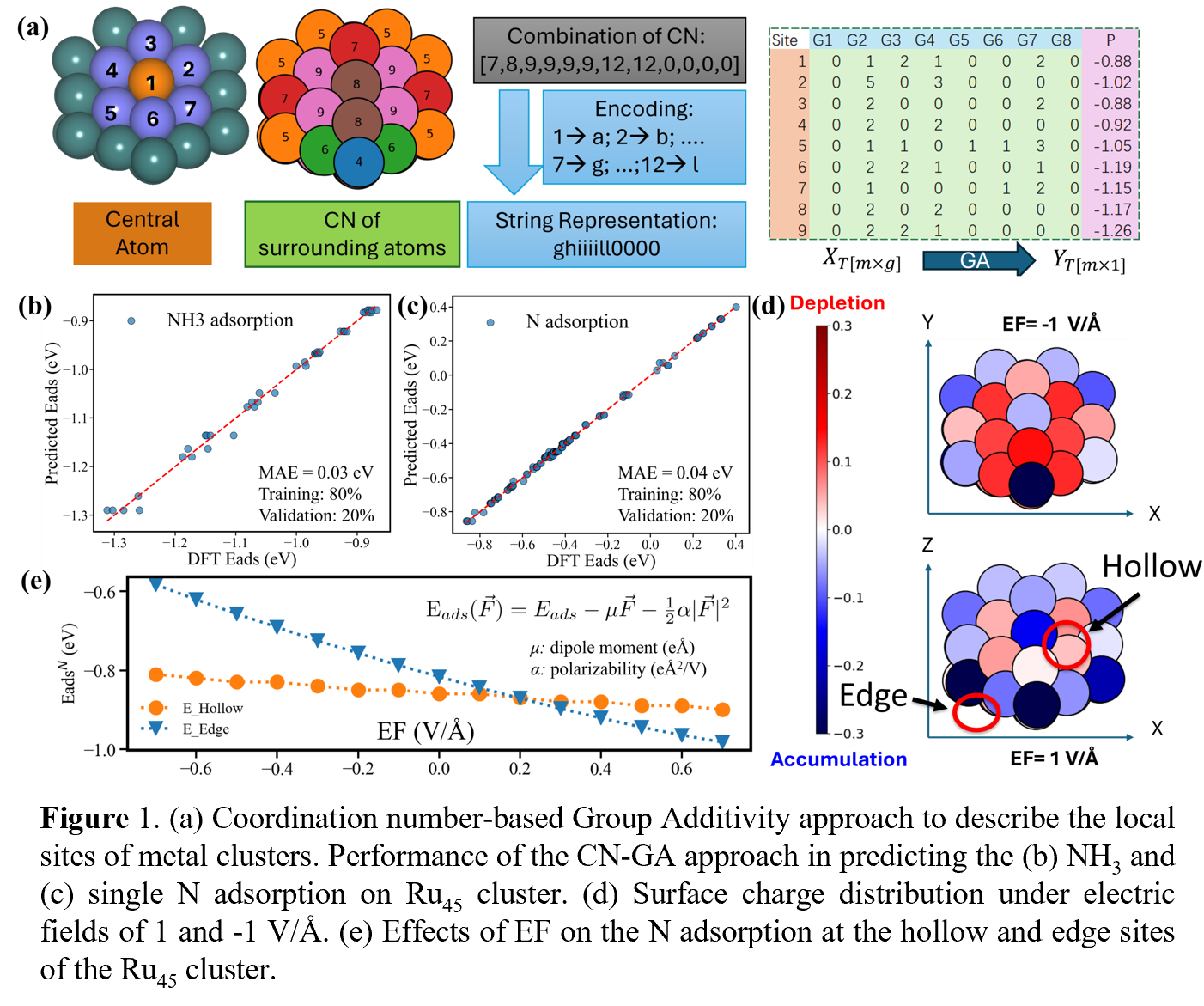
By combining multi-scale simulation (DFT, microkinetic modeling) with ML, we built a high-quality species-cluster interaction database and developed a physics-informed ML method using active site coordination number (CN) and the group additivity (GA) framework [3] (Figure 1a) to predict correlations among field-dependent catalytic activity and cluster sites. Our results (Figure 1b–c) show that the CN-GA efficiently screens species-catalyst interactions across diverse environments, accurately predicting species adsorptions for intermediates. Figure 1d shows surface charge redistribution as the field shifts from –1 to 1 V/Å, with edge and tip sites exhibiting heightened sensitivity. Notably, electron accumulation at edge sites enhances nitrogen adsorption (Figure 1e), underscoring the role of electrostatics in modulating species-site interactions and catalytic reactions. Our CN-GA model accurately predicts the system’s dipole moment and polarizability, enabling precise estimation of field-dependent energetics. These ML-predicted energetics are then integrated into a microkinetic model to reveal how nanocluster sites impact catalytic performance under fields, ultimately providing design principles for optimizing catalyst structures in field-enhanced catalysis.
References
- Zhao, R,. Li, Q., Zhu C., Che. F. JACS Au, 5, 3, 1121–1132 (2025).
- Q.; Wittreich, G. Vlachos, D. G. ACS Sustainable Chem. Eng.9, 3043–3049 (2021).