2025 AIChE Annual Meeting
(81c) Gelation Behavior of Short Protected Peptides in Organic Medium
Authors
Israt Jahan Duti - Presenter, University of Virginia
Thomas M. FitzSimons, University of Texas At Austin
Nathaniel Conrad, The University of Texas at Austin
Paridhi Agrawal, Eli Lilly & Company
Lexie Niemoeller, Missouri University of Science and Technology
Emily J. Guinn, Eli Lilly and Company
Jingyao Wang, Texas A&M University
Anastasiia Vasiukhina-Martin, Eli Lilly and Company
Adrianne Rosales, University of Texas At Austin
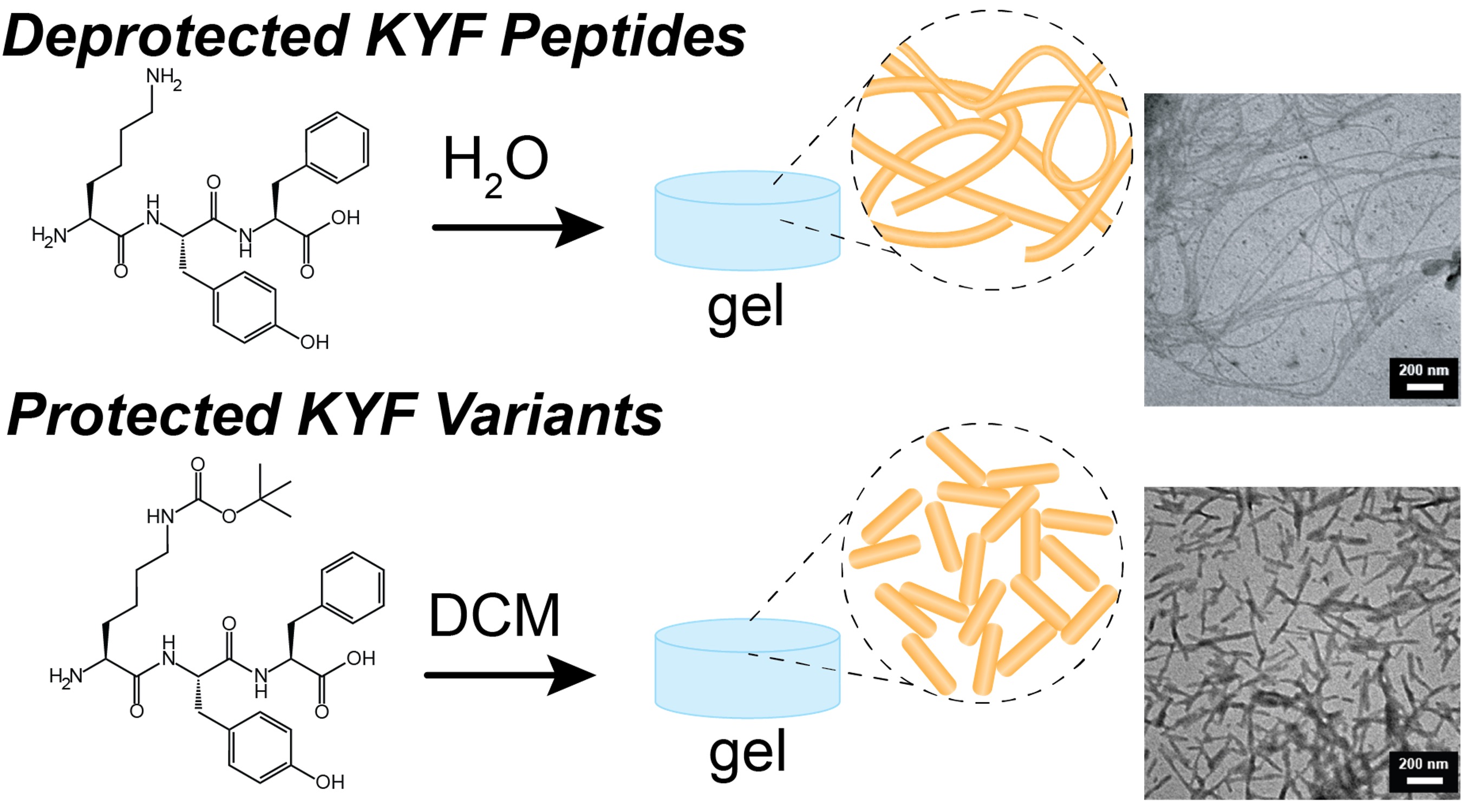
While peptide gelation in aqueous environments has been extensively explored for biomedical applications, peptide gelation behavior in organic medium is not well understood, despite the widespread use of organic solvents in solid phase peptide synthesis, hybrid synthesis protocols, and organogel applications. Here, we investigated the gelation behavior of a short peptide sequence, lysine-tyrosine-phenylalanine or KYF, with protected side chains and its derivatives in dichloromethane (DCM). Protected KYF peptides gelled in DCM at 40 mM, whereas deprotected peptides formed gels in water at the same concentration. Structural characterization via Fourier transform infrared spectroscopy indicated the presence of antiparallel β-sheets in both the protected and the deprotected KYF gels. However, transmission electron microscopy and dynamic light scattering indicated the protected peptide gels consist of short, anisotropic particles at the mesoscale, whereas the deprotected peptide gels in water form entangled fibers. The rheology of protected peptide gels in DCM show an increasing resistance to flow at higher shear rates, a shear thinning profile, and a gel-to-sol transition with increasing strain. Future work will explore the effects of length, sequence, structure and residue positions of the protected peptides on gelation. Altogether, this study provides critical insights on the assembly behavior and structure of a tripeptide motif and its variants in organic medium, which can facilitate optimizing the processing conditions of peptides in organic solvents during synthesis, as well as provide guidelines for designing organogels for wide range of applications.