2025 AIChE Annual Meeting
(355h) Gel-Based Conductive Pressure-Sensitive Adhesive: Enhancing Cohesion Via Cellulose-Derived Covalent Crosslinking
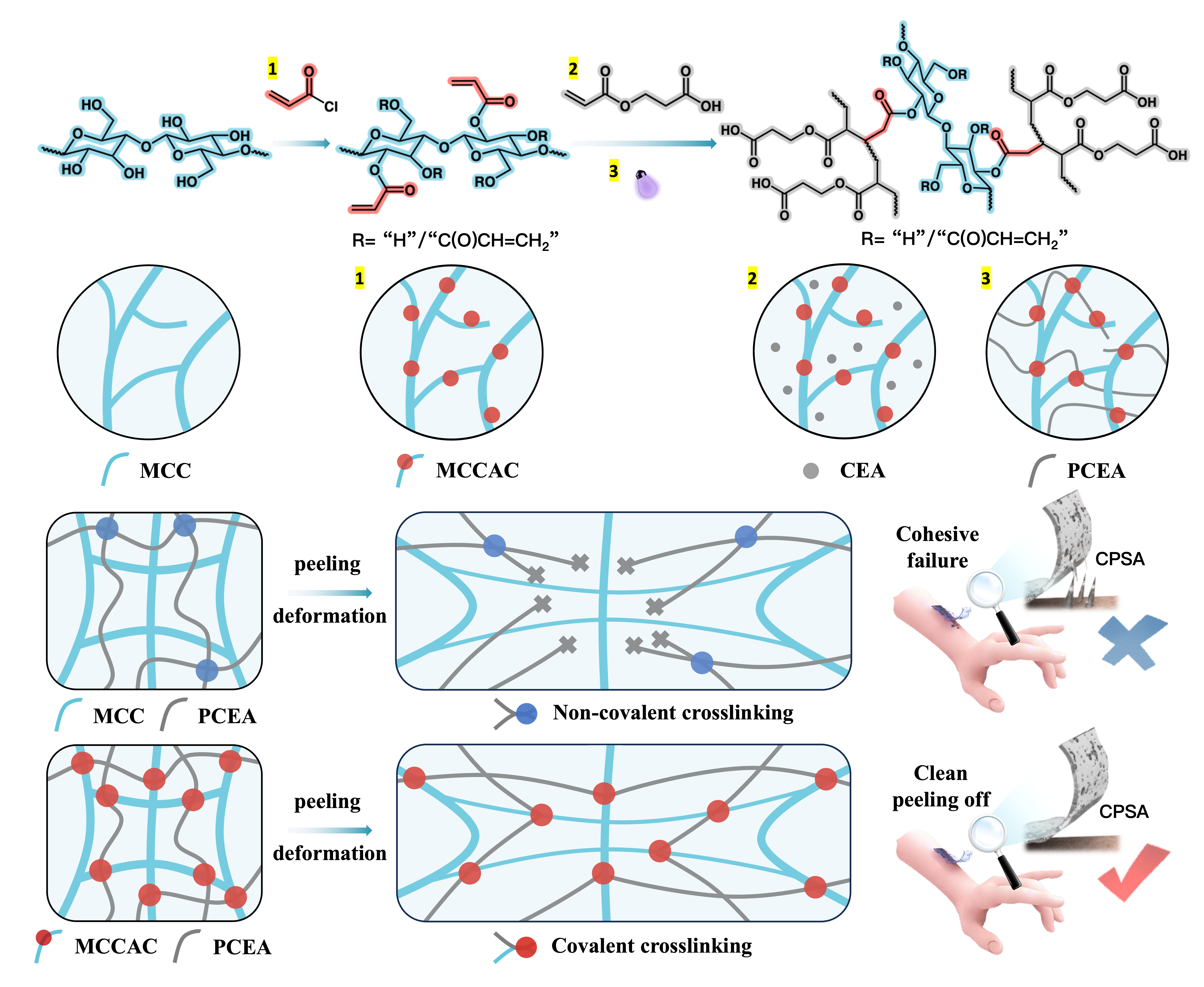
If ion-containing gels can adhere closely to the skin, they can change their resistance in response to body temperature variations and skin strain, enabling sensing functions. However, insufficient cohesion within the gel can lead to cohesive failure, compromising adhesion to the skin and causing instability in sensing performance. To address this issue, this study proposes a covalent crosslinking strategy based on cellulose. First, microcrystalline cellulose (MCC) was dissolved in an ionic liquid and reacted with acryloyl chloride (AC) via esterification. This process yielded a modified cellulose (MCCAC) with acrylate groups on its cellulose backbone, referred to as a cellulose-derived polymer crosslinking agent. Then, a eutectogel was prepared in a deep eutectic solvent (DES) via radical polymerization between MCCAC and acrylate monomers. Unlike previously reported eutectogels, where the two polymer networks remain independent, the eutectogel in this study forms an interpenetrating network between the cellulose and polymer chains. This structure enables stress distribution between the networks, preventing cohesive failure caused by local stress concentration. Results showed that the eutectogel with modified cellulose exhibited a peel strength 3.34 times higher than that of eutectogels prepared with unmodified cellulose. This strong adhesion to the skin allows applications in fever diagnosis, motion detection, and information transmission. Additionally, the DES plays a crucial role in enhancing the adhesion and functional performance of the eutectogel. The abundant functional groups in DES, derived from betaine and ethylene glycol, enable strong hydrogen bonding and electrostatic interactions with various substrates, ensuring heterogeneous adhesion. Ethylene glycol lowers the glass transition temperature of the eutectogel, which helps the eutectogel maintain flexibility and adhesion even at low temperatures. Furthermore, the dense hydrogen bond network within DES acts as physical crosslinking points, improving solvent resistance of the eutectogel. In summary, this study enhances the adhesion performance of gels by integrating and modifying cellulose. Notably, the eutectogel can achieve strong adhesion to substrates solely through applied pressure, without the need for radiation or heating, distinguishing it as a novel conductive pressure-sensitive adhesive. This advance expands the potential of eutectogels in wearable sensors, offering a simple yet effective strategy for achieving a close adhesion between the sensors and the skin.