2025 AIChE Annual Meeting
(401ab) Gate-Controlled Light-Driven Proton Transport through Graphene Membrane
Author
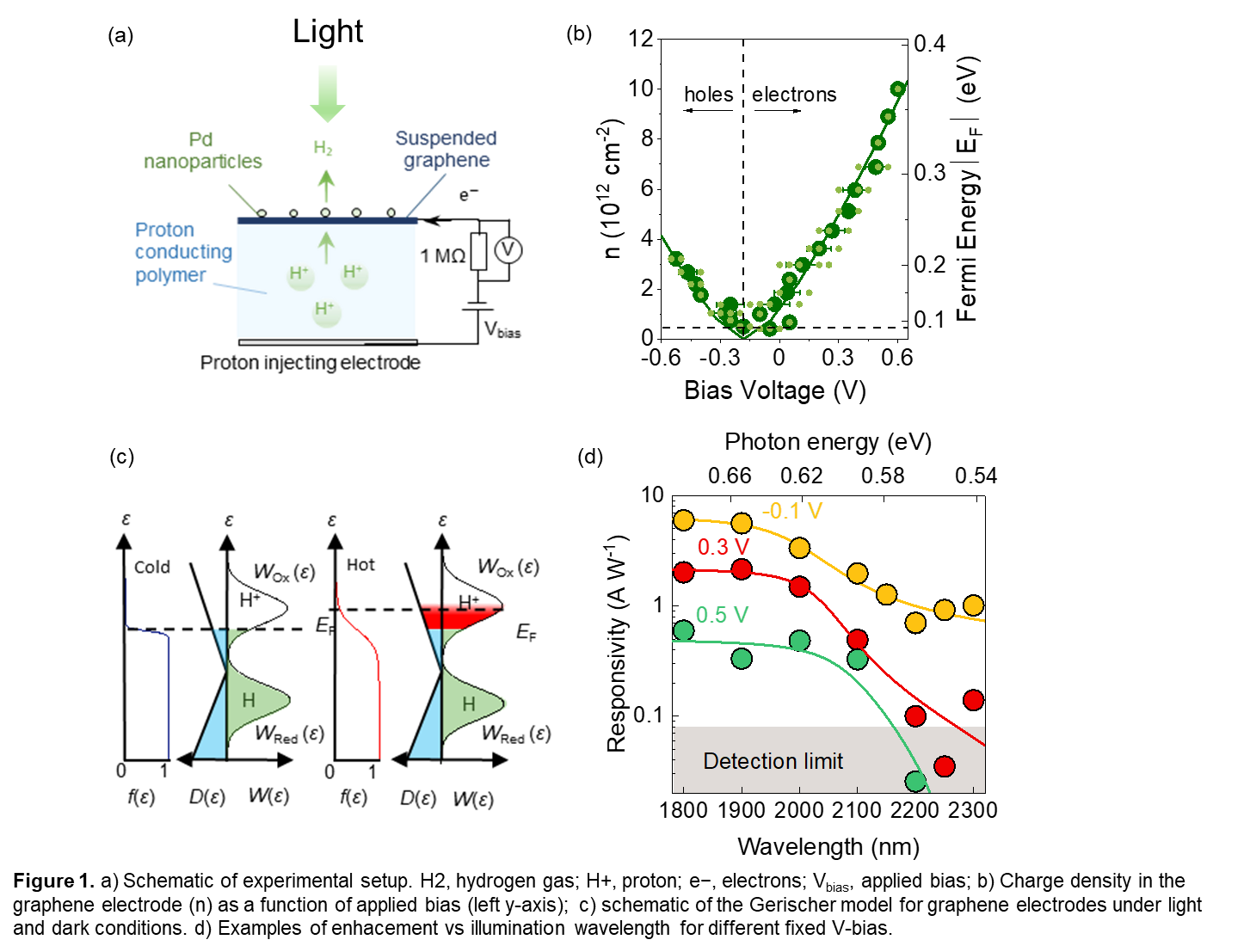
Herein, we elucidate the fundamentals of the enigmatic photo-proton phenomenon and achieve precise control over its enhanced effects [5]. We demonstrate tunable modulation of this light-driven proton transport across a range of the infrared spectrum with different voltage bias. Through photocurrent measurements and Raman spectroscopy, we revealed the photon-proton effects arises from voltage-controlled tuning of graphene’s Fermi energy. This energy level adjusted specific photo-excited electron populations, enabling selective enhancement or suppression of the proton transport rate through the monolayer graphene. These findings demonstrate a dependence between graphene’s electronic and proton transport properties, offering unprecedented insights into light-matter interactions at ultrathin membrane. These fundamental insights can stimulate several innovative promises to substantially reduce the energy consumption of the membrane separation process, therefore contributing to the energy-efficient industry transition and building a more sustainable society for the future.
References
[1] Wang, L.; Boutilier, M. S. H.; Kidambi, P. R.; Jang, D.; Hadjiconstantinou, N. G.; Karnik, R. Fundamental Transport Mechanisms, Fabrication and Potential Applications of Nanoporous Atomically Thin Membranes. Nature Nanotechnology 2017, 12, 509–522.
[2] S. Huang, S. Li, L. F. Villalobos, M. Dakhchoune, M. Micari, D. J. Babu, M. T. Vahdat, M. Mensi, E. Oveisi, K. V. Agrawal*, “Millisecond lattice gasification for high-density CO2- and O2-sieving nanopores in single-layer graphene”, Science Advances, 2021, 7, eabf0116.
[3] K.-J. Hsu, S. Li, M. Micari, H.-Y. Chi, L. F. Villalobos, S. Huang, X. Duan, A. Züttel, K. V. Agrawal*, “Pyridinic Nitrogen Substituted Two-Dimensional Pores for Rapid and Selective CO2 Transport.” Nature Energy, 2024, 9, 964.
[4] Lozada-Hidalgo, M. et al. Giant photoeffect in proton transport through graphene membranes. Nature Nanotechnology. 2018,13, 300–303.
[5] S. Huang†, E. Griffin†, J. Cai, B. Xin, J. Tong, Y. Fu, V. Kravets, F. M. Peeters, M. Lozada-Hidalgo, “Gate-controlled suppression of light-driven proton transport through graphene electrodes.” Nature Communications, 2023,14, 6932.