2025 AIChE Annual Meeting
(252d) Formation of Cu-Based Single-Atom Alloys Via Catalyst Restructuring Induced By the Vinyl Acetate Synthesis Reaction
Authors
Georgios Giannakakis, Tufts University
Yogita Soni, Tufts University
E Charles Sykes, Tufts Univ
Prashant Deshlahra, Tufts University
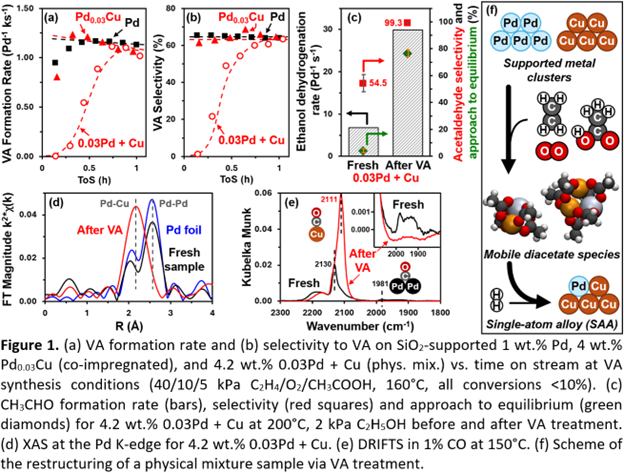
The high-value chemical vinyl acetate (VA) is produced by oxidative acetoxylation of ethylene on Pd-based heterogeneous catalysts that are known to restructure extensively under reaction conditions via formation of mobile metal diacetate oligomers, e.g. Pd3(OAc)6. Compositions beyond Pd and PdAu have been rarely studied; we examine PdCu, as Pd dispersion in Cu is thermodynamically favorable and non-contiguous Pd atoms have been proposed as highly active VA synthesis sites. On physical mixtures of monometallic Pd/SiO2 and Cu/SiO2 with 0.03 Pd:Cu atomic ratio (0.03Pd+Cu/SiO2), VA formation rate and selectivity are initially minimal but rapidly rise to match those of co-impregnated samples (Pd0.03Cu/SiO2). X-ray diffraction shows that spent 0.03Pd+Cu/SiO2 samples have much smaller nanoparticle sizes (~12nm) than fresh samples (~42nm); this is supported by transmission electron microscopy, which also shows that spent 0.03Pd+Cu/SiO2 samples contain Pd and Cu on the same SiO2 particles, suggesting that metal atoms travel micron-scale distances between particles. Pd K-edge x-ray absorption spectroscopy and diffuse-reflectance IR spectroscopy with CO probe molecules show high Pd-Pd coordination in fresh 0.03Pd+Cu/SiO2, but they detect only Pd-Cu coordination in spent samples. For non-oxidative ethanol dehydrogenation to acetaldehyde—a sensitive probe for Pd surface aggregates, which lower selectivity by forming methane and CO—selectivity increases from 54.5% on fresh 0.03Pd+Cu/SiO2 to 99.3% on the spent sample, suggesting extensive Pd dispersion into Cu. Transmission IR spectroscopy and density functional theory suggest that mobile mixed-metal diacetate oligomers form under VA synthesis conditions; we conclude that reducing these species forms single-atom alloys (SAAs). We also assess acetate formation energies for SAA formation preferences in systems beyond PdCu. This has potential applications in scalable catalyst synthesis, restoration of SAAs degraded by harsh conditions, and deposition of metal clusters in confined sites [1].
[1] Giannakakis, G., Soni, Y., Novotny, G.L., et al. J. Am. Chem. Soc. 146, 20989 (2024).