2025 AIChE Annual Meeting
Fabrication of Luminescent Self-Regulating Magnetic Hyperthermia Core-Shell Nanoparticles of Gadolinium Oxide Shell over Gadolinium Silicide Core
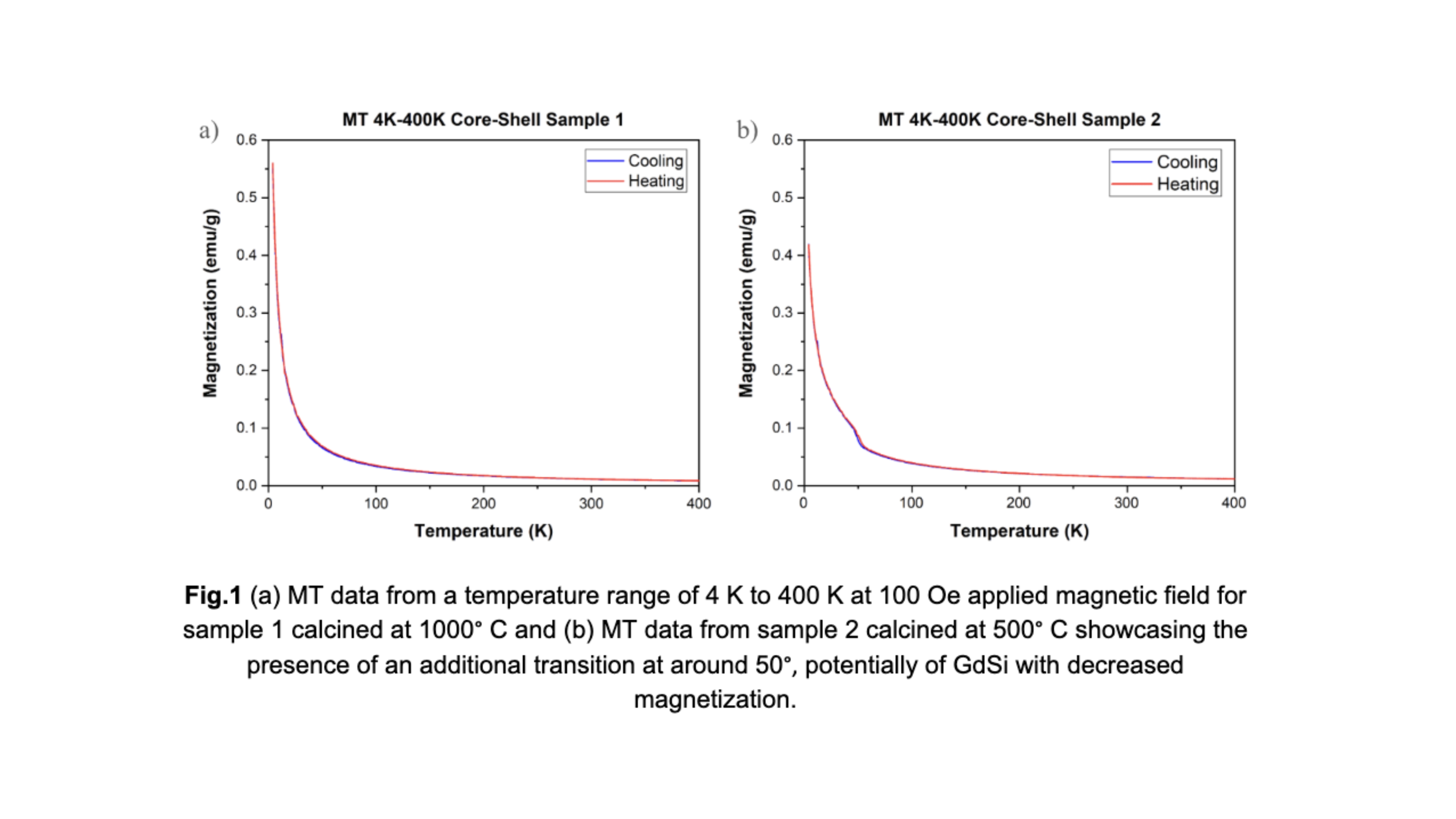
Gd5Si4 nanoparticles were prepared using the procedure detailed in previous literature [1]. Each sample was prepared by heating Gd5Si4 nanoparticles suspended in a DI water solution mixed with hydroxide at 600° C overnight in an autoclave. Suspended nanoparticles were then washed three times before being calcined at 1000° C (sample 1) and 500° C (sample 2) for 1 hour. This method produced two oxidized samples for luminescence testing. This study produced results that showcased limitations in the use of Gd5Si4 as a core material used in producing luminescence.
A vibrating sample magnetometer (VSM, Quantum Design, 3 T VersaLab) was used to measure the magnetization (M) of oxidized Gd5Si4 from 4 K to 400 K at an applied magnetic field of 100 Oe. A notable loss of the transition of Gd5Si4 was seen in both samples (Fig. 1a, b). These results indicate that the use of Gd5Si4 as the core in producing luminescent nanoparticles has limiting effects on the light produced by Gd2O3. The dark Gd5Si4 core absorbs most of the light produced by the oxidized shell, making it difficult to sense the remaining light. One solution could be through doping the Gd5Si4 core with other rare-earth magnetic materials without changing the magnetic moment of the core. This may serve as a solution to the particle's light absorption, with the addition of another ion to mitigate the damping effect produced by Gd5Si4 and promote an increase in luminescence intensity [5]. Moving forward, this guides the decision to look at ways to overcome the light absorption of Gd5Si4 or investigate magnetic materials which exhibit properties suitable for magnetic hyperthermia treatment which could be used as an alternative core.
Acknowledgments:
Authors would like to acknowledge the following NSF grants: # 2304513, #2349694 and #2336233. This project was also partially funded by VCU Presidential QUEST grant.
References:
[1] Z. Boekelheide, Z. A. Hussein, S. M. Harstad, A. A. El-Gendy and R. L. Hadimani, "Gd5Si4 Micro- and Nano-Particles for Self-Regulated Magnetic Hyperthermia," in IEEE Transactions on Magnetics, vol. 53, no. 11, pp. 1-4, Nov. 2017, Art no. 5400204, doi: 10.1109/TMAG.2017.2708688.
[2] A. A. El-Gendy et al., "Ferromagnetic Gd5Si4 Nanoparticles as T2 Contrast Agents for Magnetic Resonance Imaging," in IEEE Magnetics Letters, vol. 8, pp. 1-4, 2017, Art no. 1507504, doi: 10.1109/LMAG.2017.2728503.
[3] Smith, S. E., Bermudez, S., Pavan Chaitanya, Boekelheide, Z., Rojas, J. V., & Hadimani, R. L. (2025). Influence of X-ray irradiation on the magnetic and structural properties of gadolinium silicide nanoparticles. Nanotechnology, 36(33). https://doi.org/10.1088/1361-6528/adf7ae
[4] Raunak Kumar Tamrakar, D.P. Bisen, Upadhyay, K., Sahu, M., Ishwar Prasad Sahu, & N. Bramhe. (2015). Comparison of emitted color by pure Gd2O3 prepared by two different methods by CIE coordinates. Superlattices and Microstructures, 88, 382–388. https://doi.org/10.1016/j.spmi.2015.09.033
[5] Pei S, Ge X, Sun L. Metal Ions Doping for Boosting Luminescence of Lanthanide-Doped Nanocrystals. Front Chem. 2020 Dec 8;8:610481. doi: 10.3389/fchem.2020.610481. PMID: 33364228; PMCID: PMC7753119.