2025 AIChE Annual Meeting
(42d) Exploring Synergies between SMEs and AI-Powered Tools in Reaction Optimization
In the effort to establish improved workflows in process chemistry development, we aimed to compare a set of prevalent computational tools for reaction optimization [1,2] – Bayesian Optimization (BO), Quantum Mechanics (QM), and Machine Learning (ML) – with Subject Matter Expert (SME) guided development. A “virtual lab” case study was designed around a high throughput experimentation (HTE) database,[2] complemented with a calculated dataset for level of impurities and a green score, to approximate the exercise to the reality of late stage process chemistry development in the pharmaceutical industry. The reaction selected was a Pd-catalyzed C−H arylation, with four variables available to optimize performance (yield, purity) and sustainability (green score).
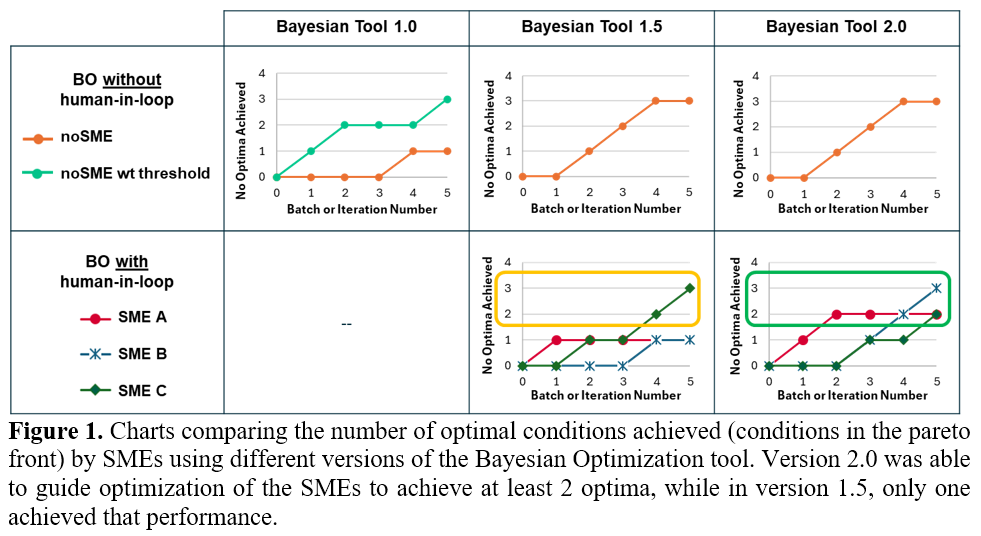
Initial results showed no single approach consistently outperformed others under equivalent lab time constraints. In the case of BO, human intervention in the optimization path was generally positive for better results, but not in all cases. Further tune of the BO algorithm increased the consistency of the tool to reliably achieve two out of four optimal reactions conditions from the Pareto front (Figure 1), and to be more resilient to human inputs, mitigating potential biases.
This study demonstrates the benefit of a hybrid approach integrating computational efficiency with SME expertise to accelerate process chemistry development.
References:
- Asprion, N.; Böttcher, R.; Mairhofer, J.; Yliruka, M.; Höller, J.; Schwientek, J.; Vanaret, C.; Bortz, M. Implementation and Application of Model-Based Design of Experiments in a Flowsheet Simulator. Chem. Eng. Data 2020, 65 (3), 1135–1145.
- Shields, B. J.; Stevens, J.; Li, J.; Parasram, M.; Damani, F.; Alvarado, J. I. M.; Janey, J. M.; Adams, R. P.; Doyle, A. G. Bayesian Reaction Optimization as a Tool for Chemical Synthesis. Nature 2021, 590 (7844), 89–96.