2025 AIChE Annual Meeting
Exploring the Mechanical and Structural Properties of Bombyx Mori Hydrogels Formed By Electrogelation
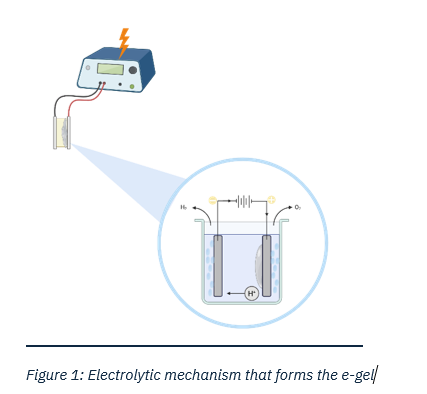
Building on these insights, we are exploring electro-gelation (e-gels) as a complementary method for rapid silk hydrogel formation,4-6 leveraging the formation of α-helices rather than β-sheets. The α-helix formation is desirable as it is a much faster gelation process that forms a softer, more elastic, and reversible gel that is desirable for applications like cell scaffolding. By applying a direct current across silk fibroin solutions, localized pH decreases below the isoelectric point, triggering gelation through a shift in ion diffusion. The first step in this process focused on the development of an electrogelation set-up in our laboratory, based on designs inspired by prior silk literature4-6 and the fuel cell community.7-8 We prepared regenerated Bombyx mori silk fibroin solutions, pre-conditioned them at 60 °C, and applied an electric field across electrodes to form silk fibroin e-gels. The resulting materials were characterized using SEM, FTIR, UV–vis spectroscopy, and shear rheology. These data demonstrate that gelation parameters, such as applied voltage, solution pH, and silk molecular weight, can strongly influence the transparency, secondary structure, and stiffness of the resulting hydrogels. Future work aims to scale up the gelation process, using a larger cell with circular geometry to increase the sample size. This scale-up will allow us to obtain better mechanical data on the e-gels. Together, this work compares fibroin processing and hydrogel assembly, expanding opportunities to engineer silk hydrogels for biotechnology and biomedical applications.
References
- Rockwood DN, Preda RC, Yucel T, Wang X, Lovett ML, Kaplan DL. Materials fabrication from Bombyx mori silk fibroin. Nat Protoc. 2011;6(10):1612-31. Epub 20110922. doi: 10.1038/nprot.2011.379. PubMed PMID: 21959241; PMCID: PMC3808976.
- Pacheco MO, Aikman EL, Bagnis HK, Gerzenshtein IK, Truong TD, Stoppel WL. Degumming Time Governs Self-Assembled Silk Fibroin Hydrogel Properties through Molecular Weight and Amino Acid Composition. Biomacromolecules. 2025;26(8):5069-85. Epub 20250725. doi: 10.1021/acs.biomac.5c00506. PubMed PMID: 40709791.
- Partlow BP, Hanna CW, Rnjak-Kovacina J, Moreau JE, Applegate MB, Burke KA, Marelli B, Mitropoulos AN, Omenetto FG, Kaplan DL. Highly tunable elastomeric silk biomaterials. Adv Funct Mater. 2014;24(29):4615-24. Epub 2014/11/15. doi: 10.1002/adfm.201400526. PubMed PMID: 25395921; PMCID: PMC4225629.
- Lin Y, Xia X, Shang K, Elia R, Huang W, Cebe P, Leisk G, Omenetto F, Kaplan DL. Tuning Chemical and Physical Cross-Links in Silk Electrogels for Morphological Analysis and Mechanical Reinforcement. Biomacromolecules. 2013;14(8):2629-35. Epub 2013/07/19. doi: 10.1021/bm4004892. PubMed PMID: WOS:000323143700021; PMCID: PMC3767971.
- Leisk GG, Lo TJ, Yucel T, Lu Q, Kaplan DL. Electrogelation for Protein Adhesives. Advanced Materials. 2010;22(6):711-+. Epub 2010/03/11. doi: 10.1002/adma.200902643. PubMed PMID: WOS:000274910200007.
- Kojic N, Panzer MJ, Leisk GG, Raja WK, Kojic M, Kaplan DL. Ion Electrodiffusion Governs Silk Electrogelation. Soft Matter. 2012;8(26):2897-905. Epub 20120528. doi: 10.1039/C2SM25783A. PubMed PMID: 22822409; PMCID: PMC3399521.
- Cross, E.R. The electrochemical fabrication of hydrogels: a short review. SN Appl. Sci. 2, 397 (2020). https://doi.org/10.1007/s42452-020-2194-5
- Chen, J.; Wang, X.; Li, Y.; Dai, R.; Wang, Z. Conductive nanofiltration membrane with a hydrogel coated stainless steel mesh support for electrically enhanced fouling mitigation potential. Environ. Sci.: Water Res. Technol., 2022, 8, 2652–2662