2025 AIChE Annual Meeting
(522c) Exploiting Heat Transfer Limitations in Carbon Capture with Microthermometry Via Upconverting Nanoparticles
Authors
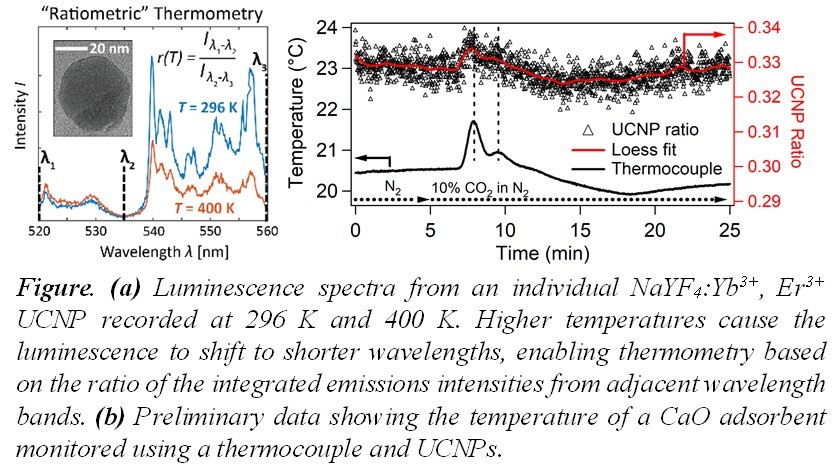
Our in situ microthermometry technique overcomes the averaging effects of conventional temperature sensors and enables measurement of localized thermal gradients by exciting the UCNPs with near-infrared light and measuring the intensity ratio of a pair of closely spaced green bands for reliable temperature readings, Figure. Under external heating, UCNP ratio closely tracks the thermocouple reading, confirming minimal formation of thermal gradients. We then use CO oxidation as a probe reaction to generate heat on the catalyst surface to differentiate between localized and bulk heating. Upon running CO oxidation, we observe a sharp spike in the measured UCNP ratio, above the bulk thermocouple reading, indicating that the exotherm of CO oxidation creates localized hot spots at the Pt-based active sites. We observe that the localized hot spots accelerate CO2 desorption, supporting our hypothesis that exothermic CO oxidation drives CO2 desorption at faster rates than bulk heating.
Our findings highlight how microscale thermal gradients can be harnessed to accelerate CO2 desorption in DFMs, providing insight into the complex mechanism of combined reaction and desorption. By correlating localized temperatures with real-time CO2 adsorption and desorption, we establish a framework for engineering future catalytic reactors that strategically couple active sites and adsorbents to enable more energy efficient carbon capture and utilization.