2025 AIChE Annual Meeting
(671g) Experimental Validation of Centrifugal Reverse Osmosis (CRO) for Desalination Near Local Thermodynamic Equilibrium
Authors
Tzyy Haur Chong, Nanyang Technological University
Lee Nuang Sim, Nanyang Technological University
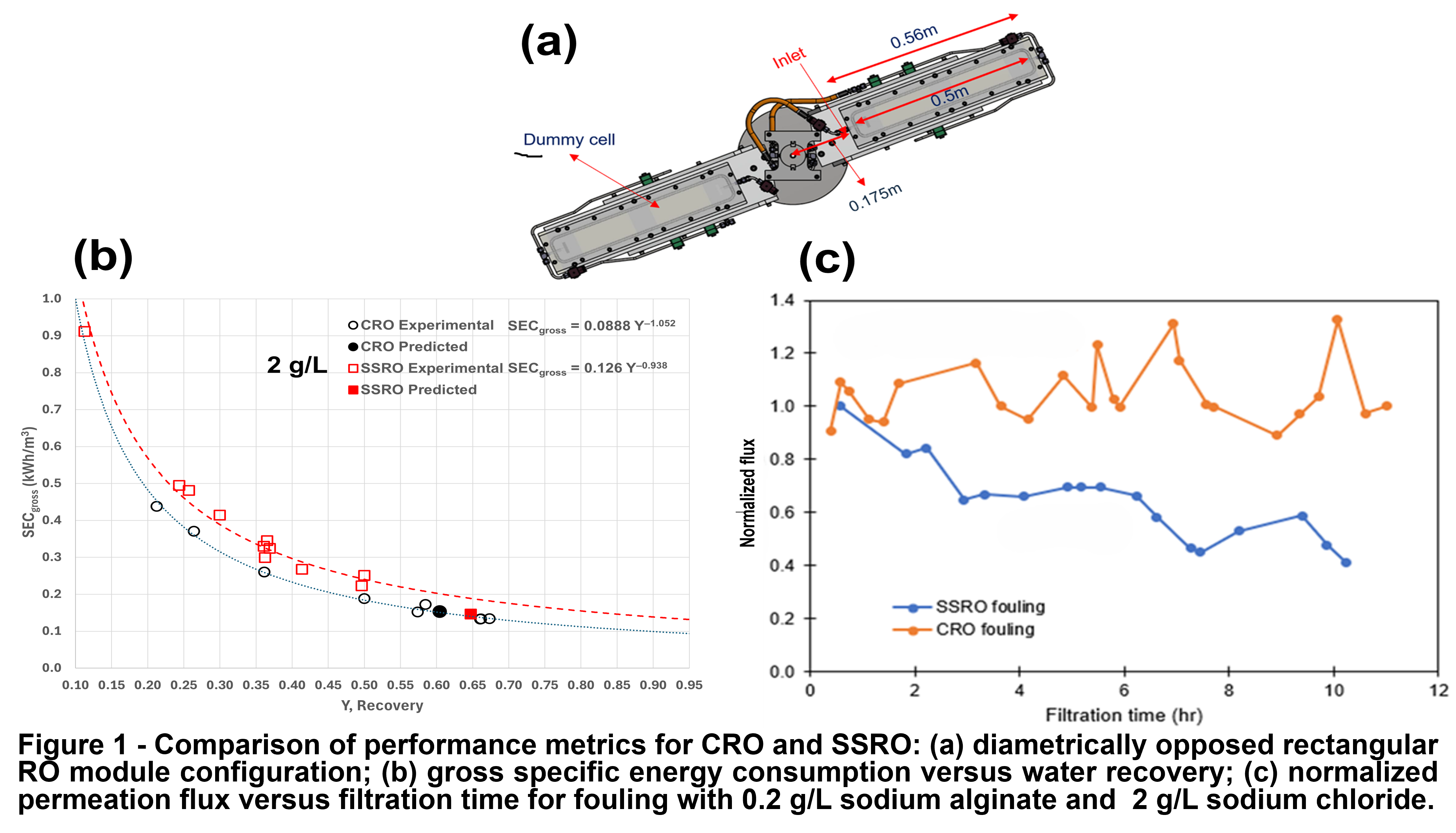
Less than 0.008% of our freshwater resources are available for our current population of 8 billion people. The only way to increase our freshwater resources is via desalination of seawater or inland brackish water. The average cost of obtaining freshwater via desalination by reverse osmosis (RO) is twice that of freshwater resources but can be as much as ten times higher. This cost would be reduced significantly if RO could be operated at the thermodynamic restriction defined by local thermodynamic equilibrium between saltwater and pure water across the membrane. However, this would require an infinite number of membrane stages to achieve the desired water recovery. Operation close to local thermodynamic equilibrium is possible via the novel centrifugal reverse osmosis (CRO) process that rotates the membrane module(s) to progressively increase the transmembrane pressure (TMP) with increasing radial distance from the axis-of-rotation. In prior presentations and a published paper, the concept of CRO was proved via an idealized model that ignores all irreversibilities owing to concentration polarization, membrane fouling, membrane compaction, and pressure losses in the flow channels and through the membrane. This paper discusses the first experimental validation of CRO, whose configuration is shown in Fig. 1a. Diametrically opposed, counterbalancing, rectangular membrane modules with flat sheet RO membranes are attached to a central hollow rotating shaft that is also the inlet feed tube. The experiments were done at 300 rpm, 4 bar maximum transmembrane pressure (TMP), and 2 g/L saline water feed concentration, using an RO membrane with a measured salt rejection of 88%; the rejection is less than usual owing to operation at a lower TMP than for seawater desalination. The open circles in Fig. 1b show the measured SECgross (kWh/m3) versus the fractional water recovery Y for CRO that decreases with increasing Y owing primarily to concentration polarization. For a specified membrane rejection, rotation rate, feed pressure, and feed concentration, the idealized model that ignores all irreversibilities predicts the unique SECgross shown by the solid circle. A surprising observation is that there are two data points at higher water recoveries and lower SECgross values than the idealized model prediction. This indicates that another mechanism is operative in CRO that reduces the concentration polarization. The open squares in Fig. 1b show the measured SECgross versus Y for conventional single-state RO (SSRO). CRO reduces the SECgross relative to SSRO by as much as 27.8% at the highest recovery. The idealized SSRO model predicts the SECgross shown by the solid square. All the measured water recovery values are lower and the corresponding SECgross values are higher than the predicted idealized performance for SSRO implying that the mechanism mitigating concentration polarization in CRO is not operative in SSRO. This mitigating mechanism also significantly reduces membrane fouling as shown in Fig. 1c. For a foulant concentration of 0.2 g/L sodium alginate and 2 g/L sodium chloride, SSRO shows a progressive flux decline. In contrast, CRO maintains a constant flux within experimental error over 12 hours. The mechanism operative in a CRO module that reduces concentration polarization and mitigates membrane fouling will be explained in this presentation.