2025 AIChE Annual Meeting
(392bg) Exact Hull Reformulation for Quadratically Constrained Generalized Disjunctive Programs
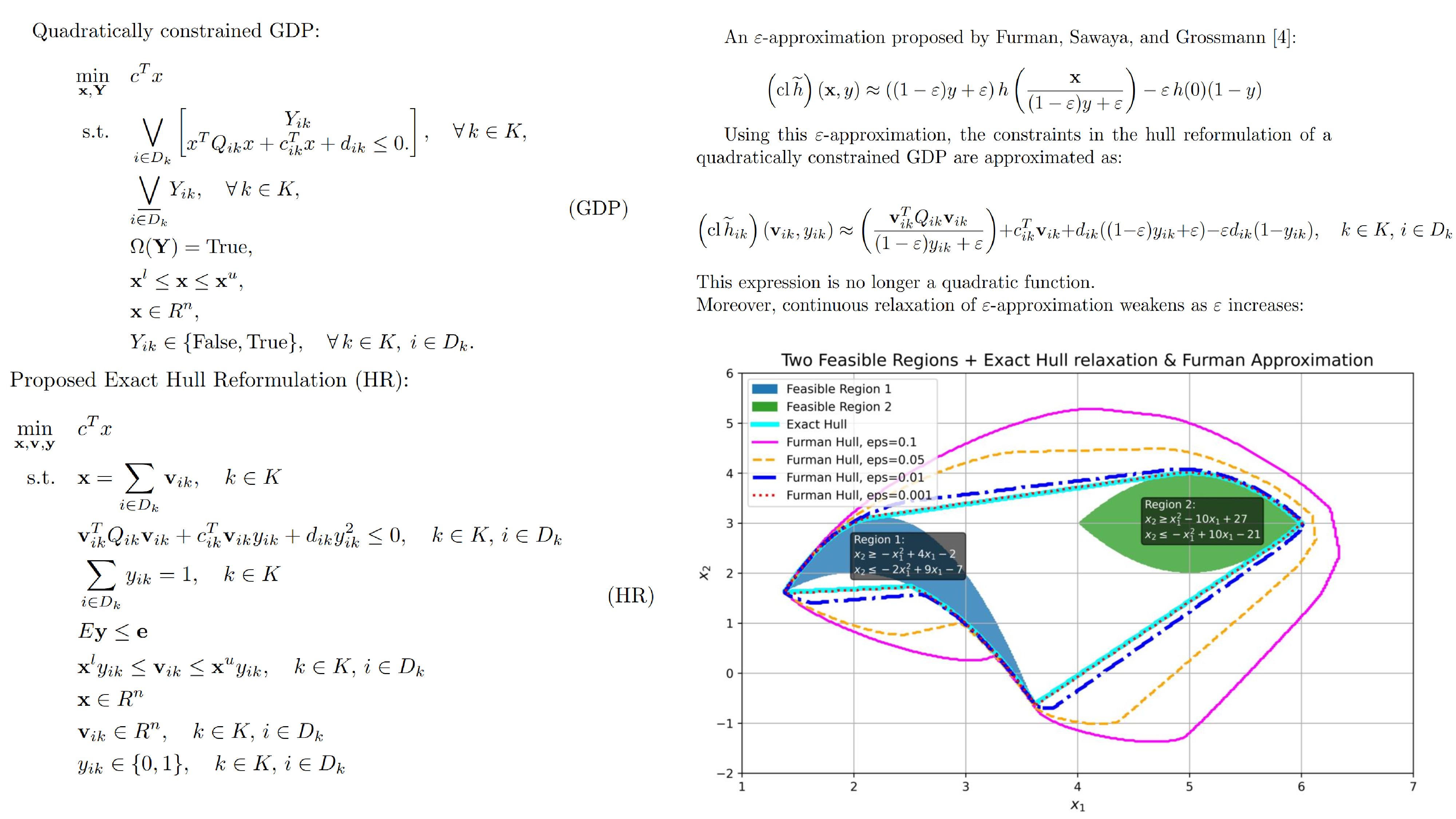
In this work, we show that a Quadratically Constrained GDP can be reformulated into an exact hull representation that preserves the quadratic structure of the original problem. Specifically, constraints of the form xTQx+cTx+d≤0 within a disjunction in hull reformulation approach can be replaced by vTQv+cTvy+dy2≤0, where v is a disaggregated variable and y is the binary variable associated with the disjunct. Therefore, we propose constructing exact hull reformulations of GDP with quadratic constraints, including non-convex quadratic constraints, avoiding the need for ε-approximation. We implement this approach in Pyomo [5] and benchmark it across several GDP-based problems previously reported in the literature, such as a Continuous Stirred-Tank Reactor (CSTR) network design [6], a constrained layout optimization, k-means clustering, and a set of randomly generated test instances [3]. All models are solved using Gurobi [7], a leading solver for Mixed-Integer Quadratically Constrained Programs (MIQCP)[8]. Our computational results demonstrate that the exact reformulation enables a more efficient solution to quadratic GDP problems compared to the ε-approximation approach. For instance, in the largest tested case involving a CSTR network [6] with 20 reactors, the exact hull reformulation achieved a 1.8x reduction in solution time relative to the ε-approximation method proposed by Furman, Sawaya, and Grossmann [4], which is the default option for handling any nonlinear constraints in Pyomo when applying hull reformulation. This performance gain highlights the practical advantage of preserving the quadratic structure and avoiding approximation-based complexity.
This study underscores the value of customized reformulations in GDP-based optimization. The proposed exact hull reformulation enables faster and more scalable solutions to quadratic GDP problems, offering practical advantages in real-world applications across Process Systems Engineering and other domains. While prior work has discussed the benefits of exact analytic hull reformulations for specific functions such as convex quadratics [9], most of the existing literature has focused primarily on convex disjunctive sets. In contrast, this work extends the scope by demonstrating the feasibility and impact of exact hull reformulations for disjunctive sets that are not necessarily convex. By enabling broader applicability and enhancing solver performance without approximation overhead, this contribution provides a novel and practically significant advancement in the use of GDP for modeling and solving complex optimization problems.
[1] I. E. Grossmann and F. Trespalacios, “Systematic modeling of discrete-continuous optimization models through generalized disjunctive programming,” AIChE J., vol. 59, no. 9, pp. 3276–3295, 2013, doi: 10.1002/aic.14088.
[2] I. E. Grossmann and S. Lee, “Generalized Convex Disjunctive Programming: Nonlinear Convex Hull Relaxation,” Comput. Optim. Appl., vol. 26, no. 1, pp. 83–100, Oct. 2003, doi: 10.1023/A:1025154322278.
[3] D. E. Bernal Neira and I. E. Grossmann, “Convex Mixed-Integer Nonlinear Programs Derived from Generalized Disjunctive Programming using Cones,” Feb. 19, 2024, arXiv: arXiv:2109.09657. doi: 10.48550/arXiv.2109.09657.
[4] K. C. Furman, N. W. Sawaya, and I. E. Grossmann, “A computationally useful algebraic representation of nonlinear disjunctive convex sets using the perspective function,” Comput. Optim. Appl., vol. 76, no. 2, pp. 589–614, Jun. 2020, doi: 10.1007/s10589-020-00176-0.
[5] M. L. Bynum et al., Pyomo — Optimization Modeling in Python, vol. 67. in Springer Optimization and Its Applications, vol. 67. Cham: Springer International Publishing, 2021. doi: 10.1007/978-3-030-68928-5.
[6] D. A. Liñán, D. E. Bernal, L. A. Ricardez-Sandoval, and J. M. Gómez, “Optimal design of superstructures for placing units and streams with multiple and ordered available locations. Part I: A new mathematical framework,” Comput. Chem. Eng., vol. 137, p. 106794, Jun. 2020, doi: 10.1016/j.compchemeng.2020.106794.
[7] “Gurobi Optimization, LLC.,” Gurobi Optimization. Accessed: Mar. 27, 2025. [Online]. Available: https://www.gurobi.com/
[8] T. Karia, C. S. Adjiman, and B. Chachuat, “Assessment of a two-step approach for global optimization of mixed-integer polynomial programs using quadratic reformulation,” Comput. Chem. Eng., vol. 165, p. 107909, Sep. 2022, doi: 10.1016/j.compchemeng.2022.107909.
[9] O. Günlük and J. Linderoth, “Perspective Reformulation and Applications,” in Mixed Integer Nonlinear Programming, vol. 154, J. Lee and S. Leyffer, Eds., in The IMA Volumes in Mathematics and its Applications, vol. 154. , New York, NY: Springer New York, 2012, pp. 61–89. doi: 10.1007/978-1-4614-1927-3_3.