2025 AIChE Annual Meeting
(355e) Evaluation of Hydrogel Networks By Complementary Lab-Scale Methods: Hyperelastic Modeling and Time-Domain NMR
Two hydrogels with quite different network structures, widely used in various applications, including 3D printing, are examined: poly(ethylene glycol) diacrylate (PEGDA) and thiol-ene crosslinked dextran. PEGDA hydrogels were synthesized from monomers with molecular weights ranging from 700 to 4000 Da by photopolymerization at polymer concentrations of 7% to 30 wt.% in water. Dextran gels (Dextran modified with pentanoate groups (PDEX) and dextran hydrogels crosslinked with divinyl sulfone (DVSDEX)) were prepared by the functionalization of dextran with pentanoate groups, which enables crosslinking through a photopolymerized thiol-ene reaction with dithiothreitol.
Hydrogels are generally assumed to follow the classic neo-Hookean elastic model under compression or tension, from which network mesh size is estimated. However, not all gels fit this model well, often with deviations increasing with strain. Multiple-parameter models can accurately fit data over a broader range of strains and provide additional structural information beyond the standard model. While neo-Hookean and the Mooney-Rivlin models are the most often used in hydrogels, there are other models that have seen recent use. Specifically, in addition to the neo-Hookean and Mooney-Rivlin models, the Ogden, Rubinstein-Panyukov, and Localization models are examined. Broadly, these models fall into two main categories: mechanics-derived, including the neo-Hookean, Mooney-Rivlin, and Ogden models, and those derived from polymer network physics theory, including the Localization and Rubinstein-Panyukov models,. While the multi-parameter mechanics models seek to represent the mechanics behavior of the hydrogels better, they do not provide a greater understanding of the polymer’s network structure. The models derived from polymer physics, on the other hand, aim to interpret deviations from neo-Hookean behavior and provide insights into the network structure.
The data for these models was obtained from unconfined uniaxial compression of gel disks using a RSA3 dynamic mechanical analyzer. Gel disks were placed between two lubricated parallel plates and compressed at a rate of 0.005 mm/s until fracture. This stress-strain data was then used with the models as mentioned earlier. For PEGDA, molecular weights and concentrations were varied. As the polymer concentration at hydrogel formation increases for PEGDA gels, both the covalent and entanglement contributions to the modulus increase. For the dextran hydrogels, a range of molecular weights and polymer concentrations were tested, as well as pentanoate functionalization and thiol:ene ratio. As the thiol:ene ratio was varied, the covalent contributions increased, but the entanglement contributions were less strongly affected. When the polymer concentration at formation was increased, however, both contributions increased.
LF-NMR is an experimentally simple, quick, and non-destructive technique that has the potential to determine a distribution of characteristic length scales in hydrogels. Its speed and experimental simplicity suggest a potential use for the rapid characterization of hydrogel formulations in the development of applications. These tests were performed by loading several discs of the hydrogel stacked in a small sample tube and cooling to 21° C. After which they were loaded into the machine where they were subjected to a magnetic field
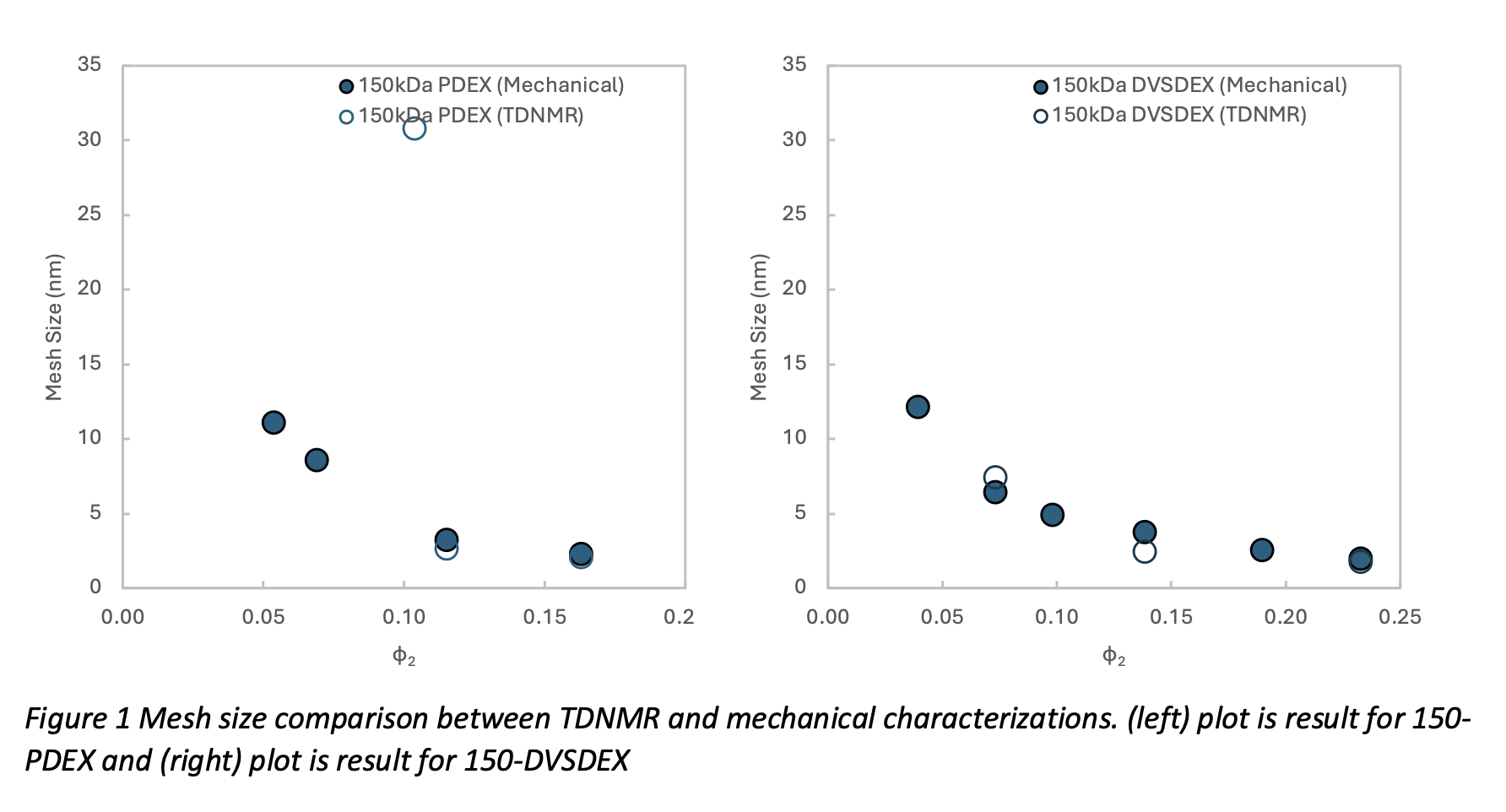
Proton relaxation times in the time domain (T2) are related to surface-solvent interactions, and theory can be used to convert the T2 distributions into network mesh sizes. PEGDA gels were characterized in solution before polymerization, after polymerization, and after equilibration with water. A noticeable reduction in T2 was observed for PEGDA gels upon cross-linking, indicating the mobility constraint imposed by the formation of the hydrogel network. The mesh size ξ calculated from TDNMR and mechanical characterization for dextran and PEGDA hydrogels matched well over the range of formulations tested, using a fiber radius parameter obtained from size exclusion data using the Ogden model. This important result demonstrates that the experimentally simpler TDNMR method yields mesh sizes comparable to those obtained using the standard method of modulus measurement or by more advanced methods such as SAXS or SANS.
In terms of the mechanical models examined the neo-Hookean, Mooney-Rivlin, Ogden, Rubinstein-Panyukov, and Localization models were applied to uniaxial deformation. Their fits were assessed against plots of reduced modulus versus inverse extension ratio to model deformation over a broader range and gain additional insight into the gel network structure. The Ogden model performed best in terms of fitting stress-strain curves to higher ratios and the reduced modulus plots over the range of formulations. In contrast, Localization and Rubinstein-Panyukov models fit both well above c*. Both models captured low-strain behavior and captured the curvature and maxima in these plots. The Mooney-Rivlin model fit the stress-strain curves but was unable to fit the reduced modulus plots. Localization and Rubinstein-Panyukov models suggested that entanglements play significant roles at all strains, and that their contribution decreases as network concentration increases. This work highlights the value
of employing two-parameter models to comprehend the deformation behavior of hydrogels.
In addition to the mechanical testing, solute partition, and LF NMR also provided additional insight into the structure of hydrogels. PDEX created from the thiol-ene reaction showed a smaller mesh size than DVSDEX hydrogels. This smaller mesh size offers additional support, and PDEX creates a more tightly crosslinked hydrogel network than DVSDEX. Higher crosslink density and higher volume fraction both lead to a lower mesh size calculation. As PDEX exhibits both higher volume fraction and crosslink density at the same polymer weight fraction at synthesis compared to DVSDEX, the mathematical expression will result in a tight mesh size. However, when the mesh sizes of the two hydrogel types are compared at the same volume fraction, the difference between the two types is minimized, and both follow a very similar trend. Mesh sizes, when determined by mechanical characterization and LF NMR as a function of polymer content for PEGDA hydrogels, exhibited the same trends and magnitudes, agreeing with published data using small-angle X-ray and neutron scattering, as seen in Figure 1, which confirms the validity of using the LFNMR technique. In addition to providing an alternative to mechanical testing, LFNMR offers a method for measuring mesh size without requiring destructive sample preparations, such as SEM, or access to facilities like SAXS and SANS.