2025 AIChE Annual Meeting
(390aj) Equitable, Sustainable, and Safer Process Design: Game Theory-Informed Social Life Cycle Assessment for Safety Governance
Authors
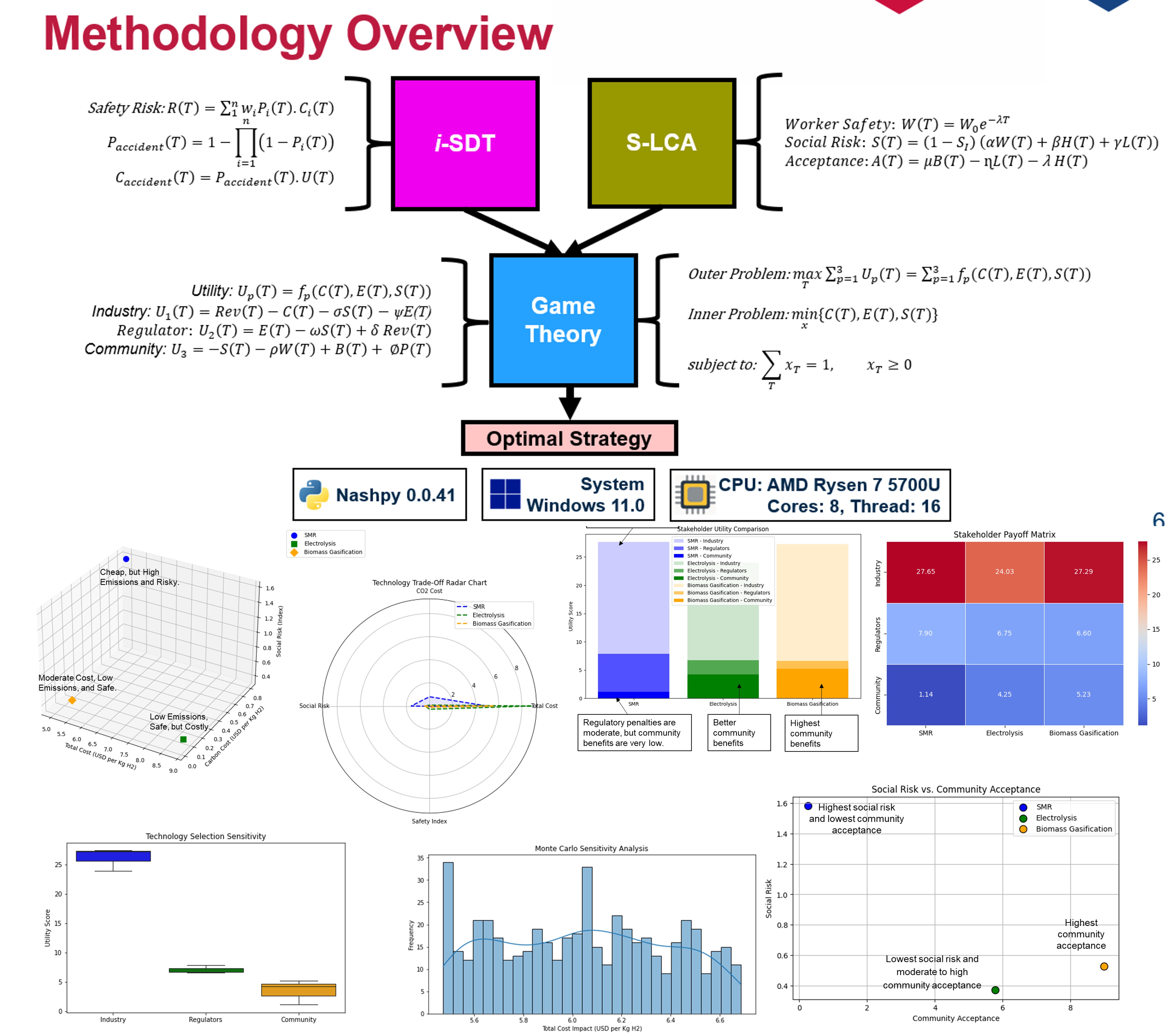
Our methodology combines three tools to form a robust optimized framework. First, we utilize in-house developed modified i-SDT, a probabilistic, data-driven, property-based tool, to perform inherently safer design evaluations across the technologies involved [2,3]. This module quantifies safety risks by estimating accident probabilities (e.g., explosions, toxic releases) and consequences through hybrid mechanistic and data-driven modeling. i-SDT enables a proactive safety assessment which is a critical parameter for stakeholders to measure true safety risk index of that technology. Next, an S-LCA is conducted through newly developed unified life cycle sustainability assessment (LCSA) framework on the selected technologies [4], focusing on social risk factors such as worker safety, community health, and employment impacts. This assessment quantifies social risks using both primary and secondary data to provide a comprehensive social impact profile for each technology. This helps the stakeholders to take decisions in a quantified manner and find out the hidden potential social costs. Finally, we integrate game theory to model the strategic interactions among stakeholders, analyzing equilibrium strategies for decisions related to safety investments, transparency in risk communication, and community engagement [4]. This game-theoretic approach incorporates parameters such as regulatory compliance, reputational concerns, and public perception, allowing for an equilibrium-based analysis that identifies optimal strategies for each stakeholder group and brings fairness in stakeholder decision making. By combining i-SDT’s hybrid modeling with S-LCA and game theory, our framework captures both the probabilistic and social dimensions of process safety in a holistic manner. Monte Carlo simulations and bilevel optimization are incorporated to evaluate trade-offs across cost, safety, and sustainability under uncertainty.
The framework’s robustness is validated through two different case studies with inherent process trade-offs:
- Hydrogen Production Technologies: Comparative analysis of Steam Methane Reforming (SMR), Electrolysis, and Biomass Gasification reaffirms cost-safety-environment trade-offs (e.g., SMR’s low cost [$4.14/kg] vs. Electrolysis’s high safety [index: 0.88] vs. Biomass Gasification’s low operational cost [$1.90/kg]).
- Carbon Capture and Storage (CCS): Trade-offs emerge between pre-combustion (high efficiency, elevated leakage risk) and post-combustion (lower efficiency, safer geological storage) technologies, with cost disparities ($52-114/ton CO2) influencing regulatory compliance strategies.
By examining the multi-dimensional trade-offs between safety, cost, and social equity, the framework reveals persistent misalignments among stakeholders. In the hydrogen sector, industries continue to favor cost-effective but high-risk technologies like SMR because it provides them highest payoff (27.44), while communities bear the consequences with the lowest payoff (1.14). Nash equilibrium analysis highlights these trade-offs and identifies a Pareto optimal mix of hydrogen production (55% SMR, 30% Electrolysis and 15% Biomass Gasification) that balances the competing interests, and CCS policy portfolios balancing tax incentives and leak monitoring. Monte Carlo analyses further quantify volatility, showing CCS cost variances (±18%) tied to geopolitical feedstock uncertainties and for hydrogen production the mean total cost is $6.45/kg and $1.70 being the standard deviation. By addressing sector-specific trade-offs through a unified lens, this framework advances adaptive governance strategies that harmonize safety, equity, and resilience. Its applicability across energy, chemicals, and healthcare underscores the critical role of socio-technical systems in achieving sustainable industrial transitions. The framework demonstrates the necessity of diversified, policy-informed strategies to mitigate these risks, promoting socially responsible and technically robust process safety governance.
References:
- Mannan M, Sarker N, Al-Ghamdi S, Eljack F, Kazi M-K. Socially Responsible Process Safety: Game Theory-Informed Social Life Cycle Assessment for Equitable Decision-Making. 2025 AIChE Spring Meeting, Dallas, TX, USA. (https://aiche.confex.com/aiche/s25/meetingapp.cgi/Paper/702040)
- Eljack F, Kazi M-K, Kazantzi V. Inherently safer design tool (i-SDT): A property-based risk quantification metric for inherently safer design during the early stage of process synthesis. Journal of Loss Prevention in the Process Industries. 2019;57:280-90.
- Kazi M-K, Eljack F, Al-Sobhi SA, Kazantzis N, Kazantzi V. Application of i-SDT for safer flare management operation. Process Safety and Environmental Protection. 2019;132:249-64.
- Mannan M, Al-Ghamdi S, Kazi M-K. Game theory-informed blockchain framework for social life cycle assessment: Enhancing sustainability in Germanium extraction from PV scrap. 2024 AIChE Annual Meeting, San Diego, CA, USA. (https://aiche.confex.com/aiche/2024/meetingapp.cgi/Paper/691855).