2025 AIChE Annual Meeting
(709d) Enhanced Yaw Reliability in NREL 5-MW Turbines Under Various Wind Conditions
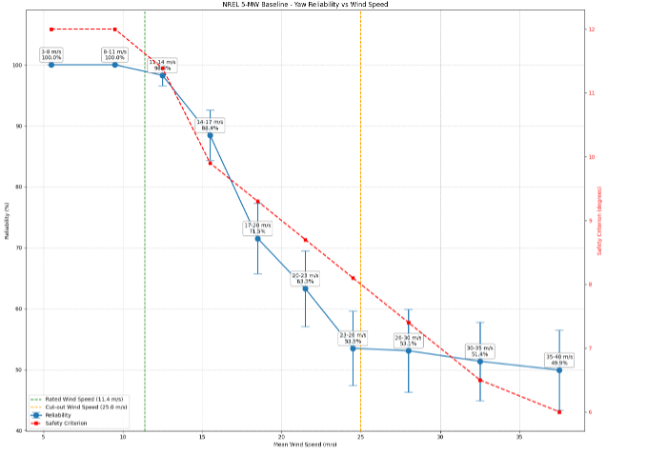
Latin Hypercube Sampling is employed to efficiently explore input uncertainties, while advanced statistical methods (empirical, lognormal, Weibull, Gamma, and bootstrap analyses) quantify the system's reliability against established safety criteria. Under typical conditions with wind speeds ranging from 3 m/s to 10 m/s characteristic of the moderate wind regimes encountered in the Gulf region and the yaw system consistently operates within prescribed safety thresholds. In contrast, under storm conditions common to the region, where wind speeds can exceed 25 m/s, the system is subjected to elevated aerodynamic loads and rapid fluctuations. The reliability (blue markers and error bars) remains near or above 90–100% for mean wind speeds up to about 14 m/s, reflecting robust yaw performance under moderate Gulf wind conditions. As wind speed increases beyond rated values and approaches the cut‑out region, reliability progressively declines to around 50% by 35 m/s, highlighting the system’s susceptibility to extreme loads and rapid yaw misalignments. The safety criterion (red dashed line, right axis) underscores the critical threshold for yaw angles, with higher wind speeds causing more frequent excursions near or beyond this limit. In these severe scenarios, our enhanced yaw control strategy with aggressive brake torque logic and dynamic damping adjustments play a critical role in maintaining yaw alignment within tighter safety margins, although increased variability in maximum yaw angles indicates potential challenges that warrant further optimization to mitigate mechanical fatigue.
Overall, this simulation framework not only evaluates the performance of an aggressive yaw control strategy across a wide spectrum of operational scenarios but also provides robust visualizations and statistical summaries to inform operational decision-making. The methodology contributes to the broader field of energy systems modeling, control, and optimization, offering valuable insights for integrating renewable technologies into decarbonization strategies and supporting a more resilient, sustainable energy infrastructure.