2025 AIChE Annual Meeting
(449a) Enhanced Extraction of Dermal Interstitial Fluid Using Microneedles By Increasing Skin Water Content.
Authors
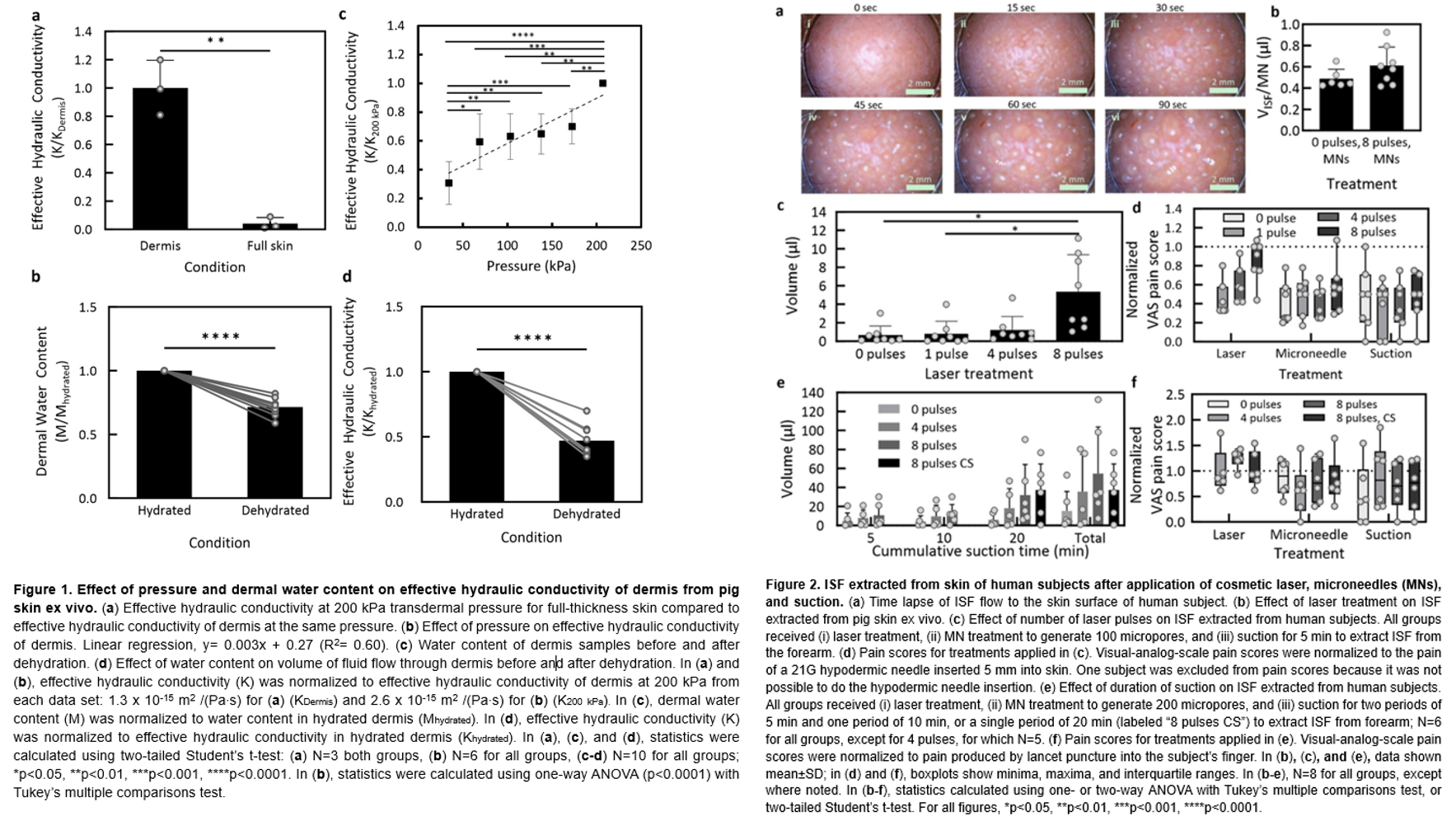
To test this hypothesis, we did studies in pig skin ex vivo and found that increasing skin water content increased dermal hydraulic conductivity by ~50% (Figure 1), and ISF extraction 7-fold (Figure 2). We tested effective hydraulic conductivity of the dermis compared to that of skin (epidermis and dermis), and found that the effective hydraulic conductivity of the dermis was ~20-fold higher than that of full-thickness skin (Figure 1a). The hydraulic conductivity of the skin also increased 3-fold with pressure, going from ~0.9 x 10⁻¹⁵ m2/(Pa∙s) at 33 kPa to ~2.6 x 10⁻¹⁵ m2 /(Pa∙s) at 200 kPa (Figure 1b). The hydraulic conductivity also increased with skin water content, increasing by a factor of 2 when hydration increased by 30% (Figures 1c and 1d).
We leveraged these findings to develop an ISF extraction method involving laser pretreatment of skin to increase water content, microneedle puncture of skin to provide pathways for ISF flow, and suction to convectively drive ISF flow (Figure 2a). Using this method, we extracted averages ISF volumes > 5 μl when applying suction for 5 min (Figure 2c), and up to 55 µl (Figure 2e) when applying suction for 20 min from the skin of human subjects. These volumes represents up to a 10-fold increase compared to previous results. The method did not increase pain in humans relative to application of a finger stick (Figures 2d and 2f). We also note that the method did not work ex vivo, consistent with our expectation that the mechanism involves a physiological reaction (Figure 2b).
Overall, the laser-microneedle-suction system provides a simple method to sample tens of microliters of ISF from skin, which is enough for use in many point-of-care diagnostic tests. This system could enable study of ISF biomarkers and develop ISF-based diagnostics for clinical medicine.