2025 AIChE Annual Meeting
(258a) Energy Utilization Strategies in Lignocellulosic Biorefineries
Upgrading biogas to biomethane is one such alternative 4. Biomethane, a renewable fuel, can be directly injected into natural gas pipelines. However, research on capturing and upgrading biogas to biomethane in second-generation biorefinery design remains limited. Lignin valorization is another promising alternative, with considerable research focused on studying various technologies and products, placing special emphasis on advancing catalytic approaches to enhance key economic drivers5,6. Utilizing the surplus chemical energy in the side streams for heat generation further enables the integration of carbon capture and storage (CCS), which can significantly reduce GHG emissions7–9.
While these strategies have been proposed, it remains unclear which one is the best in terms of economic viability, environmental sustainability, and overall system performance; as well as under what incentive structure. Furthermore, it is unclear how the use of natural gas for CO2 capture impacts the economic potential and fossil-based emissions of biorefineries. Additionally, the impact of numerous factors (e.g., renewable energy and fuel incentives, CO2 sequestration credits, energy demand of co-product technologies, and co-product selling prices) is not fully understood.
To address this gap, we assess and compare different lignocellulosic biorefinery systems to identify key drivers, evaluate trade-offs, and draw insights into system performance. We study three co-production baseline systems: (1) surplus electricity generation (BEL), (2) upgrading biogas to biomethane (BBM), and (3) valorizing lignin into high value bioproduct (BLV). We examine carbon and energy flows, economic potential, carbon footprint (CF), as well as overall energy efficiency of these baseline systems. We then study a biorefinery with carbon capture (BCCS) and subsequently explore the implications of natural gas usage. Finally, we extend the scope of our study to investigate the impacts of key parameters on system economics and CF, and further explore options for CO2 mitigation by integrating carbon capture in the three baseline systems.
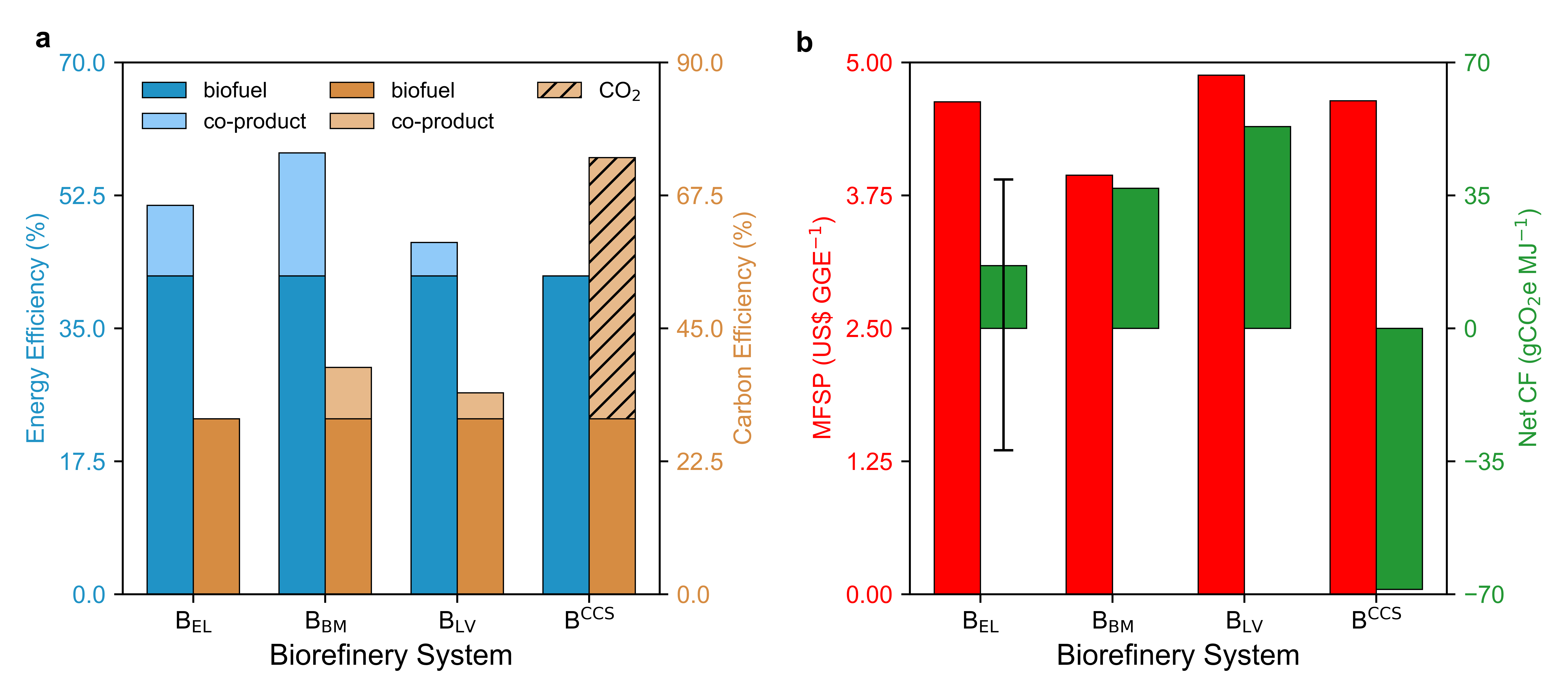
The attached figure shows the key metrics (energy efficiency, carbon efficiency, minimum fuel selling price, net carbon footprint) of the three co-production baseline systems, and the carbon capture system. We observe that from an energy perspective, the BBM system has the highest efficiency (~58%) due to biomethane’s high specific energy. The BCCS system has the highest carbon efficiency, but this is strongly linked to the efficiency of the capturing process. If we narrow down to the three co-production systems, the BBM system achieves the highest carbon efficiency.
From the economic viewpoint, the BBM system has the lowest minimum fuel selling price (MFSP) at US$3.94 GGE-1 mainly due to numerous financial incentives associated with selling biomethane, while the BLV system has the highest MFSP.
From a sustainability standpoint, the BCCS system has the lowest net CF. If we narrow down to the three co-production baselines, the BEL system exhibits the lowest CF, with a net value of 16.5 gCO2e MJ-1, followed by BBM (36.9 gCO2e MJ-1) and BLV systems (53.1 gCO2e MJ-1). The BEL offsets approximately 23.2 gCO2e MJ-1 of emissions (based on the average emission factor of the US electricity grid). However, if electricity sales result in emission offset from different power sources (coal, natural gas, nuclear, and diesel power plants), the amount displaced, and consequently the net CF, would vary as indicated by the black vertical line in the BEL net CF figure. Producing biomethane enables 2.8 gCO2e MJ-1 offset, while 11.6 gCO2e MJ-1 is displaced for acetic acid production via lignin valorization.
We also perform sensitivity analyses to determine how variations in key parameters impact the economics, carbon footprint, and overall system performance.
References
- Singh, N. et al. Global status of lignocellulosic biorefinery: Challenges and perspectives. Bioresour. Technol. 344, 126415 (2022).
- Humbird, D. et al. Process Design and Economics for Biochemical Conversion of Lignocellulosic Biomass to Ethanol: Dilute-Acid Pretreatment and Enzymatic Hydrolysis of Corn Stover. http://www.osti.gov/scitech/biblio/1013269 (2011).
- Davis, R. E. et al. Process Design and Economics for the Conversion of Lignocellulosic Biomass to Hydrocarbon Fuels and Coproducts: 2018 Biochemical Design Case Update; Biochemical Deconstruction and Conversion of Biomass to Fuels and Products via Integrated Biorefinery Pathways. NREL/TP--5100-71949, 1483234 http://www.osti.gov/servlets/purl/1483234/ (2018) doi:10.2172/1483234.
- Yang, M., Baral, N. R., Anastasopoulou, A., Breunig, H. M. & Scown, C. D. Cost and Life-Cycle Greenhouse Gas Implications of Integrating Biogas Upgrading and Carbon Capture Technologies in Cellulosic Biorefineries. Environ. Sci. Technol. 54, 12810–12819 (2020).
- Huang, K., Fasahati, P. & Maravelias, C. T. System-Level Analysis of Lignin Valorization in Lignocellulosic Biorefineries. iScience 23, 100751 (2020).
- Bartling, A. W. et al. Techno-economic analysis and life cycle assessment of a biorefinery utilizing reductive catalytic fractionation. Energy Environ. Sci. 14, 4147–4168 (2021).
- Geissler, C. H. & Maravelias, C. T. Analysis of alternative bioenergy with carbon capture strategies: present and future. Energy Environ. Sci. 15, 2679–2689 (2022).
- Hanssen, S. V. et al. The climate change mitigation potential of bioenergy with carbon capture and storage. Nat. Clim. Change 10, 1023–1029 (2020).
- Gabrielli, P., Gazzani, M. & Mazzotti, M. The Role of Carbon Capture and Utilization, Carbon Capture and Storage, and Biomass to Enable a Net-Zero-CO2 Emissions Chemical Industry. Ind. Eng. Chem. Res. 59, 7033–7045 (2020).