2025 AIChE Annual Meeting
(57c) Enabling Load-Flexible Fixed-Bed Reactor Operation with Core?Shell Catalyst Pellets
Authors
A critical issue is the occurrence of thermal runaways, which arise from the strong temperature dependence of reaction rates according to the Arrhenius law. Small variations in process conditions can lead to significant shifts in hot spot temperatures, reducing selectivity, accelerating catalyst deactivation or even causing material damage.
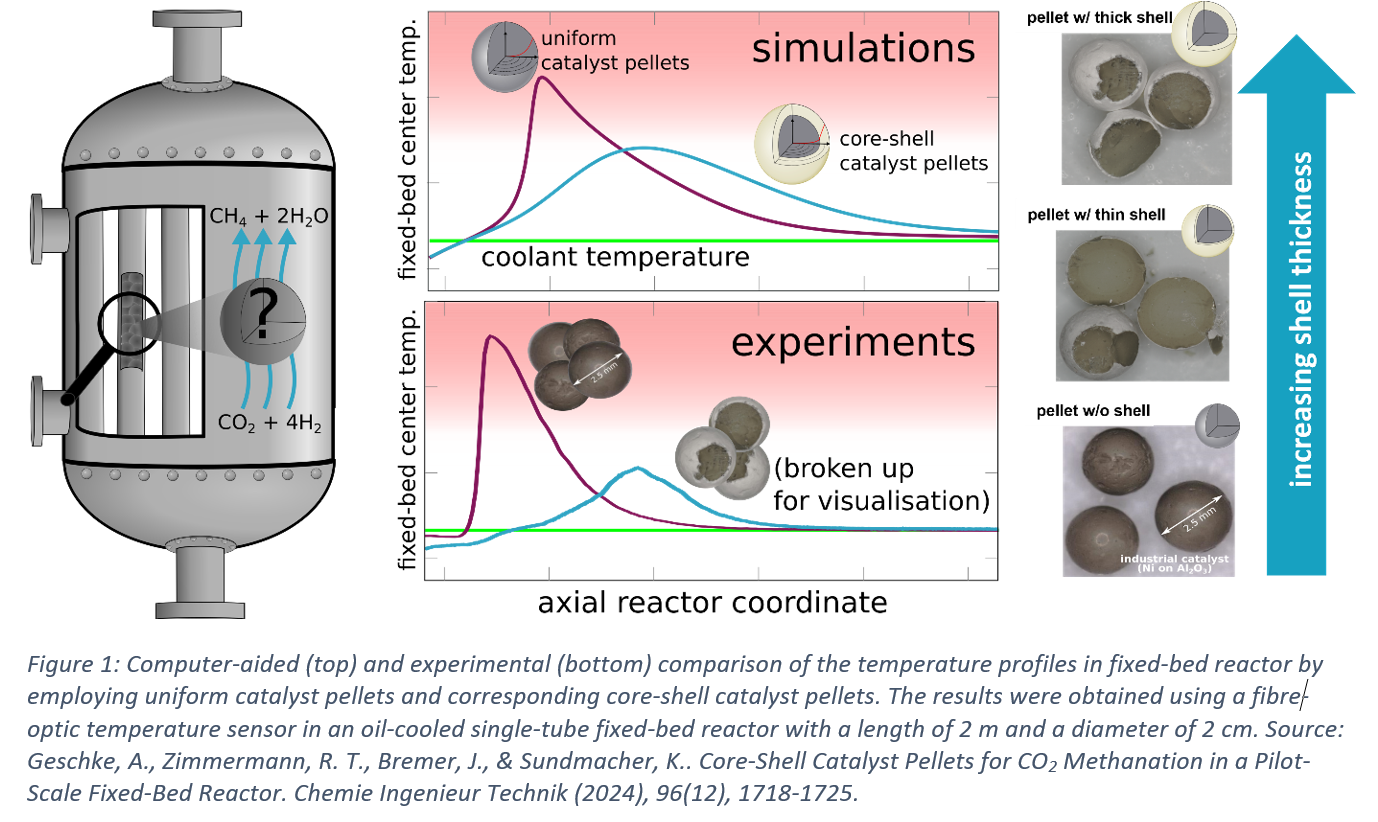
In this contribution, we present core-shell catalyst pellets. Core-shell catalyst pellets exhibit a catalytically active core and a porous, inert shell. The shell, produced, e.g., by fluidized bed coating of commercially available catalyst pellets, introduces a diffusion barrier that becomes rate-limiting at elevated temperatures. Using analytical equations, it is shown that this induces a shift from a reaction-controlled to a diffusion-controlled regime. As a result, the positive feedback between heat release and temperature rise is interrupted, stabilizing the temperature profile and preventing thermal runaway.
Experimental studies in an oil-cooled single tube reactor (length: 2 m, diameter: 2 cm) confirm the effectiveness of this approach. Compared to uniformly active catalyst pellets, core-shell configurations significantly reduce hot-spot temperatures while maintaining comparable conversions. The inert shell material - typically inexpensive aluminum oxide - can be tailored to specific process requirements, and the coated pellets can be used directly in existing reactor systems without further modifications. These results demonstrate that tailored core-shell catalysts offer suitable approach to load-flexible, safe, and efficient operation of fixed-bed reactors in dynamic energy systems.