2025 AIChE Annual Meeting
(52b) Elucidating Kinetics of Propane Activation on Pt-Based Electrocatalysts at Room Temperature in Aqueous Acidic Electrolyte.
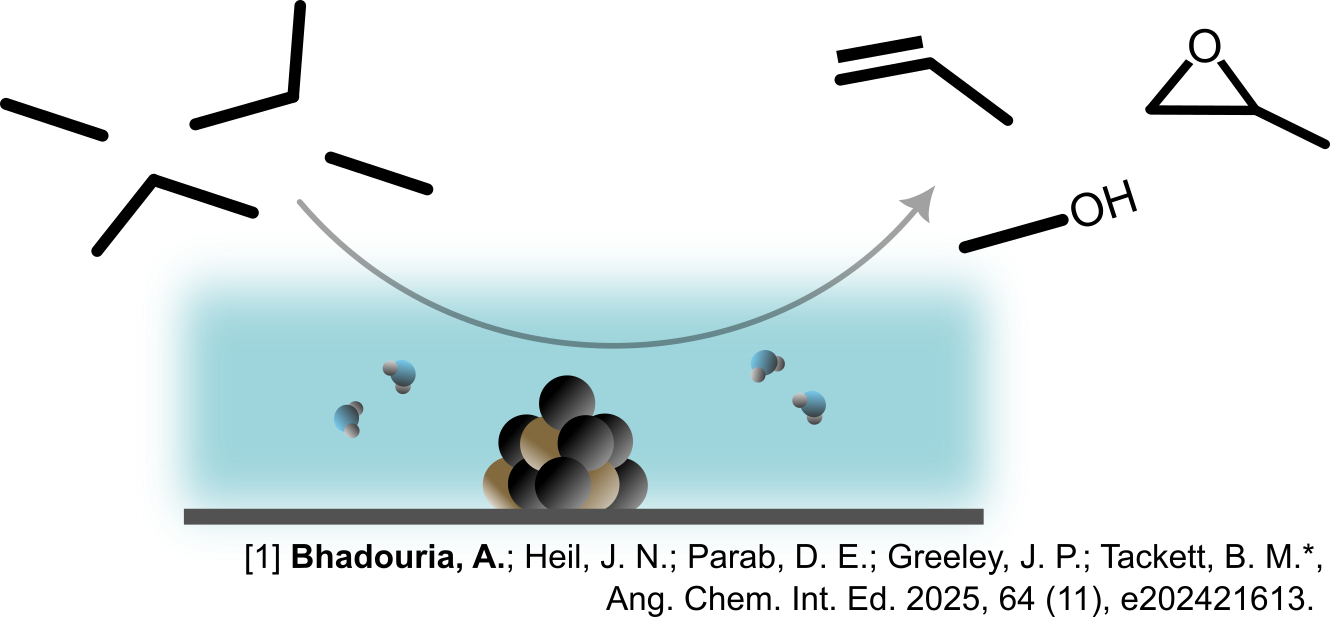
In this work, we extend our analysis to uncover propane adsorption and desorption kinetics on Pt. Kinetic analysis using coulometry was used to determine the dependence of adsorption rate on propane partial pressure and active site concentration, revealing reaction orders of 1 and 2, respectively. These findings enabled us to derive kinetic parameters and develop a microkinetic adsorption model consistent with the following scheme: an initial C—H activation step forming propane-derived adsorbate species, followed by the oxidation of H* adatoms to H⁺ ions. These kinetic parameters, consequently, revealed factors influencing adsorption and desorption; for instance, low pH and potentials near potential-of-zero-charge (pzc) for Pt were found to have the highest propane adsorption rates. Furthermore, we developed regression models to deconvolute the m/z signals in the mass spectrometer to determine the identity of desorbed gases. This approach established a methodology for calculating partial currents during in-situ transient experiments in order to elucidate potential-dependent product desorption.
We believe our findings can be directly applied to tune electrocatalysts to study structure-function relationships to selectively valorize alkanes.