2025 AIChE Annual Meeting
(632e) Electrosynthesis of Long Chain Fatty Alcohols from CO2
Authors
Ke Xie, Northwestern University
Chad A. Mirkin, Northwestern University
Edward H. Sargent, University of Toronto
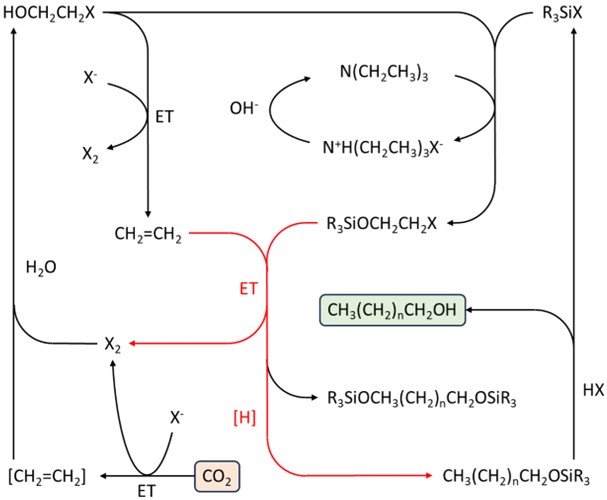
Electrocatalytic conversion of CO2 to valuable products is an attractive technique to mitigate the greenhouse gas emissions and achieve a sustainable carbon cycle, but the products are typically limited to small C1 ~ C3 species. Long chain fatty alcohols are energy rich molecules and versatile feedstocks facilely convertible to hydrocarbon fuels and edible lipids, which are traditionally synthesized by thermocatalysis at high pressure and temperature conditions from petrochemical precursors. Here we combine CO2 electroreduction reaction (CO2RR) with electrochemically induced oligomerization to achieve an efficient electrosynthesis of long chain fatty alcohols from CO2 in a tandem electrocatalysis system at normal pressure and temperature condition. By coupling CO2RR with an anodic bromide oxidation reaction to obtain the synthesis intermediate 2-bromoethanol, a mild electroreduction of its carbon-bromine bond on a silver cathode enables the generation of active radical species, initiating the oligomerization of ethylene that also comes from CO2RR. By tuning the kinetics of electroreduction and chain propagation, we have achieved the production of saturated even-numbered long chain fatty alcohols with record high Faradaic efficiencies (FE) and carbon selectivities at considerable yields in an H-cell setup. This work demonstrated a sustainable facile alkyl chain construction strategy starting from CO2 via stepwise electrocatalysis.